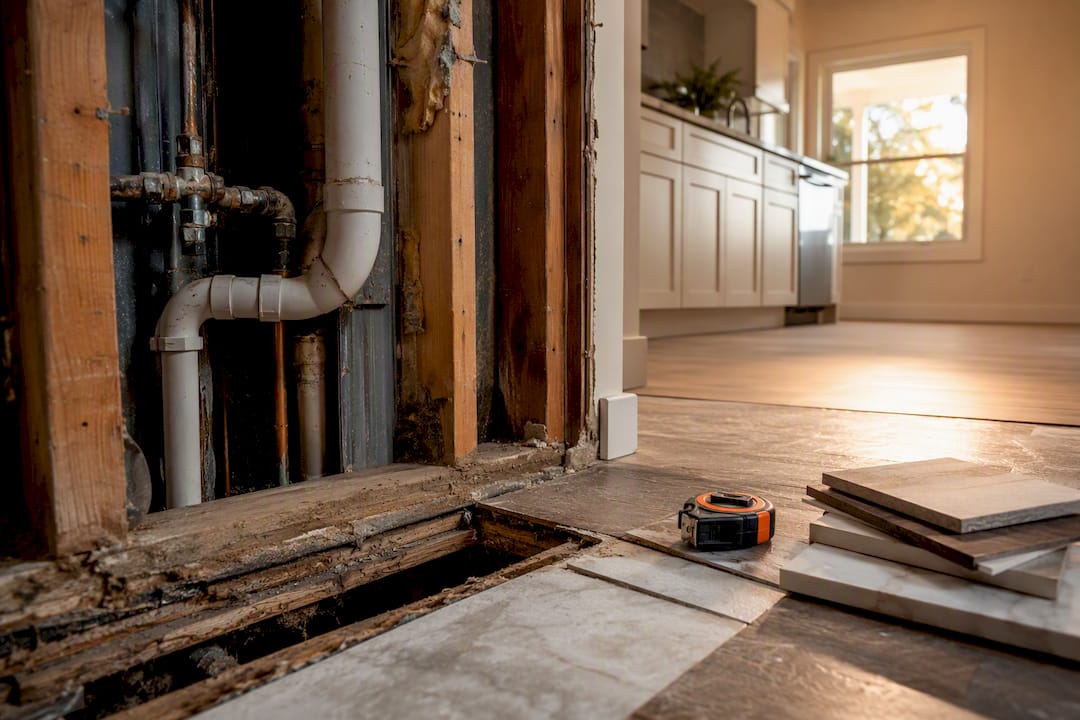


The main remodeling contract types are fixed-price, cost-plus, time-and-materials, and guaranteed maximum price. The difference that actually matters is who pays when costs run over the original estimate. Fixed-price puts that risk on the contractor, cost-plus puts it on you, and GMP splits it up to an agreed-upon cap. Pick based on how well-defined your scope already is.
TL;DR:
- Fixed-price contracts charge a set fee regardless of cost overruns, making the scope detailed and predictable essential to avoid unexpected change orders.
- Cost-plus contracts bill actual expenses plus a markup, requiring open-book transparency and regular invoice review to prevent disputes.
- Time-and-materials contracts pay for labor and materials at agreed rates, best used when project scope is uncertain and capped with a maximum spend.
- Guaranteed maximum price contracts cap your total payment, with costs billed up to the cap and any savings split between owner and contractor, suitable for mixed scope projects.
- The project’s success largely depends on clear scope, defined exclusions, and accountability, rather than the chosen contract type alone.
Table of Contents
- What Is a Fixed-Price Remodeling Contract?
- How Does Cost-Plus Pricing Work?
- What Is a Time-and-Materials Contract?
- What Is a Guaranteed Maximum Price Contract?
- Who Pays When Remodeling Costs Go Over Budget?
- How Do I Pick the Right Contract for My Remodel?
- Why Scope Clarity Beats Contract Type
- Get Up-Front Pricing Before You Sign Anything
- Sources
- FAQ
What Is a Fixed-Price Remodeling Contract?
A fixed-price, or lump-sum, contract sets one total price for the entire job before work starts. You pay that number regardless of how many hours the crew logs or how materials prices shift. Payment usually follows milestones: a deposit at signing, a draw at framing or demo completion, another at rough-ins (plumbing, electrical), and a final payment tied to substantial completion.
Contractors build a risk premium into fixed-price bids because they’re absorbing the uncertainty. A vague scope forces bidders to guess, and that guesswork usually gets priced high to cover the contractor’s downside. It also opens the door to change orders the moment reality doesn’t match the blueprint. Remodeling contracts: What to know from the National Remodeling Authority frames fixed-price as the option where the contractor, not the homeowner, absorbs overrun risk in exchange for that premium.
To keep the premium reasonable and avoid surprise add-ons, insist on:
- A line-item scope of work, not a one-paragraph summary
- Named allowances for fixtures, tile, and cabinetry (with dollar caps, not vague estimates)
- Written exclusions spelling out exactly what’s not included
Fixed-price works best for predictable projects like a standard bathroom refresh or a kitchen where the layout isn’t changing and there’s no reason to expect hidden structural issues.
Pro Tip: Ask for a schedule of values that breaks the lump sum into line items. If a contractor won’t itemize, that’s usually a sign the price was padded to cover unknowns they haven’t told you about.
How Does Cost-Plus Pricing Work?
Cost-plus bills you for the actual cost of labor and materials, plus a fee or percentage on top. Instead of one locked number, you’re paying what the job genuinely costs, plus the contractor’s margin. Industry guidance puts typical residential markups between 15% and 25%, according to Buildwise.
That markup usually covers overhead, supervision, and profit, not the raw materials or labor hours themselves. Because you’re absorbing the cost risk, open-book accounting isn’t optional. You should see:
- Every vendor invoice and receipt tied to your project
- A regular cadence of invoice packages (weekly or bi-weekly, not monthly surprises)
- A running total compared against the original estimate
Design & Biz’s contract guide recommends exactly this kind of documentation discipline to prevent scope-related disputes before they start. Cost-plus fits best when the unknowns are real: a gut renovation, an older home where structural surprises are likely, or a project where the design keeps evolving.
What Is a Time-and-Materials Contract?
A time-and-materials (T&M) contract bills labor hours at an agreed rate plus materials at cost or with a markup. There’s no lump sum and no fixed total until the work is done, which means governance matters more here than in any other contract type. You need to see:
- Weekly or bi-weekly invoices with hours worked and materials purchased
- Regular job-site walkthroughs to confirm progress matches billing
- A running comparison of hours logged against the original estimate
The safeguards that make T&M workable are a not-to-exceed clause capping total spend, a blended labor rate instead of separate rates for every trade, and a stop-loss threshold that triggers a conversation before costs run past an agreed point. Federal procurement rules go so far as to restrict T&M use unless no other contract type will work, and typically require a ceiling price. That’s a strong signal for homeowners: T&M without a cap is an open checkbook. Use it for small repairs, a discovery phase before a bigger job, or scopes that are genuinely impossible to price upfront.
What Is a Guaranteed Maximum Price Contract?

A guaranteed maximum price (GMP) contract sets a hard ceiling on what you’ll pay. Costs get billed cost-plus style up to that cap, and the contractor typically absorbs anything above it, according to Provision’s breakdown of GMP structures. That caps your downside while still giving the contractor cost-plus flexibility below the ceiling.
Some GMP contracts include a savings clause: if the final cost comes in under the cap, the savings get split between owner and contractor, often 50/50, though the exact split is negotiable and should be spelled out in writing.
- GMP works well on larger projects where some scope is known and some isn’t
- A hybrid pattern, capped T&M discovery followed by a fixed-price build, is often smarter than jumping straight to GMP
- Discovery-then-fixed reduces the padding contractors add when they’re pricing blind
AIA’s contract guidance recommends matching contract type to project predictability, and GMP language shows up in AIA forms used specifically for remodels of this size.
Who Pays When Remodeling Costs Go Over Budget?
Every one of these contract types answers one question differently: if actual costs exceed the estimate, who covers the gap? Fixed-price puts it on the contractor. Cost-plus puts it on you. T&M puts it on you unless a cap is in place. GMP splits it up to the ceiling, then shifts it to the contractor. That single question should drive every decision you make about which structure fits your project.
Payment timing follows a similar logic. Fixed-price contracts use milestone payments; cost-plus and GMP typically use monthly draws tied to work completed. Across all of them, a common and reasonable practice is holding back roughly 10% as final retainage until the punch list is finished and signed off.
Before signing anything, confirm the contract includes:
- A detailed scope with named exclusions, not general language
- A written change-order process (what triggers one, how it’s priced, who approves it)
- Open-book accounting terms for cost-plus or GMP work
- Not-to-exceed or GMP ceiling language, with the savings split (if any) stated in dollars or percentages
- A dispute resolution clause naming mediation, arbitration, or jurisdiction
Pro Tip: Walk away from any contractor who won’t put a not-to-exceed number in writing for T&M work, or who refuses to show invoice backup on a cost-plus job. Both are basic transparency, not favors.
Reject any contract with a one-paragraph scope, no defined change-order path, or a contractor who bristles at providing documentation. Those are the projects that end in disputes.
How Do I Pick the Right Contract for My Remodel?
Start with three questions: how big is the project, how much of the existing conditions are known, and how much oversight do you actually want to do? A gut renovation behind old plaster walls carries more unknowns than a straightforward kitchen swap, and that alone should push you toward cost-plus or a capped discovery phase rather than a fixed bid.
- If the scope is fully known, get fixed-price bids and compare line items, not just bottom-line totals
- If there are real unknowns (old wiring, potential water damage, structural questions), negotiate a capped T&M or cost-plus discovery phase first, then convert to fixed-price once the scope firms up
- Ask every contractor the same set of questions: What’s your markup percentage? How often will I see invoices? What’s the retainage policy? Who’s my single point of contact for this job?
- Require a schedule of values, a stated final retainage percentage, and (for cost-plus or T&M) a commitment to weekly invoice packages before you sign anything
Pro Tip: Ask specifically whether one person, not a rotating crew, will be your point of contact for the life of the project. Split accountability is where good contracts fall apart on the job site.
For more on vetting the person you’re hiring, how to find the right contractor for a kitchen remodel walks through the questions that matter before you compare a single bid. If part of your project involves specialty trades, guidance on vetting a painting contractor covers the same red flags in a different trade.
Why Scope Clarity Beats Contract Type
The contract type you choose matters less than most homeowners assume. What actually determines whether a remodel goes smoothly is scope clarity and who’s accountable when questions come up mid-project. A fixed-price contract with a vague scope will generate as many change orders as a poorly managed cost-plus job. Handling design and construction under one roof removes a common failure point: the gap between what a designer drew and what a builder can actually price. A dedicated Lead Carpenter assigned to a job, rather than a rotating crew, closes the accountability gap that turns small issues into billing disputes. A structured approach to job-site cleanliness, tracked daily, also tends to correlate with fewer punch-list items lingering at the end.
— MediaBeast
Get Up-Front Pricing Before You Sign Anything
Some remodeling companies handle design and construction under one roof, which helps ensure the quoted scope is the scope that gets built, rather than a rough sketch handed off to a separate crew. Many projects include up-front pricing with a detailed breakdown and a single point of contact throughout, with systems intended to minimize dust and disruption while work is underway.
If you’re comparing contract structures for a bathroom project, the bathroom remodel cost breakdown shows real pricing tiers by fixture count, so you can see where your project likely lands before you request a quote. Planning a kitchen instead? The kitchen remodel cost guide breaks down U-shaped, L-shaped, and island layouts with the same up-front detail. Either page is a solid starting point for requesting a consultation and getting a scope-specific number instead of a rough guess.
Sources
- Remodeling contracts: What to know (National Remodeling Authority)
- Cost-plus construction questions answered (Buildwise)
- Fixed-Price vs. Cost-Plus vs. GMP: Contract Guide (Design & Biz)
- Understanding the different types of construction contracts (AIA Contracts / Learn)
FAQ
What Are the Main Types of Remodeling Contracts?
The main types are fixed-price (lump sum), cost-plus, time-and-materials, and guaranteed maximum price. Each one allocates cost-overrun risk differently, from the contractor absorbing it in fixed-price to the homeowner absorbing it in cost-plus.
What Should a Remodeling Contract Include?
A solid contract includes a detailed scope of work, named allowances and exclusions, a payment schedule with milestones or draws, a written change-order process, and a dispute resolution clause. For cost-plus or GMP work, it should also spell out open-book accounting terms and invoice frequency.
What Is the 30% Rule in Remodeling?
It’s a planning cushion, not a contract clause, and it matters most on cost-plus or T&M projects where the final number isn’t locked in advance.
What Are the Four Types of Construction Contracts?
The four commonly referenced types are fixed-price, cost-plus, time-and-materials, and guaranteed maximum price. Residential remodels most often use fixed-price for well-defined scopes and cost-plus or GMP when structural unknowns make a firm number harder to guarantee upfront.
Does Tampakitchenandbath Offer Up-Front Pricing?
Yes. Tampakitchenandbath provides up-front pricing with a detailed breakdown for both bathroom and kitchen projects, along with a dedicated Lead Carpenter assigned to each job. Current pricing tiers are listed on the bathroom and kitchen remodel cost pages.