

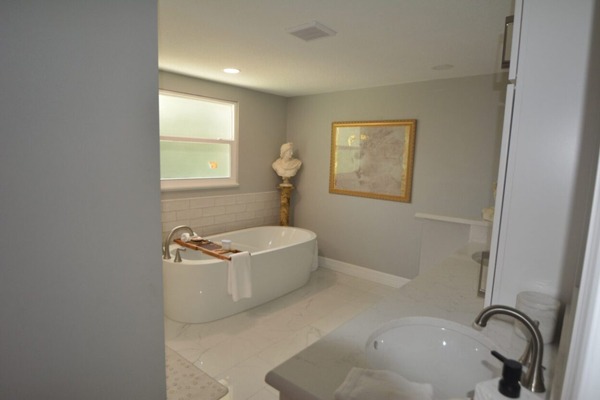
Your new exhaust fan sounds ready to inhale a bath mat, yet the mirror stays fogged, walls feel damp, and dark specks return along the grout. Frustrating? Absolutely. A larger motor can’t repair a broken moisture pathway. Effective bathroom remodeling in Tampa, FL, considers how replacement air enters, steam reaches the grille, and humid air travels outdoors through the duct.
The fan-box rating reflects performance under test conditions. Your installed result depends on room volume, grille placement, makeup air, duct resistance, exterior termination, and operating time at home.
The Label Rates the Fan, Not the Finished System
CFM measures how much air a fan is rated to move under specified test conditions. It doesn’t promise the same airflow once the unit meets your ceiling and ductwork.
Fan sizing should consider:
- Floor area and ceiling height
- Total room volume
- Enclosed shower or toilet compartments
- Multiple moisture-producing fixtures
- Resistance throughout the exhaust route
HVI provides baseline sizing guidance, but the complete room and duct arrangement need evaluation. A higher-CFM motor can underperform when the system around it limits airflow.
Long Duct Runs Quietly Rob Airflow | Bathroom Remodeling in Tampa, FL
Once humid air passes the grille, it still has a journey to make. A short, smooth duct offers less resistance than a cramped route curling through the attic.
Airflow may suffer from:
- Excess duct length
- Multiple elbows or abrupt turns
- Sagging or compressed flexible duct
- Narrower ductwork
- Leaking connections
- A restrictive exterior damper
Model-specific duct requirements matter, so universal limits can mislead. We compare product instructions with the route. A fan can sound fiercely busy while moving little air; noise doesn’t prove shower moisture reached the outdoors.
Also Read: How Can Two Similar-Sized Bathrooms Have Very Different Costs?
Steam Won’t Chase a Poorly Placed Grille
Steam follows airflow, not wishful thinking. A grille placed far from the shower may struggle to capture moisture, especially across a large room, above partial walls, or outside an enclosed shower or separate toilet compartment. Ceiling height also adds volume.
Effective exhaust needs replacement air. A door undercut or transfer path allows air to enter as humid air leaves. During bathroom remodeling in Tampa, FL, we consider grille location, partitions, and makeup air as an airflow system.
An Attic Isn’t an Exhaust Destination
Bathroom exhaust belongs outdoors—not in an attic or ceiling cavity, and not at a poorly positioned soffit where damp air can drift back toward the house.
Check for:
- Proper exterior termination
- A functioning backdraft damper
- Sealed duct connections
- Condensation protection where required
- Termination away from openings
Poor discharge can leave wet insulation, odors, stains, condensation, and concealed damage. The EPA advises venting bathroom moisture outside. Sending it into an enclosed space relocates moisture inside.
The Fan’s Work Continues After You Leave | Bathroom Remodeling in Tampa, FL
Flipping off the light shouldn’t automatically end the fan’s shift. Steam may disappear while moisture remains on tile, glass, grout, towels, and painted surfaces.
Helpful controls include countdown timers, delayed shutoffs, and humidity-sensing switches. Quieter fans also encourage consistent use during and after showers instead of inspiring an immediate dash for silence.
Give Persistent Moisture a Proper Diagnosis
Bath & Kitchen Gallery pairs two decades of construction experience with certified general contracting, upfront pricing, and a dedicated Lead Carpenter for every renovation.
Our Tampa design-build team handles showers, tile, cabinetry, complete bathrooms, kitchens, and whole-home projects throughout Brandon, Lutz, Odessa, Riverview, Temple Terrace, and nearby communities.
Tell us what stays damp, where the fan terminates, and what you want changed. Arrange a consultation and estimate for bathroom remodeling in Tampa, FL, with us at 813-933-8000.