
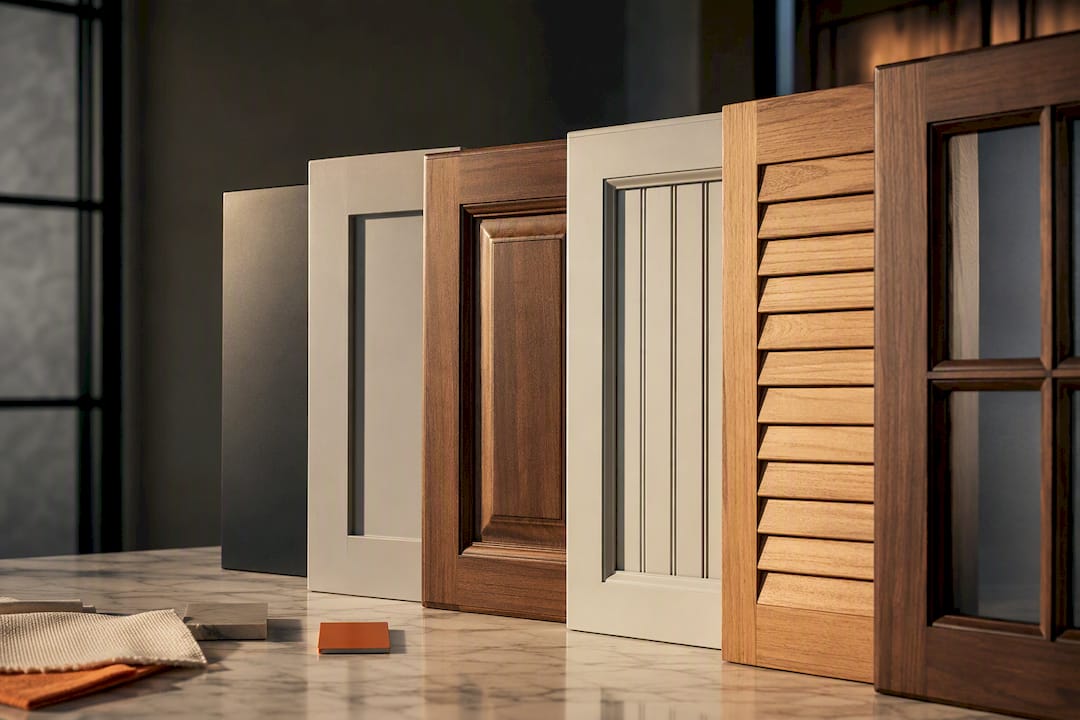
Shaker, slab, raised panel, recessed panel, beadboard, glass-front, louvered, and mullion doors cover almost every kitchen you’ll ever walk into, and picking between them mostly comes down to two things: how much detail you want to clean around and how the door reads against your home’s architecture. Shaker wins on versatility because it splits the difference between traditional and modern. Slab wins on upkeep because there’s no groove for grease to hide in. Everything below breaks down the visual differences, materials, and the practical questions worth asking before you sign off on a style.
TL;DR:
- Slab doors are easiest to clean and maintain, making them ideal for contemporary kitchens with high cleanliness standards.
- Raised panel doors add depth and shadow, fitting traditional or older homes, but they require more effort to keep grease out of grooves.
- Inset doors are more traditional and require precise construction, suitable for larger, formal kitchens, while full-overlay doors create a seamless look in smaller spaces.
- Materials like MDF and thermofoil are budget-friendly but impact durability and resistance to heat, moisture, and peeling over time.
- Combining different door styles and finishes, such as stained islands with painted perimeters, can enhance visual interest without overcomplicating design.
Table of Contents
- What Are the Main Cabinet Door Styles for Kitchens?
- Eight Cabinet Door Styles Worth Knowing (With Photos in Mind)
- Which Cabinet Door Materials and Finishes Should You Consider?
- How Do You Choose the Right Cabinet Door Style?
- How Can You Mix Cabinet Door Styles and Finishes?
- What Are the Pros and Cons of Each Cabinet Door Material?
- Does Cabinet Door Style Affect Kitchen Functionality?
- How Much Do Different Cabinet Door Styles and Materials Cost?
- What Hardware Works Best With Each Cabinet Door Style?
- Where Did Today’s Cabinet Door Styles Come From?
- How Bath & Kitchen Gallery Guides Door-Style Decisions
- Why Cabinet Door Style Deserves More Thought Than Most Homeowners Give It
- Ready to Bring Your Cabinet Vision to Life?
- Sources
What Are the Main Cabinet Door Styles for Kitchens?
Before you fall in love with a particular panel design, it helps to understand how the door actually sits inside the cabinet frame, because that detail changes the whole visual weight of a kitchen. There are three main mounting types, and each one shifts how much wood you see and how the light falls across the cabinet face.
- Inset doors sit flush inside the face frame, so the frame itself is visible around every door. This is the most traditional, custom look, and it demands tighter tolerances from whoever builds the cabinets.
- Partial-overlay doors cover most of the frame but leave a visible sliver, giving you a classic look with slightly more forgiving construction and a lower price point.
- Full-overlay doors cover the frame almost entirely, creating a clean, continuous run of cabinetry with minimal visible framework, according to Eaglewood Working’s breakdown of cabinet door types.
Smaller kitchens often look larger with full-overlay doors, since the eye reads one continuous surface instead of a grid of frames and gaps. Inset doors tend to suit larger, more formal kitchens where that visible framework adds architectural detail rather than visual clutter.
Eight Cabinet Door Styles Worth Knowing (With Photos in Mind)
Here’s what to look for in each style, and where it tends to work best in an actual kitchen.
- Shaker. A flat center panel framed by simple, square rails and stiles. It’s a recessed-panel design that reads clean in a modern kitchen and warm in a traditional one, largely because the frame width and finish do all the styling work, according to Eaglewood Working. Slim, narrow-rail Shaker doors are the version showing up most in newer builds right now.
- Slab (flat panel). One flat, uninterrupted surface with no grooves, no raised edges, nothing to catch dust. It’s the standard choice for contemporary and minimalist kitchens, and it’s genuinely the easiest style to wipe down after cooking, per Nieu Cabinet Doors.
- Raised panel. A center panel that sits higher than the surrounding frame, often with carved or beveled edges. It adds real depth and shadow, and it remains a favorite for traditional and older-home kitchens, according to MasterBrand Cabinets.
- Recessed/flat panel. The opposite of raised panel: the center sits lower than the frame. Shaker is technically a recessed-panel style, but you’ll also see wider-rail versions with more ornate detailing for a transitional look.
- Beadboard. Vertical grooved planks fill the panel instead of a flat surface, giving cabinets a cottage or farmhouse feel, according to Eaglewood Working. It reads best on an island or a hutch rather than across an entire wall of cabinetry, where the texture can start to feel busy.
- Glass-front. Clear, frosted, or seeded glass replaces the wood panel, letting you display dishware or glassware while breaking up a heavy run of solid doors, per Eaglewood Working. The tradeoff is upkeep: glass shows fingerprints and dust in a way solid wood never will.
- Louvered. Angled wood slats that allow airflow, historically used on pantry doors or laundry cabinets where ventilation mattered more than moisture control. It’s a niche pick now, mostly reserved for a specific vintage or coastal look.
- Mullion (French-lite). Thin wood dividers break a glass panel into a grid, echoing old French cabinetry and library doors. It’s decorative more than functional, best used on one or two display cabinets rather than the whole kitchen.
Which Cabinet Door Materials and Finishes Should You Consider?
The style you pick is only half the decision. What it’s made of, and how it’s finished, determines cost, durability, and how much maintenance you’re signing up for.
- Solid wood species like maple, oak, cherry, and walnut each carry distinct grain patterns; maple takes paint smoothly, while oak and walnut show more character when stained, according to Eaglewood Working’s material comparison.
- Painted finishes give you the widest color range and hide grain entirely, but chips and scratches show up more visibly than they do on stained wood, and touch-ups require matching the exact sheen.
- Stained finishes highlight the wood’s natural grain and tend to hide small dings better, which matters if you’ve got kids or pets running through the kitchen.
- MDF (medium-density fiberboard) takes paint beautifully and resists warping better than solid wood in humid climates, making it a strong budget option for painted slab or Shaker doors, though it can’t be re-stained if you change your mind later.
- Thermofoil wraps a vinyl layer over an MDF core for a low-cost, seamless painted look, but it can peel or bubble near heat sources like a range or dishwasher over time. Check out these material comparisons for a deeper look at how each holds up.
Lighter finishes visually expand a small kitchen, while dark stains and deep painted colors add drama but can make a tight galley kitchen feel closed in.
How Do You Choose the Right Cabinet Door Style?
Start with your house, not the showroom. A door style that looks stunning in a magazine photo can clash badly with the architecture you’re already living in.
- Match the style to your home’s architecture. A raised-panel door suits a colonial or traditional home; a slab door fits a mid-century or contemporary build; Shaker splits the difference and works almost everywhere.
- Factor in room size. Detailed profiles like raised panel or mullion doors can visually crowd a small kitchen, while slab and Shaker doors keep sightlines open.
- Think about how you actually clean. If you cook often and hate scrubbing grooves, skip raised panel and beadboard. Slab doors wipe clean faster because there’s nothing for grease to settle into.
- Set your budget tier early. Stock cabinets offer the fewest style choices but the lowest cost; semi-custom opens up more door profiles and finishes; full custom gives you inset construction and exact species matching, at the highest price point.
- Choose hardware last, but choose it carefully. A slim pull on a Shaker door looks completely different from a knob on the same door, and hardware placement has to clear drawer boxes and adjacent appliances.
Pro Tip: Bring a sample door home before you commit. Kitchen lighting shifts color and grain more than showroom lighting ever will, and a stain that looked warm under fluorescent lights can look muddy under your own pendant fixtures.
If you’re weighing a full custom build against something faster and cheaper, this rundown on what to consider when replacing kitchen doors is worth a read before you meet with a cabinetmaker.
How Can You Mix Cabinet Door Styles and Finishes?
You don’t have to commit to one door style for the entire kitchen. Two-tone cabinetry, where the island gets a different color or finish than the perimeter, has become one of the most reliable ways to add contrast without a full teardown. A stained wood island paired with painted perimeter cabinets is a common, cost-effective combination that adds warmth against an otherwise neutral kitchen, a pairing that shows up constantly in current contemporary cabinet trends.
- Pair a slab-door island with Shaker perimeter cabinets to add subtle texture without mismatching styles entirely.
- Break up a long run of solid doors with one or two glass-front uppers, or swap in open shelving for a section that needs to breathe visually.
- Use a mullion-front cabinet as a single focal point, like a coffee bar or china display, rather than across multiple runs.
- Stick to one door style but vary the finish (painted upper, stained lower) if a full style mix feels too busy for your space.
What Are the Pros and Cons of Each Cabinet Door Material?
Solid wood offers the most repairability. Scratches can be sanded and re-stained, and the material ages with character rather than obvious wear. The downside is cost and sensitivity to humidity, which can cause warping in poorly ventilated kitchens near dishwashers or ranges.
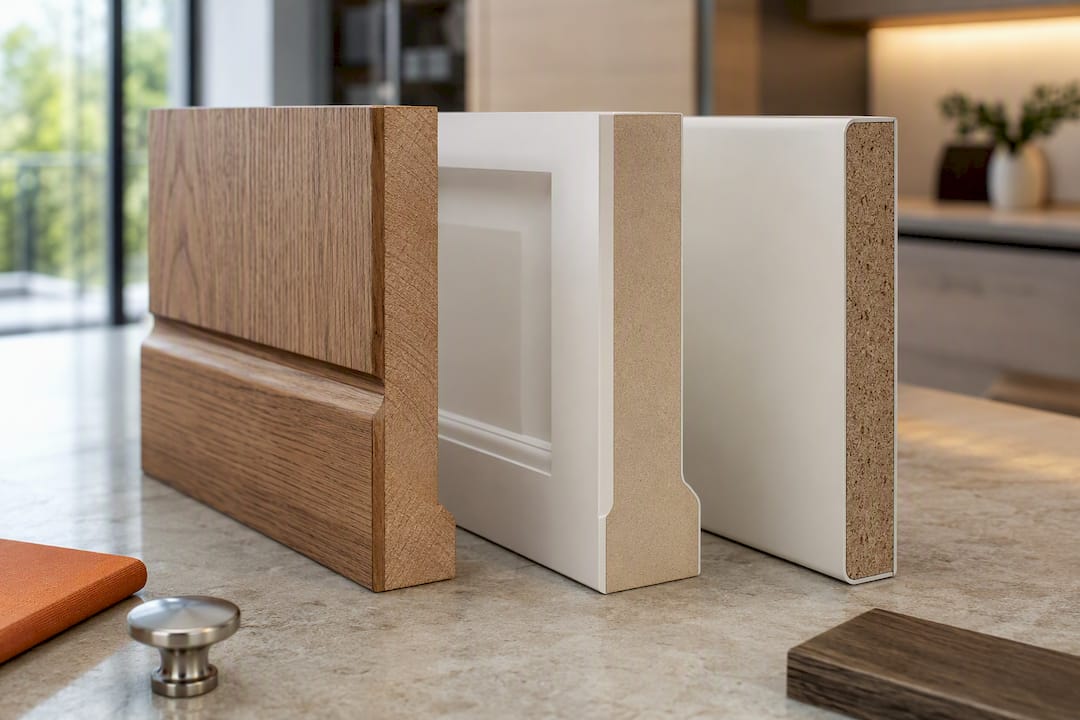
Painted MDF delivers a flawless, seamless surface that resists warping better than solid wood, and it’s usually the more affordable route to a slab or Shaker look. It can’t be restained, though, so if a scratch goes deep enough to expose the substrate, the whole panel typically needs repainting rather than a simple touch-up.
Thermofoil is the budget champion for a smooth, painted-looking finish with zero grain to worry about. Its weakness shows up over time near heat: the vinyl layer can peel at the edges when it sits close to a range or oven vent for years, according to Eaglewood Working’s material guide.
Plywood cores used in higher-end stock and semi-custom lines split the difference between solid wood and MDF, offering good moisture resistance and structural stability at a mid-range price. None of these materials is a bad choice; the right one just depends on whether you’re optimizing for repairability, budget, or long-term resistance to a busy kitchen’s heat and moisture.
Does Cabinet Door Style Affect Kitchen Functionality?
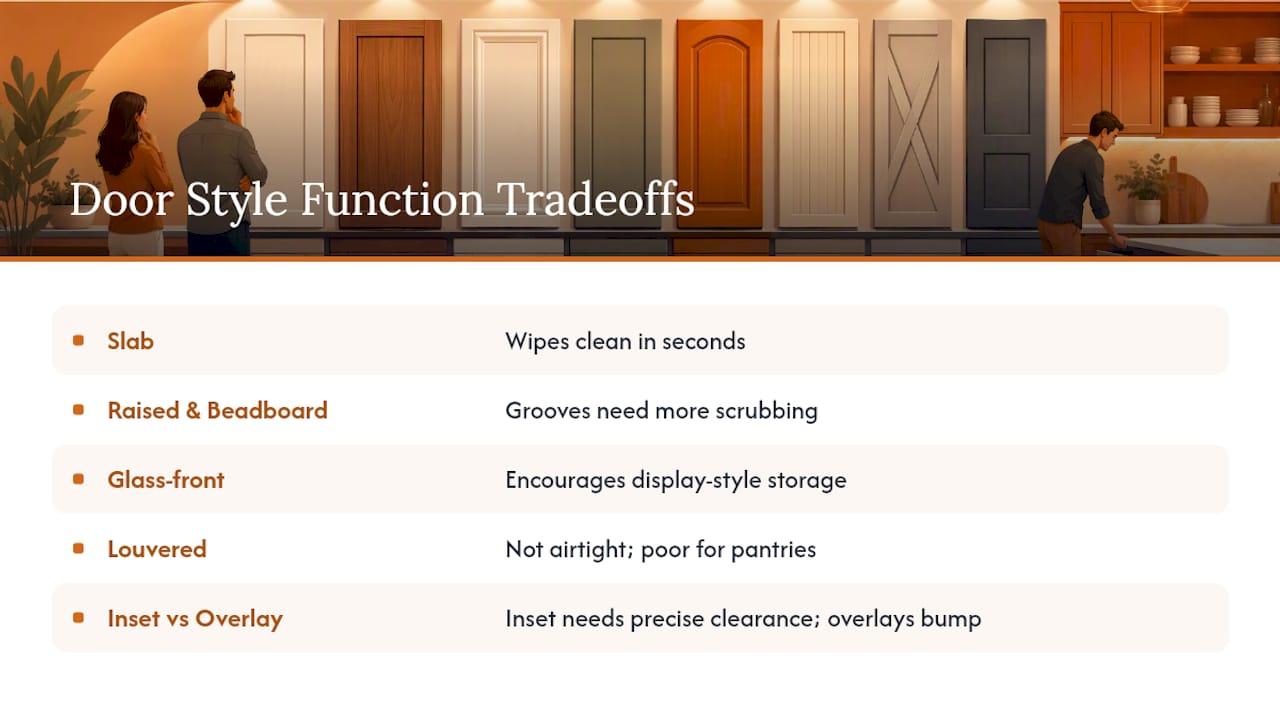
Door style isn’t purely decorative. It changes how a kitchen actually works day to day, starting with how doors clear each other and any nearby appliances. Full-overlay doors on adjacent cabinets can bump into one another if hinges aren’t spaced correctly, especially on tight corner runs. Inset doors need more precise clearances since there’s less room for adjustment once installed.
Glass-front and louvered doors change how you store things, too. Glass fronts push you toward organizing for display, which means open boxes of pasta and mismatched Tupperware suddenly matter. Louvered doors, with their open slats, aren’t airtight, so they’re a poor choice for pantries where you want to keep pests and dust out.
Panel depth affects cleaning time in a way that adds up over years, not just days. A raised-panel or beadboard door in a grease-heavy zone near the range means more scrubbing in the grooves, while a slab door in that same spot wipes clean in seconds. If your kitchen sees heavy daily cooking, functionality should weigh at least as much as looks when you’re picking a profile.
How Much Do Different Cabinet Door Styles and Materials Cost?
Cost tracks two variables: complexity of the door profile and the material behind it. Slab and Shaker doors sit at the more affordable end because they require less shaping and finishing labor than raised-panel or mullion doors. Beadboard and raised panel both add cost through extra machining, and mullion doors add cost through the glass and the dividers holding it in place.
Material shifts the price just as much as profile. Thermofoil and painted MDF options land at the lower end of the spectrum, solid wood species like maple and oak sit in the middle, and premium species like cherry or walnut push costs higher. Construction type matters too: inset doors cost more than full-overlay across every material and style, because the tighter tolerances demand more precise cabinetmaking. Stock cabinet lines offer the lowest sticker price but the narrowest style selection, semi-custom expands your options considerably, and full custom gives you every combination of style, species, and overlay type at the highest cost tier.
What Hardware Works Best With Each Cabinet Door Style?
Hardware isn’t an afterthought. It’s the detail that makes a Shaker door look modern instead of dated, or a slab door look sleek instead of stark.
- Bar pulls (long, horizontal) pair naturally with slab and slim-rail Shaker doors, reinforcing the clean, linear look of contemporary kitchens.
- Cup pulls and bin pulls lean vintage and work well on beadboard, raised panel, and traditional recessed doors, especially on drawers.
- Knobs suit almost any door style but read more traditional on raised panel and more casual on Shaker, depending on their shape and finish.
- Knurled or ribbed pulls have become a popular accent on slab doors in contemporary kitchens, adding texture without breaking the flat surface’s simplicity.
- No hardware (finger-pull or integrated channel) works only with slab doors, since the design depends on the door’s flat, uninterrupted face.
Finish matters as much as shape. Matte black and brushed brass currently dominate pairings with painted Shaker and slab doors, while oil-rubbed bronze and antique nickel still show up frequently on raised-panel and beadboard cabinetry in more traditional kitchens.
Where Did Today’s Cabinet Door Styles Come From?
Raised-panel doors trace back to European furniture-making traditions, where paneling was originally a structural solution to wood movement long before it became decorative. Solid wood panels shrink and expand with humidity, and building a frame around a smaller floating panel let cabinetmakers control that movement without cracking the door. The raised, beveled edge came later, as a decorative flourish added once the structural problem was already solved.
Shaker doors get their name from the Shaker religious communities of 18th and 19th century America, who valued plain, functional furniture stripped of ornamentation. That philosophy produced the flat-panel, square-edged design that still dominates kitchens today, precisely because its simplicity ages well and doesn’t lock a kitchen into one decade’s trend.
Slab doors are the newest entrant in relative terms, gaining traction alongside mid-century modern design in the mid-1900s and surging again with the minimalist kitchens popular now. Beadboard and louvered styles both come from practical origins, too: beadboard from wainscoting traditions meant to protect walls, and louvered doors from ventilated pantry and utility cabinetry before mechanical refrigeration made airflow less critical. Each style you’re choosing between today started as a solution to a problem long before it became a design preference.
How Bath & Kitchen Gallery Guides Door-Style Decisions
An effective remodeling approach pairs design and construction under one roof, ensuring that the team helping you choose a door style is the same team building it rather than separate sales and subcontractor crews. Having a dedicated Lead Carpenter assigned to each project and providing up-front pricing before work starts helps avoid surprise costs once a style and material are settled.
The Work Clean System keeps dust and disruption contained during cabinet installation, which matters more than most homeowners expect once demo starts. On the planning side, choosing appliances before finalizing cabinet doors keeps hardware placement and clearances from becoming a last-minute scramble.
Why Cabinet Door Style Deserves More Thought Than Most Homeowners Give It
Most people spend weeks agonizing over countertop color and backsplash tile, then pick a door style in an afternoon because it’s “the last decision.” That order of priorities is backwards. The door style is the thing you’ll see and touch every single day, on every cabinet, for as long as you own the kitchen.
The conventional wisdom pushes homeowners toward Shaker because it’s safe, and there’s a legitimate reason for that: it genuinely does age better than trend-driven profiles. But safe isn’t the same as right for every kitchen. A century-old bungalow with original trim work loses something when it gets fitted with slim slab doors that belong in a downtown condo. The mismatch is subtle at first and glaring within a year, once the newness wears off and the house just looks like it’s wearing the wrong outfit.
What gets underestimated is how much the overlay type changes a kitchen’s personality independent of the panel style itself. Two kitchens with identical Shaker doors can look decades apart depending on whether they’re inset or full-overlay, because the shadow lines and visible framework do more visual work than the panel detail people fixate on. If you’re touring showrooms, spend less time debating panel shapes and more time asking how the door sits in the frame. That’s the decision with the longer shelf life.
— MediaBeast
Ready to Bring Your Cabinet Vision to Life?
Working with a remodeling provider that combines design and construction under one team allows you to see and touch real material samples before committing, with transparent pricing based on your chosen style and materials.
Having a dedicated Lead Carpenter oversee door installation from measurement to final hardware ensures continuity and accountability throughout the project, improving communication between design and installation teams. If you’re ready to see how Shaker, slab, or a custom inset profile would actually look in your space, start with Tampakitchenandbath’s kitchen remodeling services in Tampa and get a project quote built around the style you actually want, not the one that was easiest to stock.
Sources
- Cabinet Door Styles: Types, Examples & How to Choose
- Flat Panel and Slab Cabinet Door Styles | Nieu Cabinet Doors
- Cabinet Doors: Styles and Types – MasterBrand Cabinets
- Explore Contemporary Kitchen Cabinet Doors | Stylish Designs