
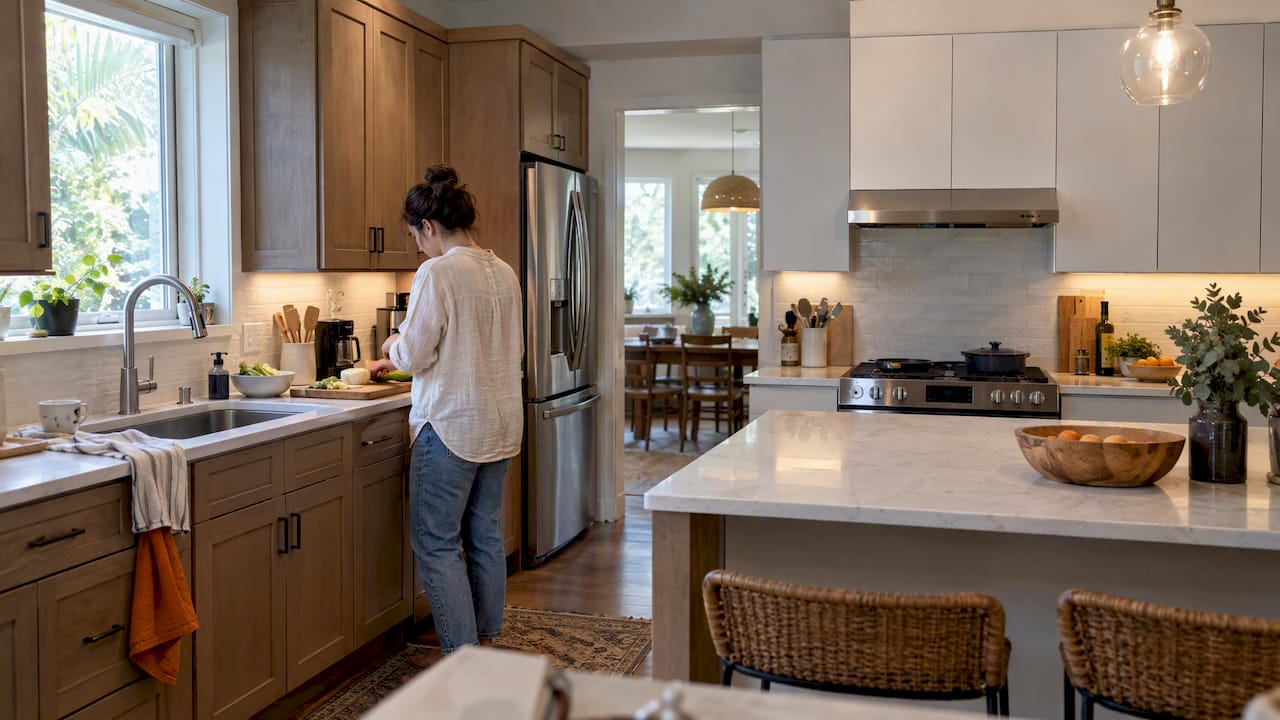
Shaker doors have a five-piece frame around a recessed center panel. Slab doors are one flat piece with no frame. Shaker is the safer, more traditional pick and hides wear well. Slab is sleeker, wipes clean in one pass and is the only style that gives you a true handleless look. The better choice depends on your home’s architecture, how much cleaning you want to do and how soon you plan to sell. Door style also matters less than most people think. The material, the finish and the build quality behind the door do more of the work.
Below we walk through the differences that show up in a real kitchen, what each style costs you in upkeep, and how to decide. We also cover the option many designers prefer, which is using both.
TL;DR
- Shaker is the classic, versatile choice. It fits traditional, transitional and farmhouse kitchens and has the broadest appeal to future buyers.
- Slab (also called flat-panel) is minimal and modern. It is the easiest to wipe down and the best match for handleless, European-style kitchens.
- Both are durable if built well. They fail differently: painted Shaker joints can show hairline cracks, and slab edges can chip or lift in hot, damp zones.
- The material and finish usually affect price and performance more than the door shape does.
- You do not have to pick one. Shaker on the perimeter with a slab island is a common, deliberate look.
Table of Contents
- What actually separates the two styles
- Shaker vs. slab at a glance
- How popular is each style right now?
- Look and feel: matching the door to the house
- Cleaning and daily life
- Durability: how each style fails
- Cost: where the money really goes
- Resale value and long-term appeal
- You do not have to choose just one
- Our perspective
- How to decide in five steps
- Planning a kitchen with Shaker, slab or both?
- FAQ
- Sources
What actually separates the two styles
The difference is construction. A Shaker door is built from a frame of two vertical stiles and two horizontal rails around a flat recessed panel. That is five pieces. A slab door is a single flat piece, usually MDF, plywood, laminate or veneer-wrapped board, with no frame and no recess.
Everything else follows from that:
- Shadow lines. The recess on a Shaker door catches light and adds depth. A slab door reads as one calm plane.
- Cleaning. A slab door has no ledges. A Shaker door has inside corners where dust and grease settle.
- Hardware. Shaker doors pair with knobs and pulls, while slab doors can go handleless with push-latch hardware or finger pulls.
- Joints. Shaker doors have joints that move slightly with the seasons. Slab doors have edges that depend on their edge banding or laminate.
Shaker vs. slab at a glance
| Factor | Shaker | Slab (flat-panel) |
|---|---|---|
| Look | Classic, softly traditional, works in transitional spaces | Minimal, modern, clean-lined |
| Construction | Five-piece frame and recessed panel | One flat piece |
| Cleaning | Wipe, plus a detail pass on the corners | One wipe |
| Typical weak point | Hairline cracks at painted joints | Edge chipping or banding lift near heat and moisture |
| Handleless option | Not really | Yes |
| Resale appeal | Broadest buyer pool | Strong with buyers who want modern |
| Cost to make | More machining and assembly | Simpler door, but finish and material set the real price |
How popular is each style right now?
Shaker is still the default. In the 2025 U.S. Houzz Kitchen Trends Study, Shaker-style cabinets accounted for 61% of the kitchen cabinets installed by the homeowners surveyed. Flat-panel sits in second place.
Slab is gaining ground. Houzz’s 2026 design predictions say sleek flat-panel cabinets and vanities are growing in popularity, even in traditional and transitional rooms. So slab is no longer limited to ultra-modern homes.
A trend is a poor reason to pick a door, though. The NKBA’s coverage of 2026 European design trends describes a move away from stark minimalism toward softer, warmer spaces with more texture. The practical advice is to choose by the architecture of your home and by how long you will live in it, not by what is rising on social media.
Look and feel: matching the door to the house
When Shaker is the better fit
Choose Shaker if your home has traditional or transitional bones: crown molding, paneled doors, arched openings, a Florida-style Mediterranean or ranch layout with warm finishes. A Shaker door looks at home next to those details because its frame echoes them. It also takes color well. White, soft greige, sage and navy all look intentional on Shaker.
Shaker is also forgiving. It looks right with brushed nickel, matte black or brass hardware. Years later, it will not look like a particular year.
When slab is the better fit
Choose slab if the home is modern or open-plan, with simple trim and clean lines. Slab shows off what is around it: bold stone with movement, rich wood grain, or a quiet solid color. A single flat plane gives your eye a calm backdrop.
Slab does need discipline. A flat door has no frame to hide behind, so poor alignment, uneven gaps, a mismatched veneer or a cheap finish are all visible. Slab looks best when the design and the installation are careful.
Matte vs. glossy finishes
Finish is a separate decision from door style, but slab doors put it front and center. Gloss reflects light and makes a small kitchen feel brighter. It also shows fingerprints, streaks and every flaw in the surface. Matte hides smudges and feels softer, which fits the warmer direction designers are describing. If you have young children or cook a lot, matte is usually the less stressful choice. In either finish, ask to see a full-size door sample under your own kitchen lighting before you commit.
Cleaning and daily life
This is where slab has a real edge. A slab door has no ledges, so a damp cloth takes care of the whole surface in a single pass. Shaker doors have recessed centers and inside corners where dust, cooking grease and grime build up. According to the Captivating Cabinets blog, the extra Shaker cleaning comes to a few more minutes a month.
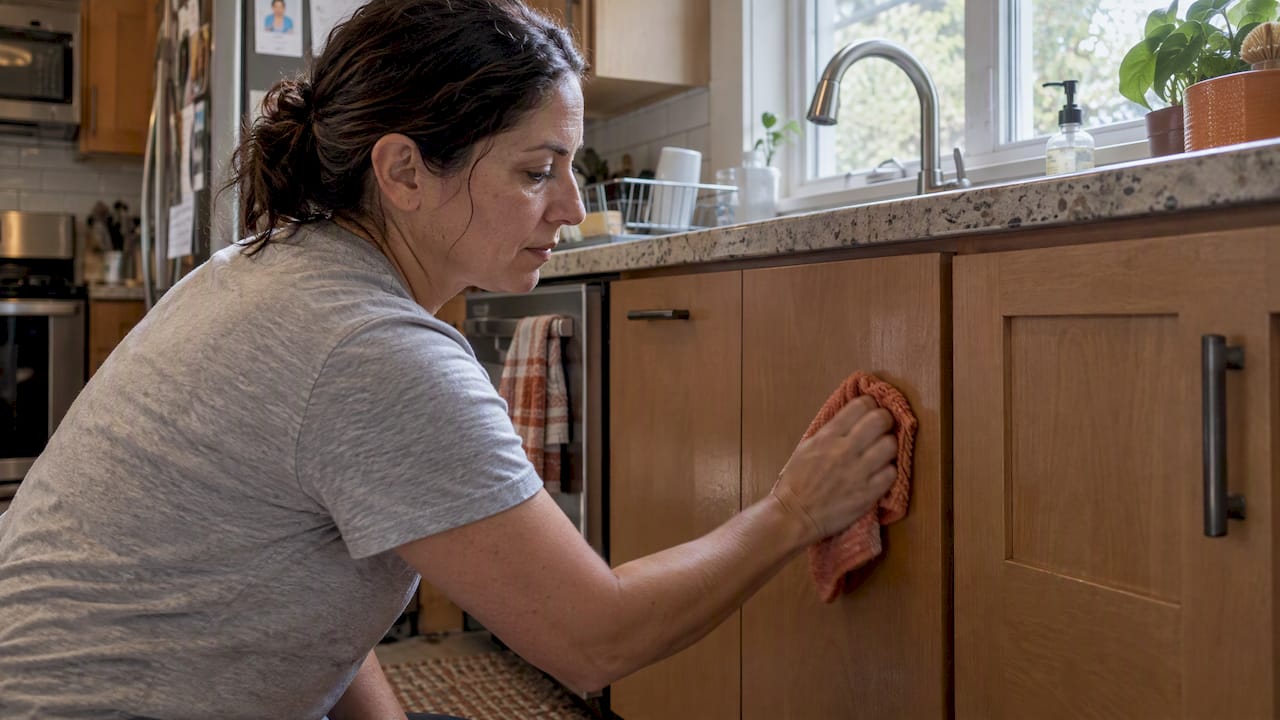
In practice, the difference depends on where the cabinets are. Cabinets above the range collect airborne grease no matter what style they are. A busy family that runs the kitchen hard may notice slab’s easier cleaning. A household that cleans on a schedule will barely register the Shaker corners.
One point favors Shaker. The framed profile and slightly textured look hide minor scuffs and wear better than a flat, uniform surface, where a single scratch catches the light.
Durability: how each style fails
Neither style is automatically tougher. Both last when the materials and finish are good. They just wear out in different ways.
- Shaker: On painted doors, the joints between the rails and stiles can show hairline cracks as the wood moves with the seasons.
- Slab: The weak point is the edge. Edge banding or laminate can chip or lift where heat and moisture are concentrated, such as beside the dishwasher or the range.
Manufacturers know this. Many warranty documents exclude damage from excess humidity or heat, and some list joint lines on painted Shaker doors as a natural characteristic, not a defect. The Hampton Bay cabinet specification guide is an example of the kind of construction documentation worth reading. Before you order any cabinet, read the warranty for exactly those exclusions.
What this means in Tampa
Our climate is hot and humid for much of the year. In a Tampa kitchen, moisture control matters more than door style. Ask what the door core is made of and how the edges are sealed. Ask whether the finish is a durable factory finish. Make sure your range hood actually vents outside and that the area beside the dishwasher is protected. A well-sealed slab door will do better than a poorly finished Shaker door, and the reverse is also true.
Cost: where the money really goes
A Shaker door takes more machining and assembly because it has five pieces, so on the same material it generally costs more to make than a plain slab. But the door shape is rarely the biggest line on the estimate. These matter more:
- Material: solid wood, plywood, MDF, laminate or thermofoil
- Finish: painted, stained, wrapped or high-gloss lacquer
- Construction: box quality, drawer hardware, soft-close hinges
- Layout and size: the number of cabinets and the amount of custom work
- Installation: how level and tight the walls and floors are
A high-end veneer or lacquer slab can cost as much as a paint-grade Shaker, or more. Compare two quotes on materials and finish first and door style second.
For a sense of whole-kitchen budgets, our published remodel ranges are on our kitchen remodel costs page. They run from 41,200 to 52,050 USD for a small U-shaped kitchen with an island up to 74,100 to 93,600 USD for a large kitchen with an island. These are full-project ranges covering design, materials and installation, not cabinet-only prices, and the final cost depends on the scope and the materials you choose.
Resale value and long-term appeal
If you may sell within a few years, Shaker is the lower-risk choice. Its classic look appeals to the widest range of buyers. Slab has strong appeal, but it is more targeted: buyers who want a contemporary or minimalist kitchen will love it, and others may find it cold.
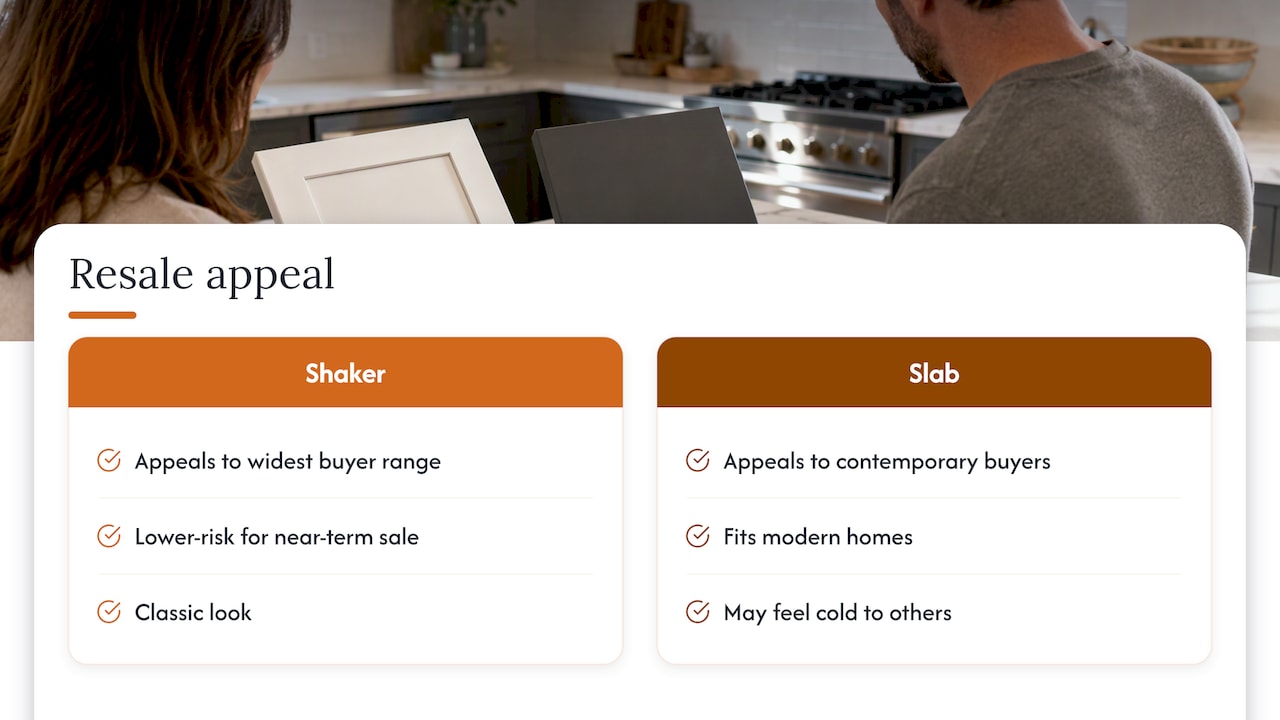
The gap is narrowing as slab spreads into transitional homes. If your house is already modern, slab will feel right to buyers who walk through it. Match the kitchen to the house and the neighborhood. If you are renovating specifically to sell, our page on remodeling your kitchen to sell covers where the money pays back.
You do not have to choose just one
Designers often wish clients knew that this is not a binary decision. A common approach is Shaker doors on the perimeter run for their timeless look and slab on the island, a pantry wall or a tall appliance panel for a sleeker contrast. The mix looks custom and deliberate, as long as the finishes are either closely matched or boldly contrasted. A near-miss in color reads as a mistake.
A few guidelines make a mixed kitchen work:
- Keep the same hardware family across both door styles.
- Either match the colors exactly or contrast them clearly, such as white perimeter cabinets with a deep green island.
- Use slab where you want the least visual noise, and Shaker where you want warmth.
- Limit yourself to two styles. A third starts to look busy.
For examples of how other designers combine door styles, this guide to Shaker-style kitchen cabinetry is a useful read, though it comes from a UK market, so check local sizing and product availability.
Our perspective
We design and build bathrooms and kitchens in-house, so we see how cabinet choices play out from the sketch to the finished room. Our view is that homeowners spend too long on door style and too little on everything behind it.
Here is how we think about it:
- Start with the house. A Shaker door in a home with traditional lines, or a slab door in a clean modern shell, rarely feels wrong.
- Then ask about the build. Door core, edge sealing and finish matter more than the profile, especially in humid Florida.
- Think about who lives there. If you want the least upkeep, a good slab door is hard to beat. If you want a kitchen that forgives scuffs and keeps a classic look, we lean Shaker.
- Consider mixing. It often solves the argument between partners.
We also believe you should see real samples before deciding. Photos flatten the shadow lines of a Shaker door and the sheen of a slab finish. Our showroom lets you hold door samples and compare materials in person. It is one reason we handle design and construction together: the person who draws the kitchen is working with the people who will install it, and each project has a dedicated Lead Carpenter who oversees the work. With up-front pricing and a detailed item list, you can see what each cabinet choice does to the total before you sign.
— MediaBeast
How to decide in five steps
- Name your style. Look at your home’s trim, flooring and architecture. Traditional or transitional leans Shaker. Modern or open-plan leans slab.
- Set your timeline. Selling within a few years favors Shaker. Staying long term lets you choose what you love.
- Be honest about cleaning. If you will not do a quick corner pass now and then, slab will make you happier.
- Check the climate fit. Ask about core material, edge sealing and finish for Florida humidity.
- Test samples at home. Look at full-size doors in your own light, next to your countertop and flooring. Bold stone with movement looks striking against simple slab, while quieter quartz or traditional granite pairs well with Shaker.
For more door profiles beyond these two, including inset, beaded and raised panel, see our guide to cabinet door styles. If you want to see how cabinets and counters work together, our kitchen cabinets and countertops page is the next step.
Planning a kitchen with Shaker, slab or both?
If you are remodeling a kitchen in the Tampa area, we can help you choose door styles, finishes and layout, then build the whole project. You get design and construction under one roof, up-front pricing, a Lead Carpenter on your job and our Work Clean System to keep dust and disruption down. Start with our kitchen remodeling services and bring your questions about cabinet style to the consultation.
FAQ
What are the downsides of Shaker cabinets?
The recessed panel and inside corners collect dust and grease, so they take a little more cleaning than slab. On painted doors, the joints can develop hairline cracks as wood moves with the seasons. They also cost more to make than a simple flat door in the same material.
What are the cons of slab cabinets?
Slab shows flaws more easily, including uneven gaps, scratches and fingerprints on glossy finishes. Edges can chip or the banding can lift near heat and moisture, such as beside a dishwasher or range. The look is also more targeted, so it can appeal to fewer buyers than Shaker.
Are slab cabinets in style?
Yes. Houzz’s 2026 predictions point to flat-panel cabinets gaining ground, even in traditional and transitional rooms. Shaker is still more common, though, and remains the most installed style in the Houzz kitchen study.
Which is better in humid Florida, Shaker or slab?
Neither wins on its own. What matters is the door core, how the edges are sealed and the quality of the finish. A well-made, well-sealed door of either style will outlast a poorly made one. Make sure the kitchen is ventilated properly and read the warranty for humidity exclusions.
Sources
- 2025 U.S. Houzz Kitchen Trends Study (Houzz press release)
- Houzz Reveals 11 of the Top Home Design Predictions for 2026
- France to Florida: European Design Trends for 2026 (NKBA)
- Hampton Bay cabinet specification guide