
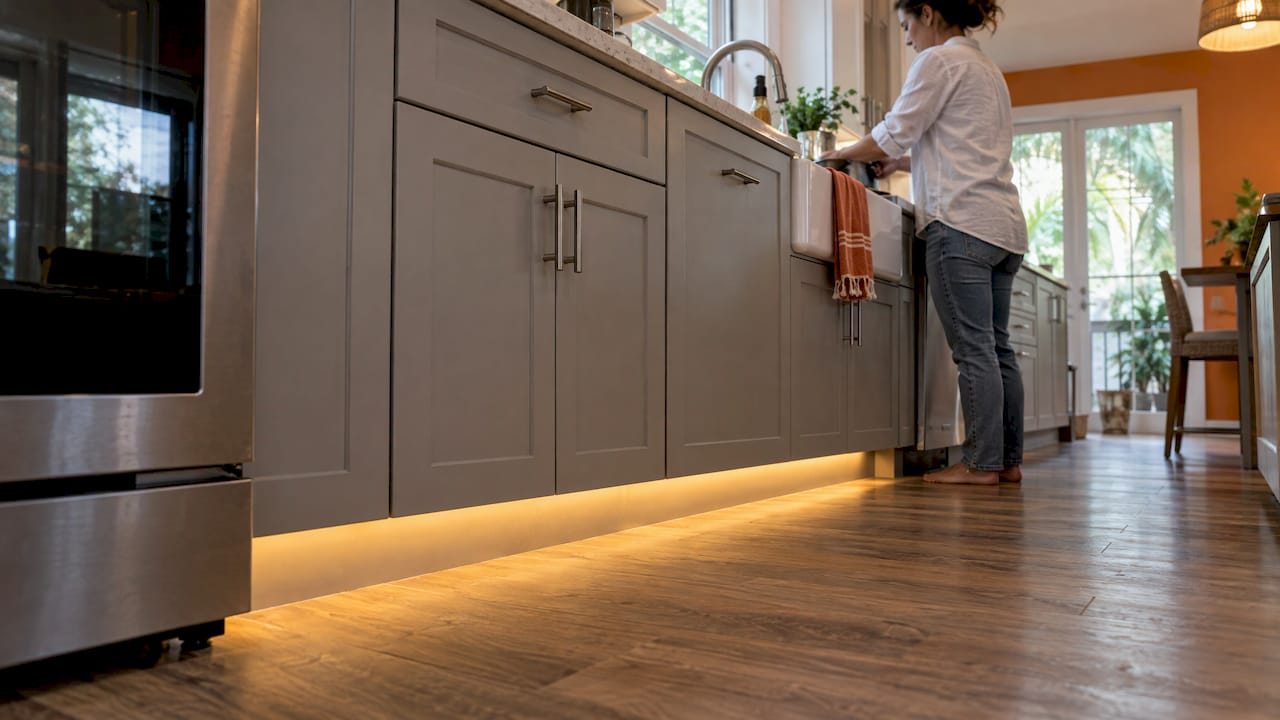
Toe kick lighting is a low-output LED strip hidden in the recess at the base of your kitchen cabinets. It washes a soft glow across the floor, works as a night light and makes the cabinet run look like it floats. It looks best when it is planned with the cabinets, the flooring and the electrical layout together. We design and build kitchens in-house in Tampa, so we can plan it into the cabinet drawings before anything is built.
TL;DR
- Toe kick lighting is accent and night lighting, not task lighting. It sits at the base of the cabinets and lights the floor.
- Mount the strip at the back of the recess, aimed outward, so the cabinet face hides it. A visible strip turns into a row of bright dots.
- Choose a warm color, low brightness, a channel with a diffuser, and a driver sized with headroom.
- It is not the same as under-cabinet lighting, which sits above the counter and lights the work surface.
- The easiest time to add it is during a remodel, when cabinets, flooring and wiring are open and planned together.
Table of Contents
- What toe kick lighting is and what it does
- Toe kick lighting vs. under-cabinet lighting
- Where to place the strip so the light shows and the strip does not
- Specs that matter: brightness, color, channel and controls
- Electrical work: who should do what
- The best time to add toe kick lighting
- Toe kick lighting in bathrooms
- Everyday living with it
- Perspective
- Planning toe kick lighting with us
- FAQ
- Sources
What toe kick lighting is and what it does
The toe kick is the recessed strip at the bottom of a base cabinet. It lets your feet get close to the counter. Toe kick lighting puts an LED strip in that recess, usually at the back of the recess and aimed outward, so the light spills across the floor in front of the cabinets.
It does three jobs:
- A night light. Late at night you can cross the kitchen for water without switching on the overhead lights. Kichler’s lighting guide notes that it also doubles as a nightlight and defines the baseline of the cabinets.
- A floating look. Light under the cabinet run visually lifts it off the floor, which adds depth in a kitchen with a solid block of cabinetry.
- Safer movement. One installer-focused blog lists navigation at night and fall prevention for seniors aging in place among the benefits.
AspectLED describes it as lights under base cabinets or bathroom vanities, typically 2 to 4 inches off the ground and facing down, and calls it a fairly new renovation trend that works as an accent to your general lighting.
Toe kick lighting vs. under-cabinet lighting
The two are often confused, and a good kitchen uses them for different jobs.
| Toe kick lighting | Under-cabinet lighting | |
|---|---|---|
| Location | Base of the cabinets | Underside of the wall cabinets |
| Aims at | Floor and lower wall | Countertop |
| Job | Night light, ambiance, floating effect | Task lighting for prep and cooking |
| Brightness | Low, restrained | Bright enough to work by |
Put simply, toe kick lighting is an orientation layer. Anything bright enough to read by at floor level is too bright. If you want to chop vegetables in good light, you need the counter-level layer, which we cover in our guide to under cabinet lighting. Together with ceiling lights, the three layers form a kitchen lighting plan that works at 7 a.m. and at midnight.
Where to place the strip so the light shows and the strip does not
The design rule is simple: you should see the glow on the floor, never the strip. Sconce & Socket puts it bluntly: a visible strip becomes a row of bright dots, which is worse than no strip at all. The same logic applies to any hidden LED, and the idea of concealing LED light sources behind a ledge or panel is the same one that makes a toe kick look polished.
A standard toe kick is about 4 inches high and recessed about 3 inches. ENKORA’s technical team describes three places to mount a strip in that space:
- Underside of the cabinet box, aimed down. Set the strip back at least half an inch from the front edge so it stays out of view.
- Top of the kick face, in a 45-degree corner channel. This is their first choice for most kitchen base cabinets because it gives a wider wash of light on the floor.
- Mid-height on the kick face. It is the easiest to install but the worst looking. The lens shows, and glossy floors reflect a bright line.
Two checks matter on any option. First, test the aim before you commit to adhesive. LED Club’s design guide notes that a few degrees of aim changes how much of the source is visible from across the room. Second, check sight lines from every seat and from the doorway. Sconce & Socket suggests taping the strip in place, switching it on and looking from each seat.
Floors matter too. Extremely glossy counters and floors act like mirrors, turning a clean line into dots or streaks. If you are choosing new flooring in the same project, look at samples with the strip lit, not only in daylight.
Specs that matter: brightness, color, channel and controls
Most of the disappointing toe kick jobs come from a strip that is too bright, too cool or too exposed. These are the specs to settle.
Brightness and color
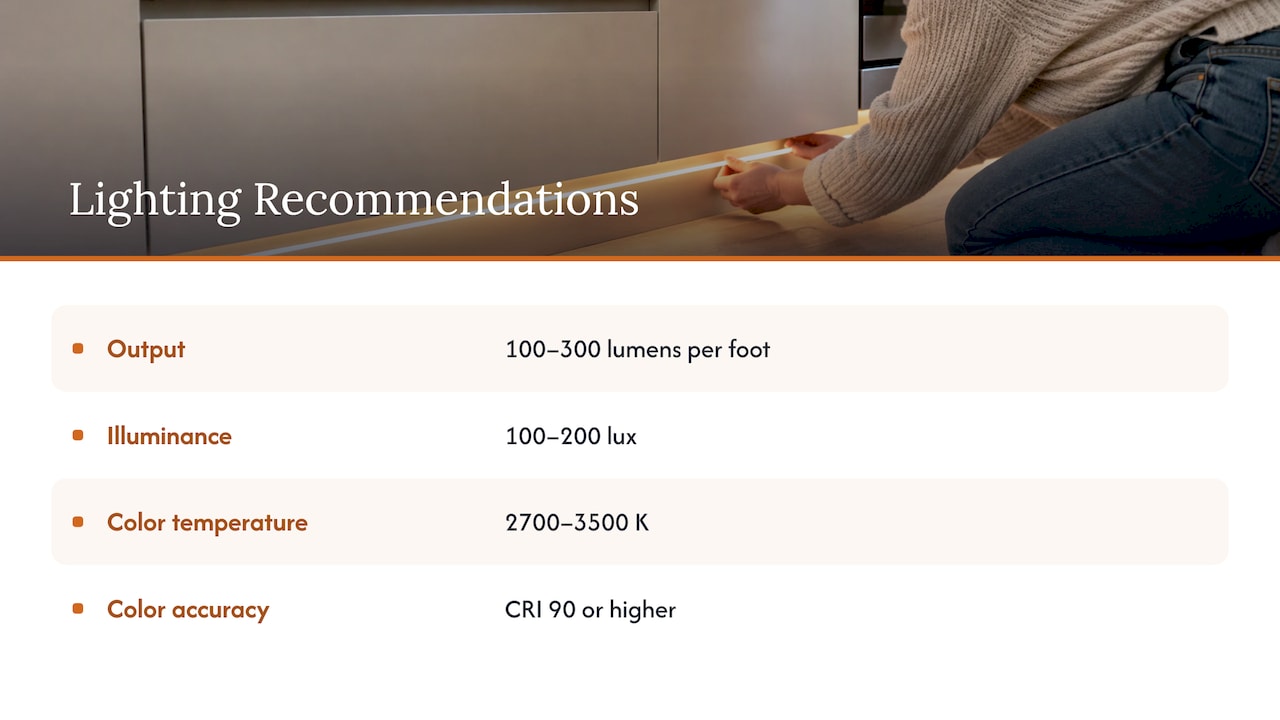
Go low. Acolyte suggests roughly 100 to 300 lumens per foot for toe kick strips, with dimmable LEDs and matched color temperatures. A lighting design guide from Reliant Electrical and Automation puts accent lighting, including toe kick and stair lighting, at 100 to 200 lux and 2700 to 3500K, with a CRI of 90 or more recommended. Kelvin (K) is the scale for how warm or cool white light looks, and lower numbers are warmer. Pick one color temperature for the whole kitchen so the floor glow does not clash with the ceiling lights. Our guide to kitchen lighting color temperature walks through the choice.
Channel and diffuser
Use an aluminum channel with a lens. AspectLED says this protects the strip from dust and debris, and Reliant’s guide advises a diffuser for ambient uses because bare strips create hot spots. Aluminum also helps dissipate heat.
Moisture rating
Kitchen floors get mopped and splashed. LED Club explains that IP65 covers splashing and low-pressure water, while IP67 covers heavier wet exposure. (IP stands for ingress protection, the rating for dust and water resistance.) The end seals, connectors and driver enclosure all need to suit the location. Mount the strip high enough in the recess that standing water is unlikely to reach it.
Power supply and dimming
Toe kick strips normally run on low voltage, with a driver converting household power to 24V for longer runs and consistent brightness, according to Acolyte. The driver is the small power box behind the strip. LED Club’s sizing rule: multiply watts per foot by the total run and add at least 20% headroom. A 24V strip needs a matched 24V driver, never a 12V one. Keep the driver in an adjacent cabinet or dry wall cavity, away from the wet floor.
LED strips dim at the driver, not at a wall dimmer, so decide at the planning stage which dimmer or control the strip will use and where it goes.
Motion sensors
A motion sensor makes the strip an automatic night light. ENKORA recommends mounting the sensor where it sees legs and feet, using a hold time from about 30 seconds to several minutes, setting a daylight threshold so it stays off in a sunny kitchen, and checking that the sensor’s amp rating covers the low-voltage run it switches.
Electrical work: who should do what
Low-voltage strips are gentle compared with the wiring behind them, but the driver still needs household power. LED Club advises that any hardwired line-voltage connection be handled by a qualified electrician where local code or the National Electrical Code requires it. Where a new circuit or switch is needed, hire a licensed electrician and have the work permitted. Reliant also notes that water getting into LED drivers is the number one failure mode, which is why the driver stays out of the toe kick itself.
On our projects, design and construction are handled by one team, so the cabinet layout, the driver location and the wiring path are decided before the cabinets are ordered, rather than found out after installation.
The best time to add toe kick lighting
You can add a strip to an existing kitchen, but a remodel makes it far easier and better looking. Three reasons:
- Cabinet depth and recess are known. The toe kick can be sized to hold a channel and keep it hidden.
- The wiring is open. The low-voltage run, driver location and any switch or sensor can be planned along the cabinet line, with outlets and appliances in mind. AspectLED advises planning how to run wire around appliances and gaps before you start.
- The floor is chosen with the light in mind. Finish, color and gloss all change how the glow reads.
If you are comparing kitchen scopes, we publish up-front price ranges. For example, our Small U-Shaped Kitchen runs $48,500 to $60,200 and our Large L-Shaped Kitchen with Island runs $62,600 to $79,100, with the full list on our kitchen remodel costs page. Those figures cover the kitchen packages listed there; ask us how lighting fits into your own scope.
Toe kick lighting in bathrooms
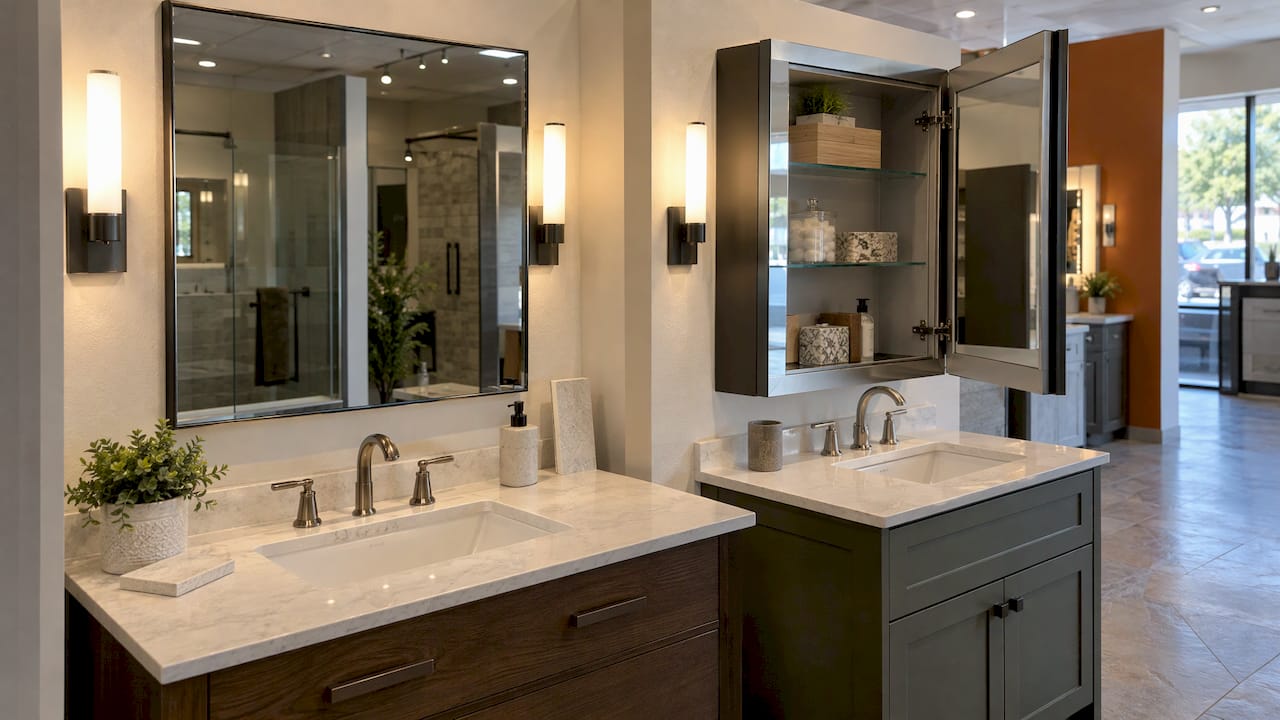
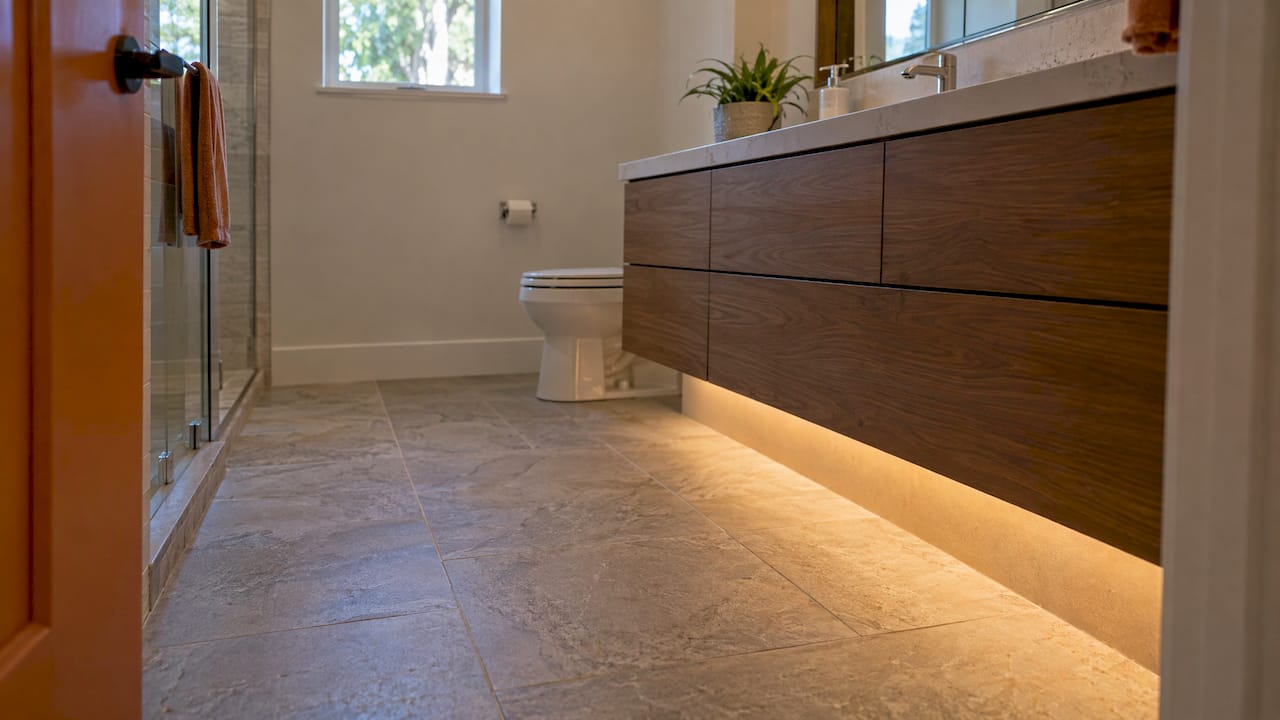
The same idea works under a floating or furniture-style vanity. It gives a soft path to the toilet at night without the glare of the main lights. Bathrooms are wetter, so the rating matters more: Reliant’s guide gives IP44 as the minimum for bathrooms, and a motion sensor with a short hold time, typically 1 to 2 minutes for a night path per ENKORA, keeps it practical. For vanity styles that leave room for it, see our vanity options.
Everyday living with it
A few practical points before you decide:
- Light grazing the floor makes dust and crumbs more visible. A matte or textured floor hides them better than a high-gloss one.
- Seated viewpoints, such as a breakfast nook or island stools, are where an exposed diode shows up. This is why the sight-line check matters.
- RTI Cabinets lists toe kick lighting for ambient lighting, nighttime navigation and decorative accent and says it is not meant for task lighting. Treat it as one layer of three.
- Protect the strip from the mop. A sealed channel and a mount set back from the front edge both help.
Perspective
Toe kick lighting is the detail people notice last and miss most. In a kitchen the glow is usually the thing a homeowner tells friends about, because it only works when everything behind it was planned properly: cabinet recess, channel, driver location and floor.
That is why we treat lighting as part of the design, not an accessory added at the end. We handle design and construction under one roof, give each project a dedicated Lead Carpenter, and price the job up front with detailed item lists. A lighting layer like this belongs on that list from day one, so it does not turn into a surprise change later.
Our Work Clean System is built to minimize dust and disruption while the work is going on, which matters in a kitchen you still have to live in. Whether you want a quiet night light or a full three-layer plan, the best result comes from deciding it at the drawing stage.
MediaBeast
Planning toe kick lighting with us
If you are remodeling a kitchen or bathroom in the Tampa area, we can plan toe kick lighting with the cabinetry, flooring and electrical layout from the start. You get design and construction from one company, a dedicated Lead Carpenter and up-front pricing with detailed item lists. Start with our kitchen remodeling page, or see our bathroom remodeling options if you want the same soft night light in a vanity.

Bring photos of the kitchen you have now and a few that show the look you like, and we will talk through where the light should go. You can also browse the full range on our homepage.
FAQ
What is toe kick lighting?
It is an LED strip hidden in the recess at the bottom of base cabinets. It lights the floor with a soft glow, acts as a night light and makes the cabinets look like they float. It is an accent layer, not a task light.
Where should toe kick lighting be placed?
Mount the strip at the back of the recess, aimed outward and slightly down, so the cabinet face hides the LEDs. A strip at the front edge is visible to anyone seated. Check sight lines from every seat and the doorway before you fix it permanently.
Is toe kick lighting the same as under-cabinet lighting?
No. Toe kick lighting sits at the cabinet base and lights the floor. Under-cabinet lighting sits beneath the wall cabinets and lights the countertop where you work. Most kitchens do best with both, plus ceiling lighting.
How bright and what color should toe kick lights be?
Keep them dim and warm. A range of about 100 to 300 lumens per foot and 2700 to 3500K covers most kitchens. Match the color temperature to your other kitchen lights and choose a dimmable driver so you can set the glow to taste.
Does toe kick lighting need an electrician?
The strip itself is low voltage, but the driver connects to household power. Any hardwired connection, new circuit or switch should be done by a licensed electrician, with permits where your local code requires them. In a remodel, this is coordinated with the rest of the kitchen wiring.
Sources
- Toe-Kick and Cove Lighting: Hidden Strips That Work, Sconce & Socket
- Light Layering, Kichler Lighting
- Toe Kick Lighting Stylish and Functional, Owings Mechanical
- Enhancing Your Kitchen & Bathroom with LED Toe Kick Lighting, AspectLED
- Toe Kick LED Strip: Layout, Channels and Sensors, ENKORA
- Kitchen Toe-Kick LED Lighting: A Design Guide, LED Club
- Under-Cabinet Lighting and Toe-Kick Lighting, The RTA Store
- Top tips for toe kick lighting with LEDs, Acolyte
- Lighting Design Guide, Reliant Electrical and Automation
- Toe Kick & Accent Cabinet Lighting, RTI Cabinets
- 3D Wall Panels with LED Lights Ideas