
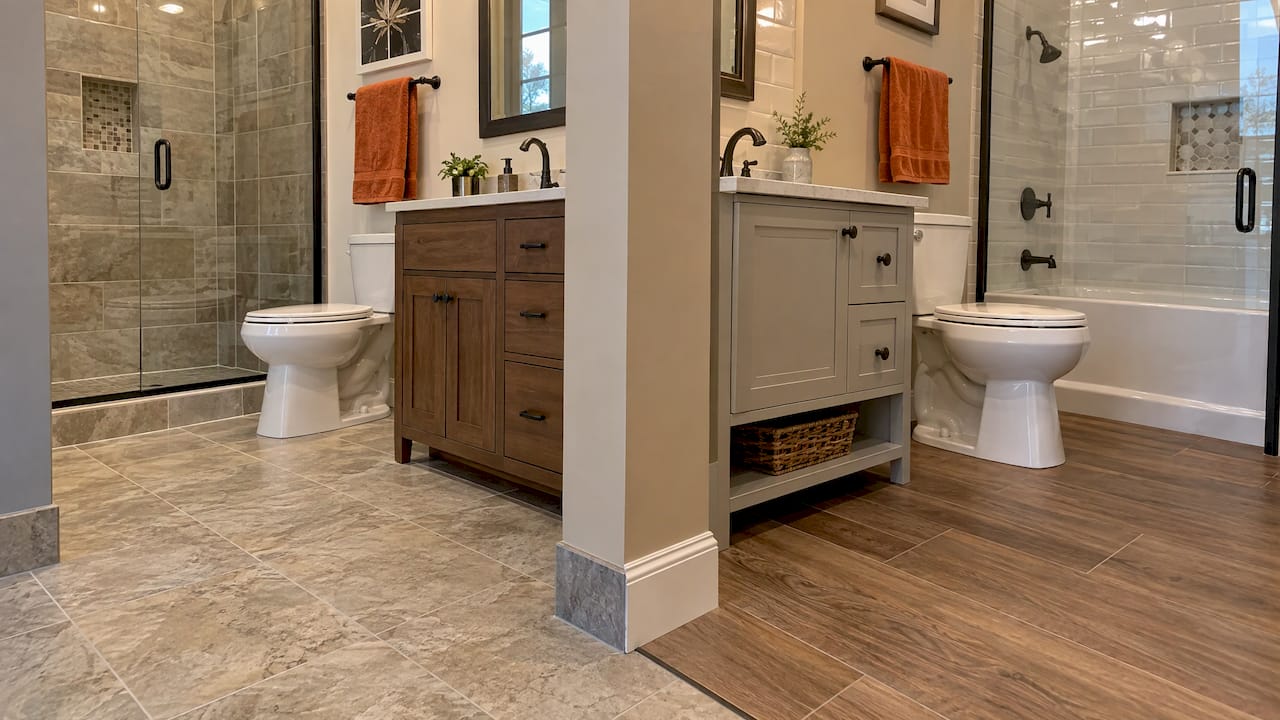
For most bathrooms that get daily showers, tile baseboard is the safer long-term choice. It is water resistant, it matches your floor or wall tile, and a mop won’t hurt it. Wood baseboard costs less, goes in faster and is easier to repair, so it still works in a half bath or a dry powder room. The right pick depends on how wet the room gets, how much you want to spend and the look you are after.
This guide compares the two on the points that matter: moisture, durability, cost, installation, repair, appearance and the joint where trim meets floor. It also covers the part most comparisons skip: neither material protects your walls on its own.
TL;DR
- Tile baseboard handles water and mopping best, so it suits full bathrooms with a shower or tub.
- Wood baseboard is cheaper, simpler to install and easier to replace, which suits dry rooms and tight budgets.
- Whichever you choose, caulk the joint at the floor and get the waterproofing behind the wall right.
- Tile reads modern and wood reads classic, so match the baseboard to the rest of the room.
- In a remodel, decide on baseboard at the same time as flooring and wall tile, not after.
Table of Contents
- The quick comparison
- Moisture: the deciding factor in a bathroom
- Durability and everyday upkeep
- Cost: what you pay on each side
- Installation: what is involved
- Appearance and design fit
- The joint matters more than the material
- Which should you choose? A simple decision guide
- Questions to settle before you order materials
- Our perspective
- Planning a bathroom remodel in Tampa?
- FAQ
- Sources
The quick comparison
| Factor | Tile baseboard | Wood baseboard |
|---|---|---|
| Moisture resistance | High. Tile is naturally waterproof | Lower. Can swell, warp or crack when wet |
| Durability under mopping and impact | Strong, resists scratches and discoloration | Can scratch, discolor or warp with repeated contact |
| Upfront cost | Generally higher | Generally lower, except very high-end species |
| Installation | More involved, needs proper prep | Simpler, basic tools |
| Repair | Harder to patch or replace | Easy to fix or replace |
| Style | Modern, seamless with tile | Classic, traditional |
The differences in the first rows come from published comparisons of wood and tile baseboards, and the cost and repair rows match Hunker’s side-by-side comparison. The sections below explain each row.
Moisture: the deciding factor in a bathroom
Bathrooms are the one room where baseboard material really matters. Water hits the base of the wall from several directions: splashes from the shower, a wet mop, a leaky supply line, a toilet overflow and plain humidity.
The U.S. Department of Energy’s Building America Solution Center says ceramic tile is appropriate for areas likely to get wet, while hardwood is not generally rated for excessive and repeated water exposure. The same guidance recommends water-resistant baseboards sealed to the floor in wet areas.
That is the core of the argument. Tile does not absorb water. Wood, even painted and primed, can take on moisture at cut ends, nail holes and the bottom edge, and that is where swelling and warping begin. A wood baseboard in a bathroom with a tub or shower is working against the room.
Where wood still makes sense:
- A powder room or half bath with no shower.
- A bathroom with a rarely used guest shower and good ventilation.
- A room where the baseboard sits well away from the splash zone.
For a primary bath used every day, tile is likely best for long-term durability and ease of maintenance.
Durability and everyday upkeep
Bathroom floors get cleaned often, and the baseboard takes the abuse. Mops, spray cleaners, vacuum heads and bare feet all bump the bottom few inches of the wall.
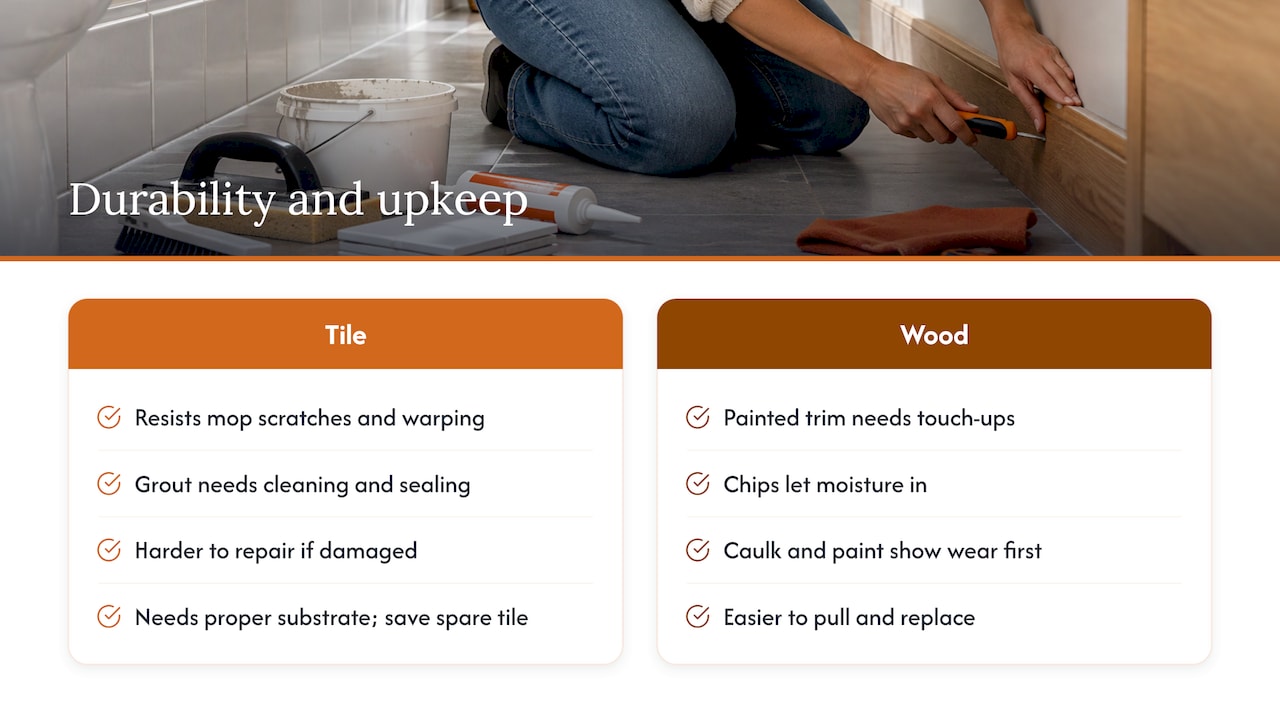
Tile shrugs this off. As one long-running homeowner discussion puts it, a mop will not scratch, discolor or warp it. Grout lines are the only upkeep: keep them clean and sealed. If you are unsure of the timing, this explainer on when to seal grout walks through new tile, older tile and sealing after cleaning.
Wood needs more attention. Painted trim needs periodic touch-ups, and chips let moisture in. In a damp room, caulk lines and paint finishes are the first things to show wear.
One trade-off to plan for: when tile baseboard does get damaged, it is harder to repair than wood, which you can pull and replace if it is kicked or worn. That is one reason to set the tile properly the first time, with a good substrate and matching spare tile saved from the job.
Cost: what you pay on each side
Tile baseboard generally costs more. The material is more expensive and the installation is harder, while wood is usually less expensive and easier to install. Hunker notes the one exception: very high-end wood can cost more than tile.
A few practical points on cost:
- Leftover tile can lower the material cost. If you are already tiling the floor or walls, cutting baseboard from the same tile uses material you are buying anyway. Order extra for the cuts.
- Labor is the bigger gap. Cutting and setting tile trim takes more time than nailing up a prefinished board.
- Replacement cost matters over time. Wood is cheap to swap, but swapping it repeatedly in a wet room adds up.
If you want a sense of how trim decisions fit into a whole-bath budget, our published ranges for complete projects are below in the promo section.
Installation: what is involved
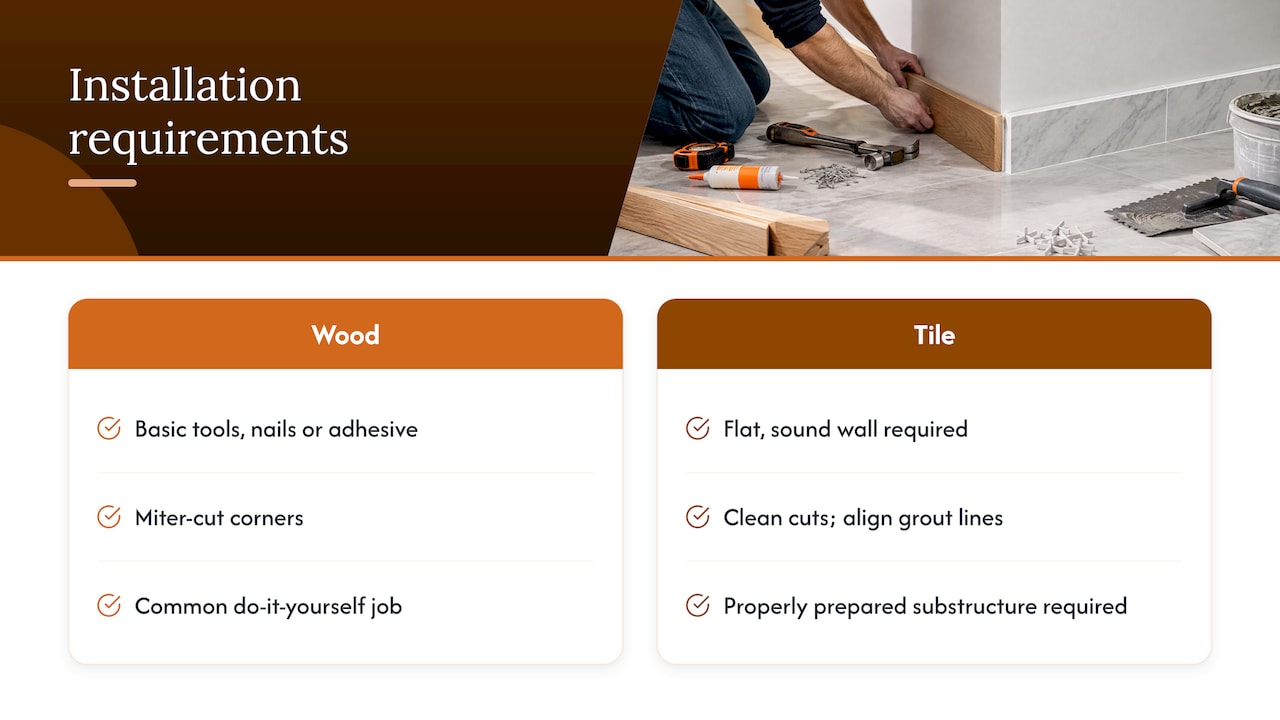
Wood baseboard is the easier install. Basic tools, nails or adhesive and a miter cut for the corners are usually enough, which is why it is common as a do-it-yourself job.
Tile baseboard asks more of the installer. The wall behind it has to be flat and sound, the cuts have to be clean, the grout lines should line up with the floor and the top edge needs a finished look. The Ceramic Tile Foundation’s overview of the TCNA Handbook explains that tile installation methods require a properly designed, constructed and prepared substructure, and that the handbook addresses wet areas, mortar, grout, workmanship and installer qualifications.
In plain terms: tile trim is only as good as what is behind it. When we remodel a bathroom, the baseboard is set in the same sequence as the floor and wall tile, so the lines, heights and grout joints agree.
Common tile baseboard styles
- Cut-down field tile. Strips cut from the floor tile, usually 3 to 4 inches high. Simple and consistent.
- Bullnose or trim pieces. Factory-finished top edge, no raw cut showing.
- Cove base. A curved profile that meets the floor smoothly, helpful for cleaning.
- Wall tile run down to the floor. In showers and wet walls, tile simply continues to the floor and no separate baseboard is needed.
Appearance and design fit
Tile baseboard has a modern look, and wood has a classic, traditional one, according to this comparison of the two materials. Beyond that, it is a matter of taste, so think about the room as a whole.
Choose tile when:
- You want a clean, continuous look from floor to wall.
- The floor is a large-format tile, stone look or patterned tile and you want the trim to feel part of it.
- You like a low-profile, contemporary finish.
Choose wood when:
- The rest of the home has painted wood trim and you want the bathroom to flow with it.
- Your style is traditional, cottage or coastal with beadboard and crown details. Our piece on beadboard in the bathroom shows how that look comes together.
- You want a painted trim color to contrast with the floor.
If you are torn, it helps to see the room before you build it. A bathroom design rendering lets you compare a tile base and a painted wood base in the same space.
The joint matters more than the material
The choice between tile and wood gets most of the attention, but moisture damage usually starts at the joint, not the face of the baseboard.
The Department of Energy’s guidance on water management at tubs and showers points out that water can penetrate grout joints and material transitions. That means tile alone does not waterproof a wall. Waterproofing and drainage details behind the tile are still necessary.
What this means for baseboard:
- Caulk where trim meets floor. Both wood and tile baseboards should be caulked to form a barrier against moisture at that joint. Use a flexible caulk rather than rigid grout at the change of plane, since the floor and wall move differently.
- Follow the waterproofing system’s instructions. Wall-to-floor junctions have specific details depending on the membrane or backer you use. Follow the manufacturer’s directions for that corner.
- Seal the floor edge. In wet areas, the baseboard should be sealed to the floor, as the Department of Energy’s guidance recommends.
- Keep grout sealed. Grout is porous and needs periodic attention, as noted above.
A beautiful tile baseboard over a poor wall-to-floor detail is still a leak waiting to happen. This is why we treat the whole assembly as one job. Our guide to making waterproof bathroom flooring last goes deeper on the floor side.
Which should you choose? A simple decision guide
| Your situation | Better fit |
|---|---|
| Full bath with daily shower or tub | Tile |
| Powder room, no shower | Wood works well |
| Remodeling the whole bathroom, floor and walls | Tile, coordinated with the floor |
| Tight budget and dry room | Wood |
| Traditional home with painted trim throughout | Wood in dry areas, tile in wet ones |
| Want the lowest long-term maintenance | Tile |
| Want the easiest future repair | Wood |
A hybrid also works. Some homeowners use tile baseboard in the full bath and keep matching wood trim in the hallway and bedrooms, with a clean transition at the doorway. Pick a height and finish that look intentional where they meet.
Height and proportion
A common tile baseboard is cut from floor tile at roughly 3 to 4 inches. Wood trim in older homes can run taller. If the bathroom opens into a room with tall trim, a slightly taller tile base, or a tile base topped with a thin painted wood cap, can bridge the two looks.
Questions to settle before you order materials
- Will the baseboard be within reach of shower spray or a tub splash?
- Is the floor tile being replaced too? If so, order enough for baseboard cuts.
- What does the wall-to-floor waterproofing detail look like in the plan?
- Does the bathroom share a threshold with a room that has wood trim?
- Do you want spare tile on hand for future repairs?
Our material selection guide for bathroom remodeling covers how these choices fit together, and you can see finished spaces in our bathroom design gallery.
Our perspective
We see baseboard decisions get made late, usually after the floor is down and someone notices the wall needs a finish. That is the wrong moment. The base of the wall is where flooring, wall tile, waterproofing and trim all meet, so it should be planned with them.
Our approach combines design and construction in-house. That means the person choosing your tile and the crew setting it are working from the same plan, with a dedicated Lead Carpenter on each project who knows how your baseboard, floor and walls connect.
In the bathrooms we remodel, we lean toward tile baseboard in full baths because it carries the look of the room down to the floor and stands up to cleaning. We keep wood in mind for dry rooms and for homes where the trim style calls for it. Either way, the detail that decides how well it lasts is the sealed joint and the waterproofing behind it.
Our Work Clean System is designed to keep dust and disruption down while tile is cut and set, and our up-front pricing lists the items in your project, so trim and finish choices are not a surprise later.
MediaBeast
Planning a bathroom remodel in Tampa?
If you are choosing baseboard as part of a bigger bathroom update, we handle design and construction together. Here are the ranges we publish for complete bathroom projects:
- Small 3-Fixture Bath with Shower: $22,100 to $30,000
- Semi-Stock 3-Fixture Bathroom with Tub: $22,000 to $25,000
- Large 3-Fixture Bath with Shower: $26,700 to $34,000
- 4-Fixture Bath with Shower: $35,000 to $46,000
- 5-Fixture Bath with Freestanding Tub: $52,400 to $65,700
See every layout and what is included on our bathroom remodel cost page, or learn how we work on our bathroom remodeling page.
Final cost depends on project scope and the materials you choose, which is why we itemize up front.
FAQ
Is tile baseboard a good idea in a bathroom?
Yes, in most full bathrooms. Tile is appropriate for areas likely to get wet, and the Department of Energy recommends water-resistant baseboards sealed to the floor in wet areas. It also matches your floor or wall tile and wipes clean. Caulk the joint at the floor and keep the grout sealed.
What is the best baseboard material for a bathroom?
For a bathroom used daily for showers or baths, tile is likely the best for long-term durability and easy cleaning. Wood works better in a dry powder room. In any bathroom, the sealed joint at the floor matters as much as the material.
Is tile baseboard more expensive than wood?
Generally yes. Tile materials cost more and the installation takes more skill and time. The exception is very high-end wood, which can cost more. If you are already tiling the floor, cutting baseboard from the same tile helps the material cost.
Can wood baseboard go in a bathroom at all?
It can, especially in a half bath without a shower. Wood can swell, warp or crack when it stays wet, so caulk the floor joint, seal cut edges and keep the room ventilated. In a room with a tub or shower, tile is the better match.
Sources
- Water-Resistant Flooring, Building America Solution Center (U.S. Department of Energy)
- Measure Guideline: Water Management at Tub and Shower (U.S. Department of Energy)
- The TCNA Handbook (Ceramic Tile Foundation)
- Wood Baseboards Vs. Tile Baseboards (Hunker)
- Tile Vs Wood: Which Is The Better Material For A Bathroom (Yahoo Lifestyle)
- Wood or Tile Baseboard in the Bathroom? (Loo Academy)
- Wood or Tile Baseboard in Bathrooms (Houzz discussion)