
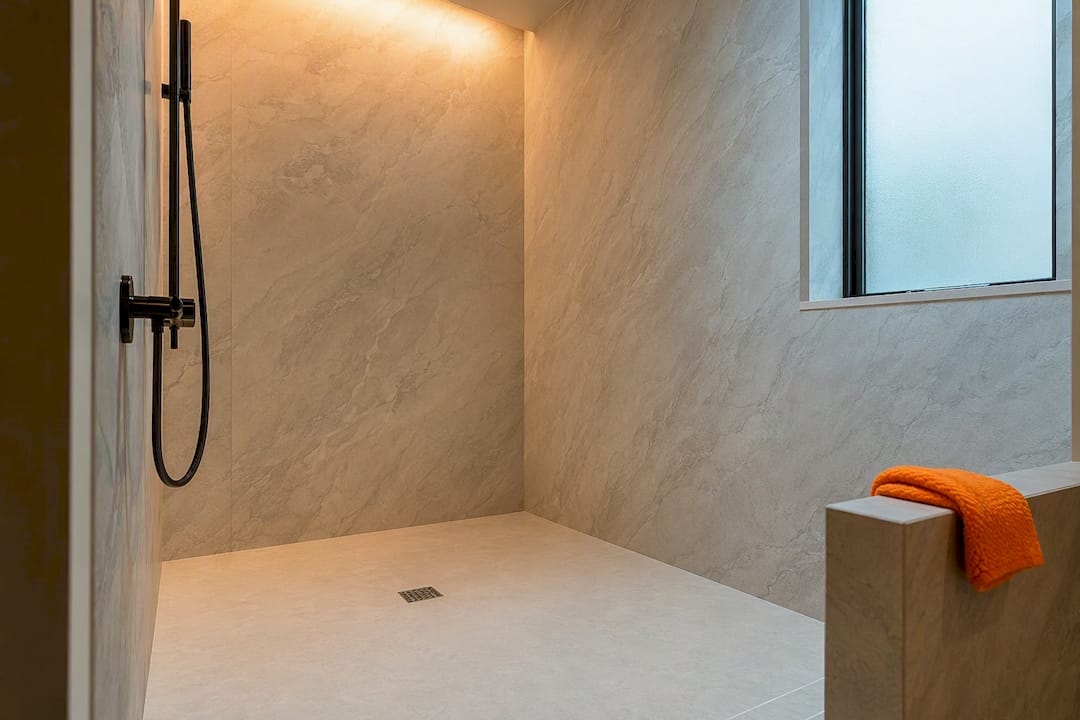
Solid surface, large-format porcelain slabs, acrylic and fiberglass panels, rigid PVC, and glass cover nearly every option for a grout-free shower. All five skip the porous cement lines that trap mildew, so they clean faster and resist mold better than tiled walls. The tradeoff runs the other direction: premium materials cost more upfront, heavy slabs need structural planning, and precise installation matters more than it does with forgiving ceramic tile.
TL;DR:
- High-end groutless shower panels like solid surface and porcelain slabs offer minimal seams and easier cleaning, but they are heavier and more expensive.
- Proper installation requires accurate templating, reinforced backing for heavy slabs, and high-quality silicone sealing to prevent leaks and early seam failure.
- Materials like acrylic and fiberglass are more budget-friendly and easier for DIY installation but tend to have a shorter lifespan and less impact resistance.
- Seam maintenance involves regular silicone inspection and recaulking every six months to prevent water damage, with no grout lines to scrub.
- Choosing the right system depends on budget, structural support, and long-term durability, with professional installation strongly recommended for premium materials.
Table of Contents
- What Are Groutless Shower Walls Made Of?
- How Do You Get a Tile Look Without Grout?
- What Does a Proper Groutless Panel Install Involve?
- What Are the Downsides of Groutless Showers?
- How Do You Choose the Right Groutless Wall?
- How Do You Keep Groutless Shower Walls Clean?
- Do Groutless Panels Work With Existing Plumbing and Fixtures?
- How Long Do Groutless Shower Walls Actually Last?
- Why a Contractor-Led Install Reduces Risk
- How a Contractor Handles Groutless Shower Installs
- Sources
- FAQ
What Are Groutless Shower Walls Made Of?
Each material family solves the tile-and-grout problem differently, and the right pick depends on budget, weight tolerance, and how custom you want the final look.
Solid surface (think Corian or Swanstone) is a non-porous acrylic-polyester blend that fabricators cut and seam to fit a specific shower. It comes in large panels, commonly 36 by 72 inches, 48 by 96 inches, and 60 by 96 inches, which means fewer seams and a cleaner line from floor to ceiling. It’s also one of the few groutless materials you can actually repair; a scratch or burn can be sanded out rather than replaced.
Porcelain and sintered stone slabs deliver the closest thing to a stone shower without the sealing headaches natural stone demands. Slabs run large enough to cover a full wall with a single seam, but that size comes with weight. A full slab can be considerably heavier than an engineered panel of the same dimensions, so it often requires reinforced backing and two installers to set safely.
Acrylic and fiberglass panels are the DIY-friendly end of the spectrum. They’re light, sold in standard kit sizes for common shower stalls, and typically install with adhesive or a click system rather than a full mortar bed. Expect a shorter lifespan than solid surface or porcelain, and less resistance to abrasive cleaners.
Rigid PVC panels use tongue-and-groove or fast-click joints and lean on color-matched silicone at the seams instead of grout. Many manufacturers back these systems with lifetime water-resistance warranties, and they’re usually the most affordable groutless option by a wide margin.
Glass works best for full enclosures or as an accent alongside another wall material, since glass alone doesn’t solve the wall-surface question but instead solves the door and visibility question. Combining glass panels with an enclosure that matches your shower’s finish tends to look more intentional than mismatched systems.
- Solid surface: non-porous, repairable, premium price
- Porcelain/sintered slabs: near-seamless, heavy, premium price
- Acrylic/fiberglass: lightest, most affordable, shortest lifespan
- Rigid PVC: budget-friendly, fast-click install, strong warranties
- Glass: pairs with other wall materials, best for enclosures and light
How Do You Get a Tile Look Without Grout?
A monolithic slab or panel reads as modern and minimal. It’s one continuous surface with no visible break, which is why solid surface and porcelain slabs dominate high-end remodels that want a spa look. If you want the tile aesthetic without the tile maintenance, several panel manufacturers now build integrated textured lines into the panel itself. Swanstone’s EverGrout pattern mimics the look of grouted subway tile while remaining a single sealed sheet, no actual grout line to scrub.
Veined solid surface and marble-look porcelain slabs push the luxury angle further, since a continuous vein pattern across a large panel looks custom in a way that repeating tile can’t match. Edge treatments matter more than people expect. A mitered inside corner or an integrated niche cut from the same slab keeps the eye moving across one surface instead of stopping at a trim piece.
- Smooth monolithic panels: modern, minimal seams, easiest to clean
- Faux-grout textured panels: tile look, single-sheet maintenance
- Veined slab patterns: high-end look with almost no visible seams
- Integrated niches and mitered corners: keep the surface visually continuous
Textured grout-look panels tend to suit traditional or transitional bathrooms where a full slab might look too stark. Smooth slabs suit contemporary spaces where the goal is visual quiet.
What Does a Proper Groutless Panel Install Involve?
Installation quality determines whether groutless walls actually deliver on the low-maintenance promise, and most of the work happens before a single panel goes up.
- Check the substrate. Walls need to be plumb and backed with solid blocking wherever a grab bar, shower seat, or shelf will attach, since panels alone don’t carry that load.
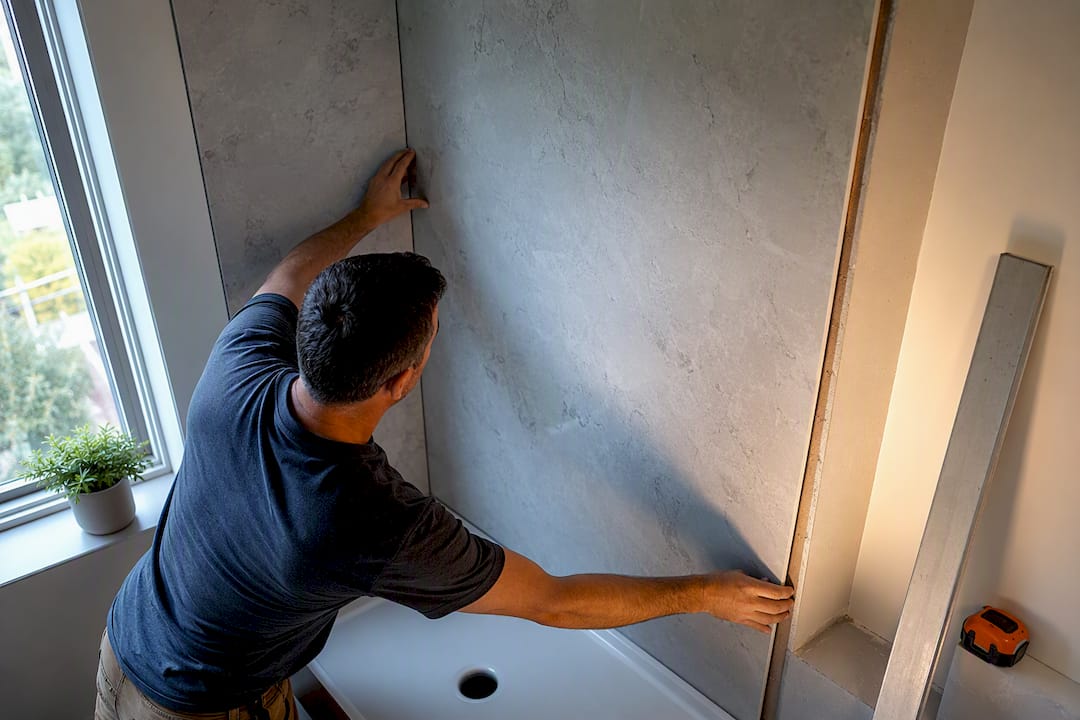
- Template before cutting. Installers make a physical template of each wall, including every plumbing and fixture cutout, so the panel gets scribed and cut once instead of trimmed repeatedly on-site.
- Cut with the right tools. Diamond blades handle porcelain and solid surface cleanly, and large panels get moved and set with suction lifters rather than hand-carried, which protects both the panel edge and the installer’s back.
- Seal with the right silicone. A high-quality kitchen-and-bath silicone, tooled into a consistent bead, is what actually keeps water out at the seams. Installers commonly go through roughly 12 to 15 tubes on a single shower once you count corners, the pan transition, and fixture penetrations.
- Let it cure before use. Rushing water exposure before silicone fully cures is one of the most common causes of early seam failure.
Pro Tip: Ask your installer to walk you through the template before panels are ordered. A five-minute review catching a misplaced valve cutout is far cheaper than a re-cut panel after fabrication.
The single biggest mistake homeowners run into isn’t the material, it’s skipping the template step or reusing an old tile template that doesn’t account for a panel’s rigidity. Panels don’t flex the way tile does, so an inaccurate template shows up as a visible gap instead of a hairline crack you could grout over. Solid substrate prep matters just as much if you’re planning a shower remodel built to handle Florida humidity year-round.
What Are the Downsides of Groutless Showers?
Groutless walls solve the maintenance problem, but they introduce different tradeoffs than the ones tile creates.
- Cost bands vary widely. Economy PVC and acrylic panels sit at the affordable end; solid surface and porcelain slabs sit at the premium end, often several times the material cost of basic ceramic tile.
- Weight requires planning. Large porcelain and sintered stone slabs need reinforced backing and sometimes a second installer just to set safely, which acrylic and PVC never require.
- Repairability differs by material. Solid surface can be sanded and refinished if scratched; porcelain and glass generally need panel replacement for anything beyond a surface scuff.
- Seams still exist. A groutless wall isn’t a seamless wall, it’s a wall with fewer, better-sealed seams. Silicone joints need periodic inspection and occasional recaulking, just at a much lower frequency than grout lines.
How Do You Choose the Right Groutless Wall?
Start by ranking your priorities, because no single material wins on every axis.
- Rank budget, durability, look, and timeline. If budget leads, PVC or acrylic wins. If a custom, high-end look leads, solid surface or porcelain wins.
- Confirm structural limits early. Ask whether your framing can support a heavy slab, or whether blocking needs to be added for accessories before panels go in.
- Check panel lead time. Custom-fabricated solid surface and slab orders can take weeks; factor that into your renovation timeline before demo starts.
- Ask your contractor direct questions: who creates the template, who cuts on-site versus in a shop, roughly how many silicone tubes the job requires, and how niches and corners get handled.
- Decide DIY versus pro. Standard acrylic kits are reasonable DIY territory for a handy homeowner. Solid surface, porcelain slabs, and anything requiring structural blocking is professional-installer territory.
How Do You Keep Groutless Shower Walls Clean?
The daily maintenance routine is genuinely simpler than tile, but it’s not zero-effort. A quick squeegee after each shower prevents the mineral spotting that hard water leaves on any non-porous surface, glass, solid surface, or porcelain alike. Because there’s no grout to stain or scrub, a weekly wipe with a pH-neutral cleaner and a microfiber cloth handles most upkeep.
Skip abrasive powders and scouring pads on acrylic and PVC panels specifically, since they can dull the gloss finish over time in a way that’s hard to reverse. Solid surface and porcelain tolerate a wider range of cleaners, but manufacturers still recommend avoiding harsh solvents that can degrade silicone seams faster than they’d otherwise wear.
The seams themselves deserve more attention than the panel surface. Silicone joints are the one part of a groutless wall that behaves like a wear item, they harden and can separate slightly over years of temperature swings and moisture cycling. Checking the caulk lines every six months and touching up any that look cracked or pulled away keeps water from finding its way behind the panel, which is the actual failure mode that causes hidden damage in any shower system, tiled or not.
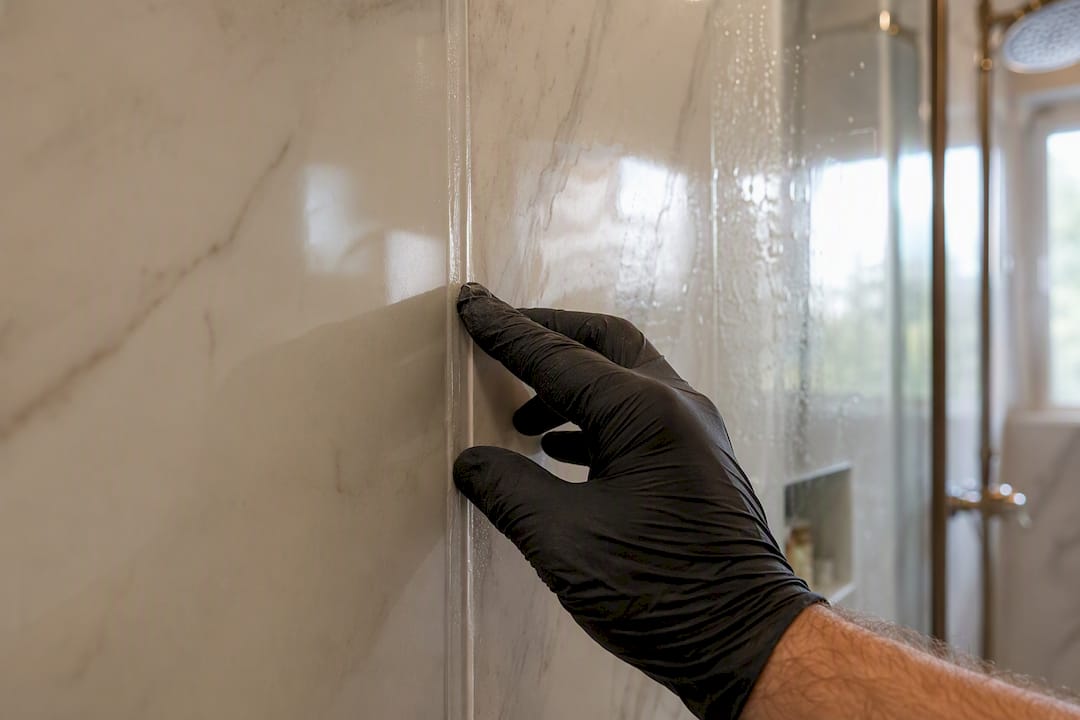
Bathrooms with sliding glass doors need one more habit: wiping down the door track, since standing water there causes more mildew than the walls do. Pair that with a quick glance at corner seams and you’ve covered essentially the entire maintenance list for a groutless shower.
Do Groutless Panels Work With Existing Plumbing and Fixtures?
In most remodels, yes, but fixture placement drives how much extra work the templating step involves. Panels get cut with precise holes for shower valves, shower arms, and niche shelving during the templating phase, which is why an accurate template matters more here than with tile, where a slightly off cutout gets hidden by trim or additional grout.
If you’re keeping your existing shower pan and simply replacing tile walls, panels can often install directly over a prepared substrate without touching the plumbing rough-in at all. Some manufacturers design wall panel systems to pair with matching shower bases for a fully coordinated grout-free enclosure, which simplifies the transition seam between wall and pan, often the single hardest joint to seal well in any shower.
Relocating a shower valve or adding a new niche changes the math, since that requires rough-in plumbing work before panels ever get templated. If your remodel plan includes moving fixtures, loop in a plumber early. Coordinating that timeline with a partner like Wallers Plumbing and Heating before wall panels are ordered avoids the expensive scenario where a template gets made, then a valve moves, and the panel no longer fits.
Grab bars, corner shelves, and recessed niches all need blocking installed in the wall cavity before panels go up, since none of these groutless materials support hardware weight on their own. That’s a substrate decision, not a plumbing one, but it belongs on the same pre-installation checklist.
How Long Do Groutless Shower Walls Actually Last?
Durability varies more by material than almost any other factor in this decision. Solid surface holds up for decades and can be resurfaced if it ever looks worn, which is part of why fabricators treat it as a lifetime material rather than a replace-in-ten-years product. Porcelain and sintered stone slabs are similarly long-lived once installed correctly, their main vulnerability is impact chipping at an edge or corner rather than gradual wear.
Rigid PVC panel systems increasingly ship with lifetime water-resistance warranties from manufacturers, which reflects real confidence in the click-joint seal technology rather than marketing alone. Acrylic and fiberglass sit at the shorter end of the range; gel-coat finishes can dull or micro-crack after enough years of hot water and cleaning, though replacement cost is low compared to the premium materials.
Warranty terms differ enough between brands that reading the fine print matters. Some cover material defects only, others cover water intrusion at the seams for the panel’s lifetime, and installation warranties from your contractor are typically separate from the manufacturer’s material warranty entirely. Ask specifically what triggers a warranty claim, whether a seam failure counts, and whether the labor to fix it is included or just the replacement material.
The honest takeaway: material quality gets you most of the way to a long-lasting shower, but installation quality is what actually determines whether you experience that lifespan or end up dealing with an early seam failure that no warranty fully covers.
Why a Contractor-Led Install Reduces Risk
Templating errors, mismatched blocking, and rushed sealant work are the failures that actually cause callbacks, not material choice. A design-and-build approach removes the handoff gaps between designer, fabricator, and installer where those mistakes creep in. Dust-control systems and a single lead carpenter overseeing fit and finish catch problems before they’re sealed behind a panel.
— MediaBeast
How a Contractor Handles Groutless Shower Installs
Some contractors design and install groutless shower walls as part of full bathroom remodels, not as an add-on subcontracted to whoever’s available that week. That matters because the templating, substrate prep, and sealant work covered above are exactly where DIY and low-bid installs run into trouble.
Every project comes with up-front pricing before work starts, so there’s no guessing on material upgrades once demo begins. A dedicated Lead Carpenter oversees your job from templating through final seam work, and the Work Clean System keeps dust and disruption contained while panels get cut and set. If you’re weighing solid surface against porcelain slabs or want to see finished examples before committing to a material, browse the Tampa bathroom remodeling gallery or schedule a consult through Tampa shower remodeling services to get a scoped quote for your space.
Sources
Manufacturer pages from Corian and Swanstone cover material specs and panel patterns in more depth than any single article can.
- Corian® Shower Walls & Pans
- How to install a grout-free shower enclosure (Fine Homebuilding sponsored post)
- Wall patterns | Swanstone
FAQ
What Is the Best Material for Shower Walls Without Grout?
Solid surface and large-format porcelain slabs are generally considered the top-tier choices because they’re non-porous, durable, and create the fewest visible seams. Acrylic and PVC panels are strong budget alternatives with shorter expected lifespans.
What Are the Downsides of a Groutless Shower?
The main downsides are higher upfront cost for premium materials, added weight requiring structural reinforcement for slabs, and the fact that silicone seams still need periodic inspection even though there’s no grout to maintain.
Is a Large-Format Slab System Better Than Acrylic Shower Walls?
Large-format slab systems generally deliver a more premium, seamless look and greater durability, while acrylic panels win on affordability and DIY-friendly installation. The better choice depends on budget and how much weight your framing can support.
Is a Groutless Shower a Good Bathroom Remodel Idea?
For most homeowners, yes, groutless walls reduce mold risk and cleaning time compared to grouted tile, making them a strong fit for busy households. The tradeoff is that materials and professional installation typically cost more than a standard tile job, which Tampakitchenandbath can help you scope during a project consult.
How Many Silicone Seams Does a Groutless Shower Actually Have?
A typical groutless shower still has seams at every panel joint, corner, and the pan transition, sealed with silicone instead of grout. Installers often use 12 to 15 tubes of silicone on one shower once every joint is accounted for.