
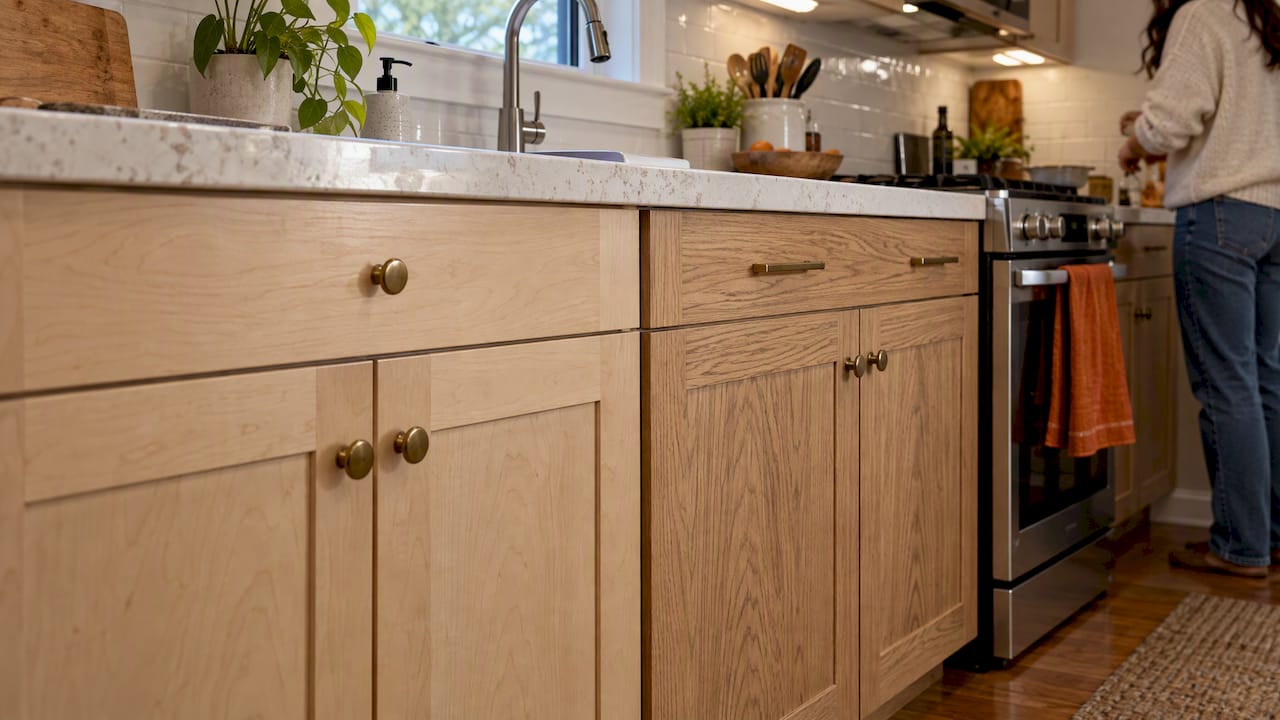
Choose maple if you want a smooth, quiet surface, especially under paint. Choose oak if you want visible grain, a forgiving stain finish and, usually, a lower price. Both are hard, long-lived woods that will outlast most kitchen trends, so the real decision is about looks, finish and budget, not survival. Below is how the two compare on the things that matter once cabinets are on your wall.
TL;DR
- Look: Maple has a fine, even grain and a smooth surface. Oak has bold, open grain you can see and feel.
- Finish: Maple is the better choice for paint. Oak takes stain more evenly, while maple can blotch with medium to dark stains.
- Strength: Maple is slightly harder on paper, but both are durable enough for daily kitchen use.
- Cost: Red oak is often comparable to maple or a little cheaper, and white oak tends to sit at a premium.
- Style: Painted Shaker and modern slab kitchens favor maple. Traditional, farmhouse and craftsman kitchens favor oak, with white oak popular in modern designs.
Table of Contents
- The quick comparison
- How maple and oak look different
- Durability: closer than most guides suggest
- Painting vs. staining
- Cost: what to expect
- Which style does each wood fit?
- Maintenance and aging
- How to tell if your existing cabinets are oak or maple
- Our perspective
- Planning a kitchen with new cabinets?
- How to decide: a short checklist
- FAQ
- Sources
The quick comparison
| Factor | Maple | Oak |
|---|---|---|
| Grain | Fine, tight, subtle | Bold, open, straight with arches |
| Natural color | Near-white to golden | Light to mid brown, often with a red or pink cast |
| Surface feel | Smooth | Slightly rough, raised grain |
| Painting | Excellent, grain stays hidden | Grain shows through unless filled |
| Staining | Can blotch with medium and dark stains | Even, predictable |
| Hardness (Janka) | About 1,450 lbf (hard maple) | About 1,290 lbf (red oak), 1,360 lbf (white oak) |
| Typical styles | Painted Shaker, slab, transitional | Traditional, farmhouse, craftsman, modern white oak |
How maple and oak look different
The biggest visible difference is the grain, and it comes down to how each tree grows. According to a cabinet maker’s guide that cites the USDA Wood Handbook, maple is diffuse-porous, with small pores spread evenly, while oak is ring-porous with large open pores. That is why maple reads as a calm, uniform surface and oak shows stripes and cathedral arches.
Maple runs from near-white to golden yellow, and its grain is usually straight with occasional waves, curls or bird’s-eye figure. Doors look clean and modern, and the wood stays out of the way of your countertops, tile and hardware.
Oak is light to mid brown, often with a red cast, and its straight, prominent grain gives cabinets a more textured, “wood-forward” character. Red oak leans pink or reddish. White oak is more neutral and tan to light brown, which is a big reason it has become a favorite for modern kitchens.
If you want a kitchen where the wood is part of the design, oak delivers that. If you want a kitchen where color, shape and hardware lead, maple is the easier backdrop.
Durability: closer than most guides suggest
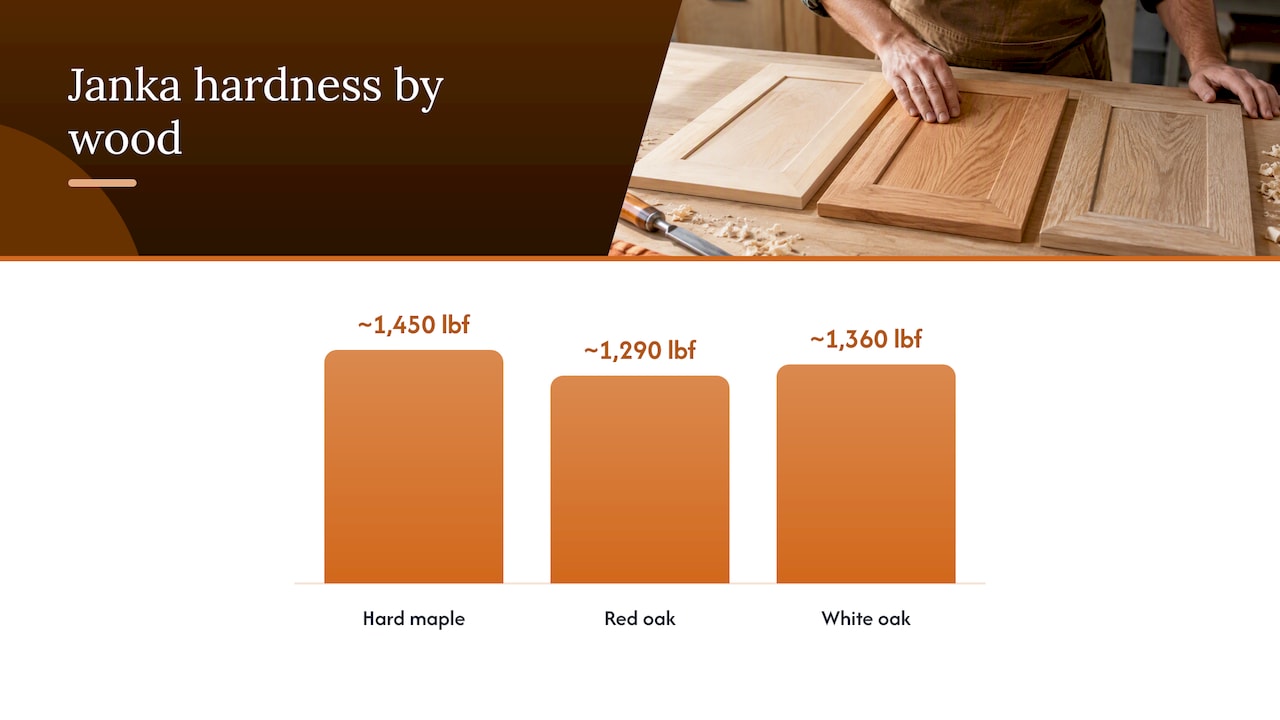
Maple wins the hardness chart, but not by enough to change how your kitchen lives. The Wood Database lists hard maple at about 1,450 lbf on the Janka scale, which measures the force needed to press a steel ball into the wood. A flooring reference puts red oak near 1,290 lbf and white oak near 1,360 lbf. Maple is harder, yet the gap is small, and published figures vary a little from source to source.
Three practical points matter more than the number:
- Dents and scratches. Harder wood resists dents, but oak’s open grain and deeper tone hide minor wear better than a smooth, pale maple door under a clear coat.
- Moisture. Cabinets near the sink and dishwasher live with humidity swings. Stability depends on how the doors and boxes are built, not only on species. Many cabinet boxes use hardwood plywood for resistance to warping, with solid wood on doors and face frames.
- Joinery and finish quality. A well-built maple or oak cabinet with dovetailed drawers and a durable catalyzed finish will outlast a poorly built one in either species.
In a Tampa-area home, where humidity is high most of the year, we pay as much attention to how a cabinet is constructed, sealed and installed as to which hardwood is on the door.
Painting vs. staining
This is where the two woods behave most differently, and it is often the deciding factor.
Why maple suits paint
Because maple’s grain is tight and uniform, paint sits on it as a smooth, even surface. White, sage, navy and greige kitchens in maple look crisp and consistent from door to door. If you are leaning toward painted Shaker doors, maple is the natural pick. Our guide to Shaker vs. slab cabinets shows how door style changes the result.
Why oak suits stain
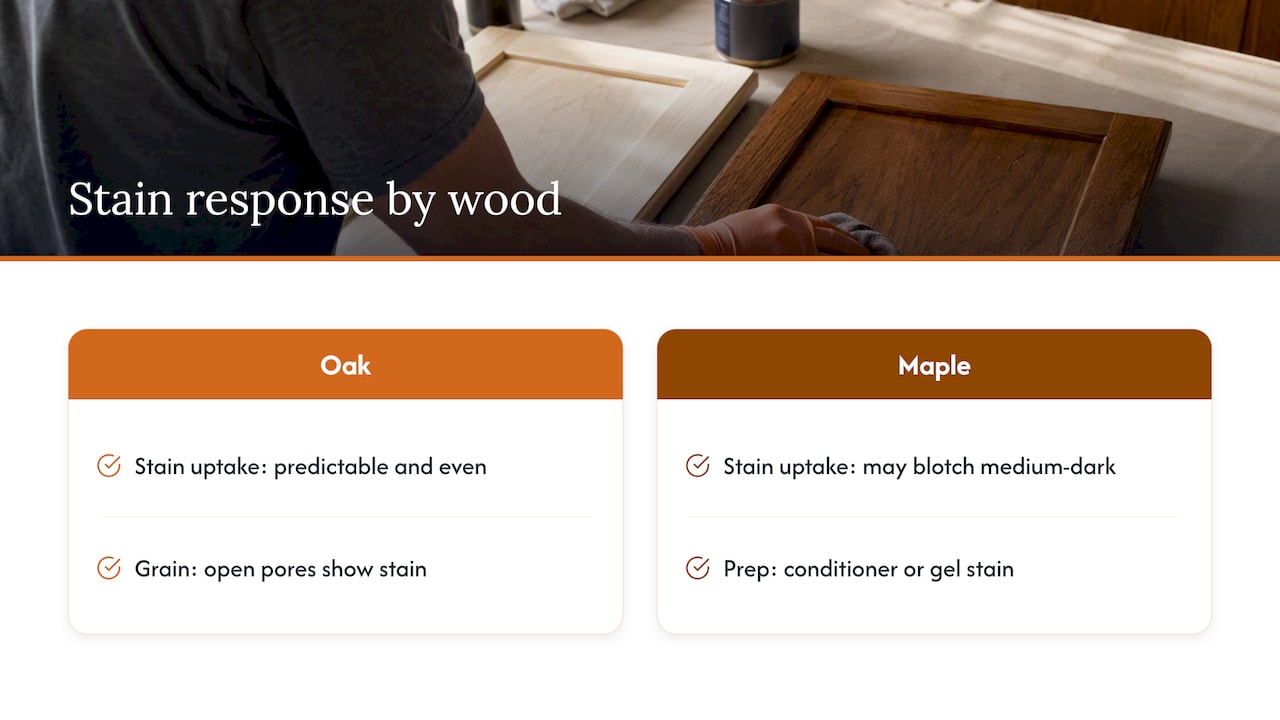
Oak’s open pores take stain predictably and show it off. A reputable woodworking reference notes that oak absorbs stain evenly, while maple’s tight grain can blotch with medium to dark stains unless it is prepped with a conditioner or gel stain. That does not mean you cannot stain maple. It means the finisher’s skill matters, and dark espresso tones on maple are a job for a professional shop rather than a weekend project.
Painting oak and matching the two woods
Painted oak is possible, but the grain will telegraph through unless it is filled. Some homeowners like that texture, and others find it frustrating. If you want the smooth look of paint, fill the grain or choose maple.
Also know that you cannot make one wood look like the other. Even when maple is stained to match oak, the species will always look different because of their distinct grain patterns. If you are adding to an existing kitchen, match the species rather than the color.
If you like a worn, rustic look on either wood, finishing techniques matter. This walkthrough of distressed wood finish recipes shows how much character a finish can add. For a deeper look at the choice itself, see our page on whether cabinets should be painted or stained.
Cost: what to expect
Price varies by door style, construction, finish and the cabinet line, so any per-foot number is only a starting point. The general pattern is consistent across the trade:
- Red oak is usually comparable to maple or slightly less expensive.
- Maple is the common baseline for hardwood cabinets.
- White oak is generally the premium option, driven by demand and a smaller supply of quality lumber.
What moves your total far more than species is the scope of the job: layout changes, countertops, flooring, appliances, lighting and labor. For context, we publish ranges for typical kitchens on our kitchen remodel costs page. A small U-shaped kitchen is listed at $48,500 to $60,200, and a large kitchen with an island at $74,100 to $93,600. Cabinet species is one line item inside those totals, and we itemize it so you can see what a change from oak to maple, or the reverse, does to the number.
Which style does each wood fit?
Maple is popular for painted Shaker, modern slab and transitional kitchens. Oak is frequently used in traditional, farmhouse, rustic and craftsman designs, and white oak is trending in modern kitchens. Maple has not gone out of style either, because it works with a wide range of finishes, glazes, stains and paints.
A few pairings that tend to work:
- Painted maple Shaker with quartz counters and brushed hardware for a classic, bright family kitchen.
- Natural white oak slab with matte black fixtures for a warm, modern look.
- Stained red oak in an older home where you want the cabinets to match existing trim and floors.
- Maple with a light natural finish for a Scandinavian-leaning, airy kitchen.
Door profile matters as much as species. Our cabinet door styles guide walks through eight common options.
Maintenance and aging
Both woods are low-maintenance. A regular wipe-down with a gentle cleaner removes grease and grime, and you should dry the surface rather than let water sit near the sink. In their natural state, both woods can yellow over time with heat and UV exposure. Maple under a clear coat can warm noticeably, which surprises people who expect a pale kitchen to stay pale. Painted maple does not have that issue, though paint at edges and corners can chip with heavy use and may need touch-ups.
Our article on caring for new kitchen cabinets covers cleaners to use and habits to avoid.
How to tell if your existing cabinets are oak or maple
If you are planning a refresh or matching new pieces to old ones, check these in good light:
- Look at the pores. Oak shows large open pores and cathedral arch patterns. Maple looks fine, smooth and uniform, sometimes with wavy or bird’s-eye figure.
- Run your hand across it. Oak feels slightly rough, even under finish. Maple feels smooth and dense.
- Check an inside edge or back. Unfinished spots, such as the inside of a cabinet, show the true grain without stain or glaze distorting it.
- Consider the color. Pink or reddish undertones often suggest red oak. A creamy, pale tone with little visible grain suggests maple.
If you are still unsure, a remodeler can identify it in seconds on site, and it matters for deciding whether to refinish, repaint or replace.
Our perspective
We design and build kitchens in-house, so we see how these woods perform in real Tampa homes and not only on a sample board. Our view is that most homeowners over-think species and under-think finish, construction and layout. A maple door with a poor paint job looks worse than an oak door with a good stain, and the reverse is true too.
Our rule of thumb is simple. Decide first whether you want paint or stain, because that usually makes the choice for you. Paint points to maple. Visible, stained grain points to oak. Then look at samples in your own light, next to your own counters and floors, before you order. Our kitchen material selection checklist lists five checks to run first, and you can compare finishes in person at our local showroom.
We also put every cabinet choice in writing with up-front pricing, so the species, door style and finish you pick show up as clear line items rather than surprises later.
— MediaBeast
Planning a kitchen with new cabinets?
Bath & Kitchen Gallery handles design and construction under one roof. You get up-front pricing with detailed item lists, a dedicated Lead Carpenter on your project and our Work Clean System to keep dust and disruption down. If you are weighing maple, oak or another cabinet material, we can show you samples and price each option side by side.
See our kitchen remodeling services in Tampa, browse kitchen cabinets and countertops, or start from the Bath & Kitchen Gallery home page to schedule a consultation.
How to decide: a short checklist
- Paint or stain? Paint favors maple. Stain, especially medium and dark, favors oak or a professionally finished maple.
- Smooth or textured? If you want to feel the wood, choose oak. If you want a sleek surface, choose maple.
- Which tone? Pale and clean points to maple. Warm and natural points to white oak. Traditional and reddish points to red oak.
- Budget? Ask for red oak, maple and white oak priced on the same door style, so you compare like with like.
- Matching existing woodwork? Match species first, then color.
- Sample in your own kitchen. Look at the wood in morning and evening light before you commit.
For a broader view, our overview of popular types of wood for cabinets covers cherry, birch and other options, and the six best cabinet materials article looks beyond solid wood.
FAQ
Is maple or oak better for kitchen cabinets?
Neither is better in every kitchen. Maple is the better match for painted cabinets and a smooth, contemporary look, while oak suits stained finishes and visible grain. Both are durable enough to last decades with ordinary care.
Are maple cabinets still in style?
Yes. Maple remains a popular, resilient cabinet material that works with paints, stains and glazes. It is especially common in painted Shaker, slab and transitional kitchens. Its neutral surface also lets you change counters and hardware later without the cabinets clashing.
Is white oak more expensive than maple?
Usually, yes. White oak generally sits at a premium, while red oak is often comparable to maple or slightly cheaper. Actual quotes depend on door style, construction and finish, so ask for each species priced on the same design.
How can I tell whether my cabinets are oak or maple?
Look closely at the grain. Oak has open pores, visible stripes and arches, and a slightly rough feel. Maple is smooth and uniform, sometimes with curly or bird’s-eye patterns. Checking an unfinished spot inside a cabinet makes it easier.
Can I stain maple to look like oak?
You can get a similar color, but the grain will never match. Maple also tends to blotch with medium to dark stains unless it is conditioned first. For a kitchen addition, match the species instead.
Sources
- Oak vs. Maple Cabinets: Grain, Hardness, Stain, Paint & Cost
- Hard Maple, The Wood Database
- Red oak and white oak Janka hardness, AZ Wood
- Maple vs. Oak: A Comparison of Kitchen Cabinet Materials
- Oak vs. Maple Hardwood, Woodworking Guru
- Can Maple be Stained to Match Oak?, Rockler
- Maple vs. Oak Cabinets: Which is Best?
- Distressed wood finish recipes