
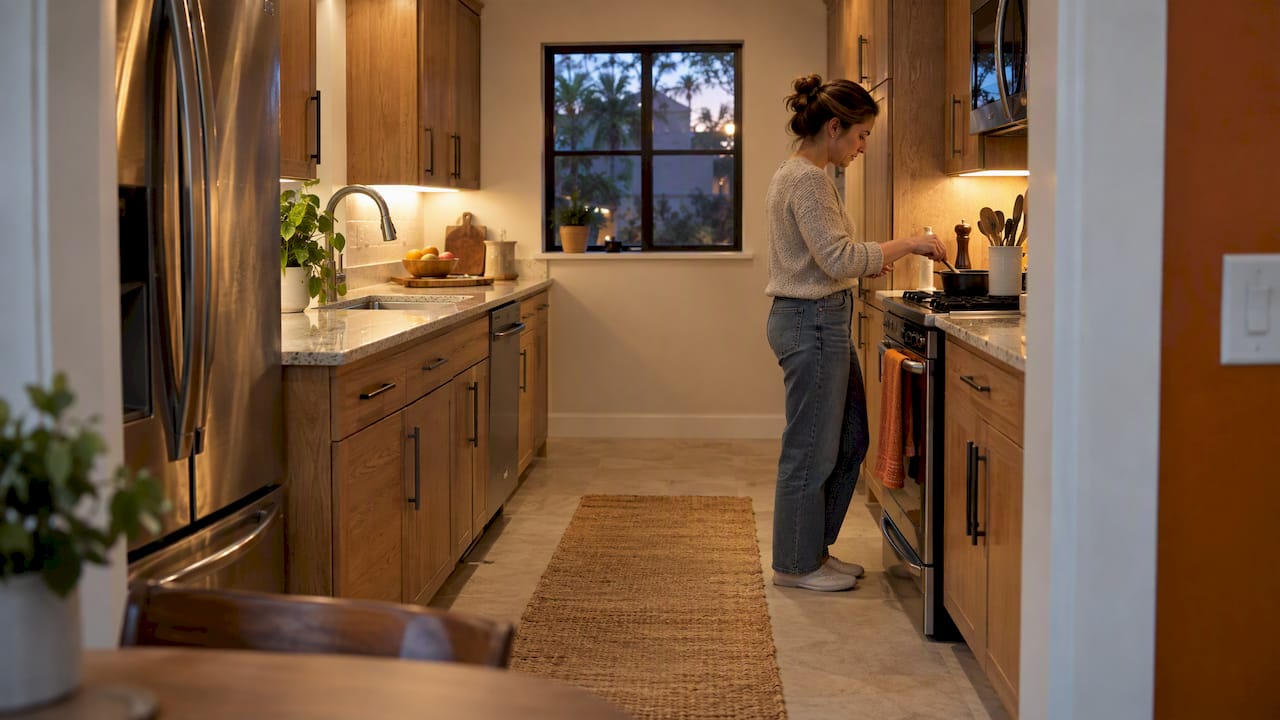
For most kitchens, 3000K is the safest all-round color temperature: warm enough to feel like home, clear enough to chop, read a recipe and wipe down a counter. Move up to 3500K or 4000K if your kitchen is white, gray or stainless and you cook a lot, and drop to 2700K only for accent lighting or a very traditional room. The bigger rule is consistency: lights that shine on the same surface should share one color temperature.
Below you will find what the Kelvin number means, how 3000K and 4000K really differ, how to set each layer of light, and how cabinets, countertops and daylight change the answer.
TL;DR
- 3000K is the default for most kitchens. Choose 3500K to 4000K for bright white, gray or stainless kitchens with lots of task cooking.
- Lower kelvin means warmer, more yellow light. Higher means cooler and bluer. Warm sits around 2700K to 3000K; cool white sits around 4000K to 5000K.
- Match lights that overlap. Under-cabinet and ceiling lights that hit the same countertop should share a color temperature.
- Dark or wood kitchens like warm light; white and stone kitchens can take crisper light. Always test with the real finishes.
- Plan lighting before cabinets and counters are ordered, so wiring, fixtures and finishes are chosen together.
Table of Contents
- What the Kelvin number actually tells you
- 3000K vs 4000K: the difference you will notice
- Warm white vs cool white: mood versus visibility
- Light the kitchen in layers, then pick a temperature for each
- Keep what overlaps matched
- How cabinets, counters and daylight change the answer
- Mistakes that make a good kitchen look wrong
- Our perspective: decide light, then finishes
- Planning a kitchen remodel in Tampa?
- Frequently asked questions
- Sources
What the Kelvin number actually tells you
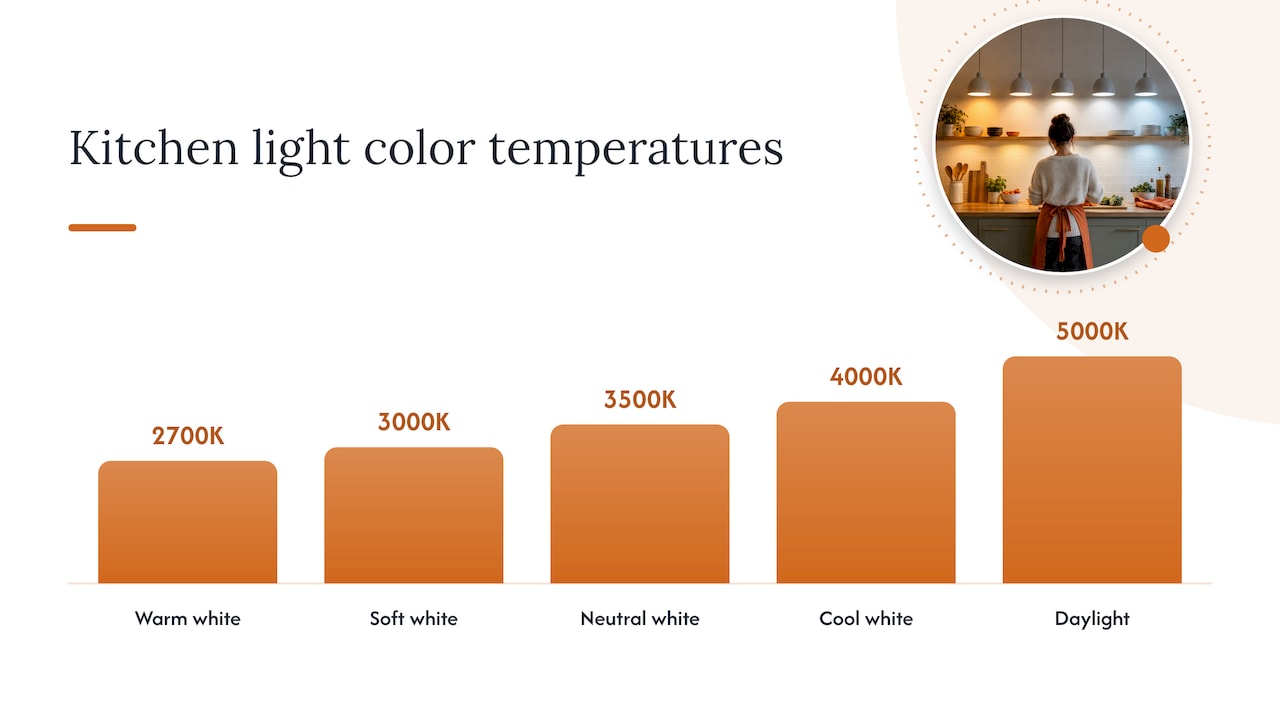
Color temperature describes how warm or cool a white light looks, and it is measured in kelvin (K). The lower the number, the warmer and more yellow the light. The higher the number, the cooler and bluer it appears, as this kitchen lighting guide explains.
The formal term on a package is correlated color temperature, or CCT. The U.S. Department of Energy describes CCT as a measure that relates a light source’s appearance to a theoretical black body heated to specific temperatures in kelvin. You do not need the physics. You need the shorthand.
The DOE’s buyer guidance gives a useful ladder for bulbs: 2,700K is warm and personal, 3,000K is soft and pleasing, 3,500K is neutral and inviting, and about 4,100K is cool, clean and efficient. Homes and restaurants sit at the warm end. Offices and classrooms sit at the cool end.
| Kelvin | Common name | How it looks in a kitchen |
|---|---|---|
| 2700K | Warm white | Candle-to-incandescent glow, very yellow on white cabinets |
| 3000K | Soft white | Warm but clean, flatters wood and cream |
| 3500K | Neutral white | Balanced, a good compromise for mixed finishes |
| 4000K | Cool white | Crisp and bright, makes white and gray look clean |
| 5000K | Daylight | Very blue-white, often feels clinical indoors |
A state energy agency makes the same distinction in plain terms: warm white is 2700K or 3000K, while cool white is 4000K or 5000K. Color temperature is not brightness. Brightness is measured in lumens, and mixing the two up is the most common shopping mistake.
3000K vs 4000K: the difference you will notice
This is the choice most homeowners face, and it is smaller than it sounds on paper and larger than it looks in a showroom.
3000K gives a warm white with a hint of yellow. Wood grain looks rich, cream cabinets look creamy, and a room open to the living area feels continuous. 4000K reads as neutral to cool white. White cabinets look crisp, quartz and marble look clean, and stainless steel looks bright rather than golden.
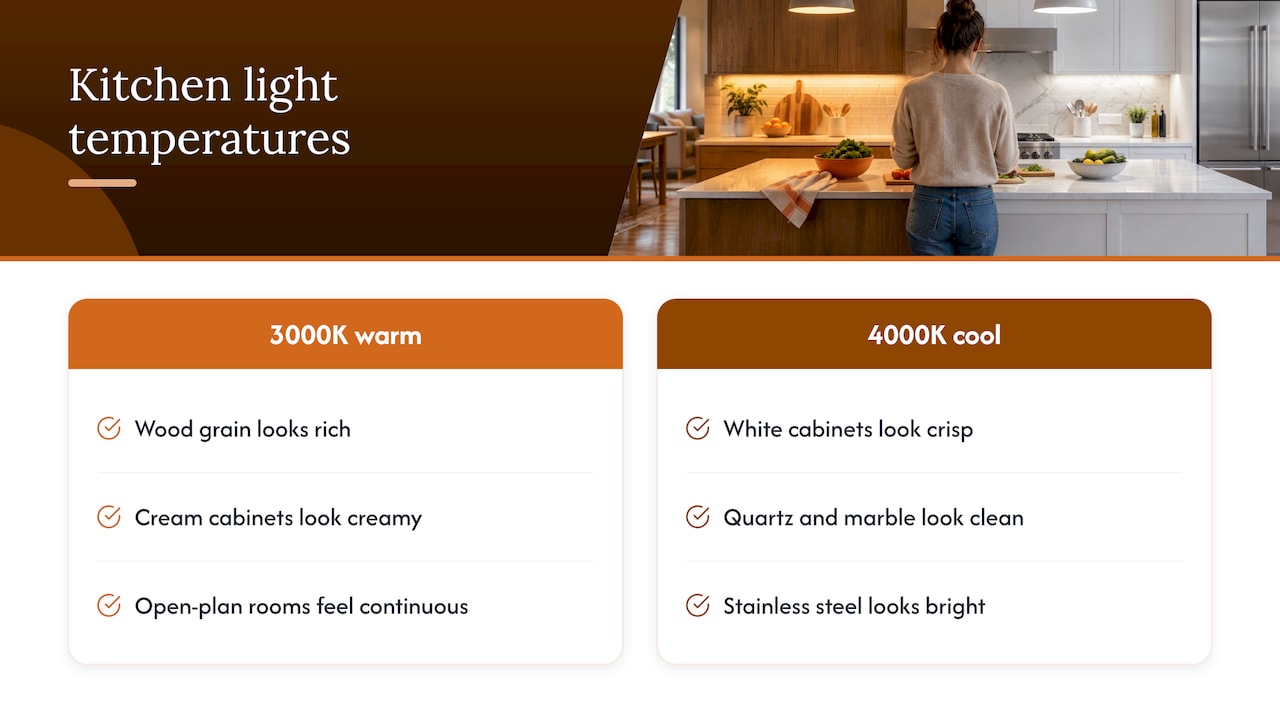
A lighting-company guide recommends 3000K for traditional or open-plan kitchens and 4000K for bright white, gray or stainless kitchens and task-heavy cooking. That matches what we see in the field: the finishes decide the answer more than the Kelvin chart does.
Opinions on the high end vary. One designer quoted in House Beautiful prefers 2700K to 3000K in residential cooking spaces and says anything above 3500K starts to feel commercial, and 4000K like a hospital break room. That is a taste judgment, not a rule, but it is a fair warning: 4000K works best when the room is designed for it, not when it is dropped into a warm kitchen.
If you want a second room-by-room comparison, this 3000K vs 4000K comparison also stresses color rendering and dimmer compatibility, two things worth checking on the box alongside the Kelvin number.
Quick decision rule
- Wood, cream, sage, navy, shaker style, or open to a living room: 3000K.
- White, gray or concrete-look finishes, modern lines, serious cooks: 3000K or 4000K, with 3500K as the middle path.
- Undecided and the kitchen has mixed finishes: 3000K to 3500K. It rarely looks wrong.
Warm white vs cool white: mood versus visibility
Warm light enhances earthy tones, wood cabinetry and stone countertops and makes a space feel welcoming. Cool light is bright and energizing, which suits task areas where you need to see clearly, according to Ideal Home’s panel of experts. The same piece warns that harsh bright-white lighting can strip the warmth from a kitchen that serves as the social hub of the house, and that a layered approach gives you flexibility.
There is also a body-clock angle. One lighting manufacturer notes that warmer tones support melatonin production and relaxation, while cooler tones suppress it and promote alertness. In practice, that is a reason to keep evening kitchen light warm or dimmable if your family hangs out there after dinner, and a reason a cooler task layer is fine for morning prep.
Light the kitchen in layers, then pick a temperature for each
Kelvin choice gets easier when you stop trying to find one number for the whole room. A kitchen has three jobs for light.
Ambient light sets the baseline: recessed cans, flush mounts, a ceiling fixture. Task light sits where you work: under-cabinet strips, pendants over the island, a light over the sink. Accent light adds depth: toe-kick lighting, glass-front cabinets, a lit shelf.
A lighting professional interviewed by Kitchen & Bath Business advises that task lighting should be two to three times brighter than ambient lighting and match its color temperature. Accent light can be used to highlight architectural features.
| Layer | Typical job | Suggested range |
|---|---|---|
| Ambient | General glow, walking through the room | 3000K (2700K to 3500K for open-plan) |
| Task | Chopping, reading recipes, cleaning | 3000K to 4000K, matched to ambient where they overlap |
| Accent | Toe-kicks, glass cabinets, shelves | 2700K to 3000K |
The task and accent ranges follow common guidance on kitchen lighting temperature, which puts precision chores at 3000K to 4000K and decorative lighting at 2700K to 3000K for a cozy glow. Treat these as starting points, not code.
Some designers go further and mix on purpose: 3000K for ambient glow and 4000K for high-clarity task zones. That can work, but it takes care, which brings us to the most important rule.
Keep what overlaps matched
If an under-cabinet light and a ceiling light both fall on the same countertop, they should be the same color temperature. Separate layers that you use at different times, such as a dim toe-kick light at night, can be warmer, as one kitchen lighting guide puts it.
The usual failure looks like this: 4000K strips under the cabinets, 2700K cans overhead, and a countertop that looks green-yellow in one spot and gray in the next. It is cheap to prevent and annoying to fix after the drywall is closed.
Here is how to keep a kitchen visually consistent:
- Buy every fixture from the same CCT family, and read the label rather than the “soft white” or “daylight” marketing name, which differs by brand.
- Use color-selectable fixtures where you are unsure. Selectable-CCT fixtures let you change the light color after installation, which takes the risk out of under-cabinet strips.
- Coordinate with adjacent rooms. In an open-plan home, the kitchen, dining and living lights are all seen together.
- Put everything on dimmers, and check that bulbs and drivers are dimmable and compatible with your dimmer.
- Test one sample at night and one by day on your actual countertop before buying the whole order.
Higher-end projects increasingly use tunable white to follow the sun through the day. One lighting specialist told Kitchen & Bath Business that clients want fluid color tuning that mimics the sun’s path. It is a real option, though most families are well served by a good 3000K plan on dimmers.
How cabinets, counters and daylight change the answer
Light color interacts with every surface it touches. Three variables matter most.
Cabinet and countertop finish
Wood, cream, sage green, navy and most shaker kitchens look best at 3000K, while bright white, gray and concrete-effect kitchens can take 3000K or 4000K, according to this guide. Under-cabinet specialists say much the same: 3000K for wood cabinets and earth tones, 4000K for white cabinets, marble or quartz and modern homes.
Those are manufacturer and retailer recommendations, so treat them as a sensible starting point. The only proof is your own samples under your own lights. If you are still choosing surfaces, our guide to choosing kitchen countertops pairs well with this step, because a polished quartz slab and a honed granite can look very different at 3000K.
Natural light
A north-facing or shaded kitchen will not become sunny by choosing 5000K bulbs. If daylight is limited, add lumens, not coolness; that is the advice in the same lighting guide. Florida homes often have the opposite problem: strong afternoon sun through big windows, then warm evening light. Dimmers and a 3000K base handle both ends of the day.
How you use the room
A kitchen where one person prepares complex meals needs strong, clear task light. A kitchen where the family does homework at the island and entertains needs warmth and control. If both describe you, layer: a bright, matched task layer on one circuit and a dimmable ambient layer on another. Our post on kitchen ideas for families who love to cook covers how the layout supports that.
Mistakes that make a good kitchen look wrong
- Choosing by bulb name. “Daylight” on one brand is 5000K, on another 6500K. Read the Kelvin figure.
- Mixing temperatures across overlapping lights. See the section above.
- Going too cool to feel “clean.” Clean comes from good fixtures and layout, not from a blue cast.
- Ignoring color quality. Look at the color rendering index (CRI) on the box. A high-CRI 3000K light shows food and finishes more faithfully than a cheap one.
- Skipping dimmers. A kitchen that is perfect for cooking at 6 p.m. can feel like an operating room at 10.
- Deciding lighting last. If cabinets and counters are ordered first, you may be stuck with recessed cans in the wrong spots and no place for under-cabinet drivers.
Our perspective: decide light, then finishes
We design and build kitchens and bathrooms under one roof, and the lighting conversation almost always starts too late. Homeowners bring us paint chips, tile samples and cabinet doors, and only afterward ask where the lights go. We think that order is backward.
Our view is simple. Pick the lighting plan alongside the layout, because the electrician, the cabinet installer and the countertop fabricator all need to know where the light lands. Start at 3000K for the whole kitchen, and move task zones to 3500K or 4000K only when the finishes ask for it. Keep anything that overlaps matched. Put it all on dimmers.
Because we handle design and construction together, with a dedicated Lead Carpenter on each project and up-front pricing, those decisions are made once, on paper, before anyone opens a wall. That is what keeps a lighting change from becoming a mid-project surprise. If you want to see how we think about layout, read our kitchen lighting plan and our piece on how lighting transforms a remodel.
— MediaBeast
Planning a kitchen remodel in Tampa?
If you are replacing cabinets, counters or the whole layout, lighting should be part of the plan from day one. We handle design, construction and finishes together, with a showroom for materials so you can see samples in real light.
For a sense of budget, our kitchen remodel cost page lists published ranges by kitchen type. For example, a small U-shaped kitchen with an island is listed at $41,200 to $52,050, and a large L-shaped kitchen with an island at $62,600 to $79,100. Final cost depends on scope and materials. When you are ready to talk, start at our kitchen remodeling page.
Frequently asked questions
What is the best color temperature for a kitchen?
For most kitchens, 3000K is the best all-round choice because it balances warmth and clarity. Consider 3500K to 4000K if the kitchen is bright white, gray or stainless and you do a lot of detailed prep. Whatever you choose, keep lights that shine on the same surface matched.
Is 3000K or 4000K better for kitchen lighting?
Choose 3000K for wood, cream, earth-tone and traditional kitchens, and for kitchens open to a living area. Choose 4000K for white, gray or modern kitchens and task-heavy cooking. If you cannot decide, 3500K or color-selectable fixtures are a low-risk middle path.
What color is 3000K light?
3000K is a soft, warm white with a slight yellow tone, similar to a traditional halogen bulb. The DOE’s bulb guidance calls it warm and pleasing and lists homes among its typical uses. It looks creamy next to white paint and rich next to wood.
Can I use different color temperatures in the same kitchen?
Yes, if the lights are separate layers used at different times, such as a warm toe-kick glow at night. Lights that overlap on the same countertop should match, or surfaces will look patchy. Selectable-CCT fixtures let you fine-tune after installation.
Does a cooler light make a kitchen look cleaner?
It can make white and gray surfaces look crisper, but too much blue can feel clinical and strip warmth from a room where people gather. Brightness and good layout do more for visibility than a higher Kelvin number. Add lumens and layers before you add coolness.
Sources
- LED Color Characteristics, U.S. Department of Energy
- Purchasing Energy-Efficient Light Bulbs, U.S. Department of Energy
- Household lighting, NSW Environment, Energy and Science
- Best colour temperature for kitchen lighting, LightGuru
- The Four Layer Formula for kitchen lighting, House Beautiful
- Should kitchen lighting be warm or cool? Ideal Home
- Overview of light color and ideal areas of application, Shelly USA
- A Lighting Pro on Lighting a Kitchen, Kitchen & Bath Business
- How to Choose Kitchen Lighting Temperature, The Decor Mag
- What is the Best Color Temperature for a Kitchen? Guocio
- How to Choose Under-Cabinet Lighting, Bees Lighting