
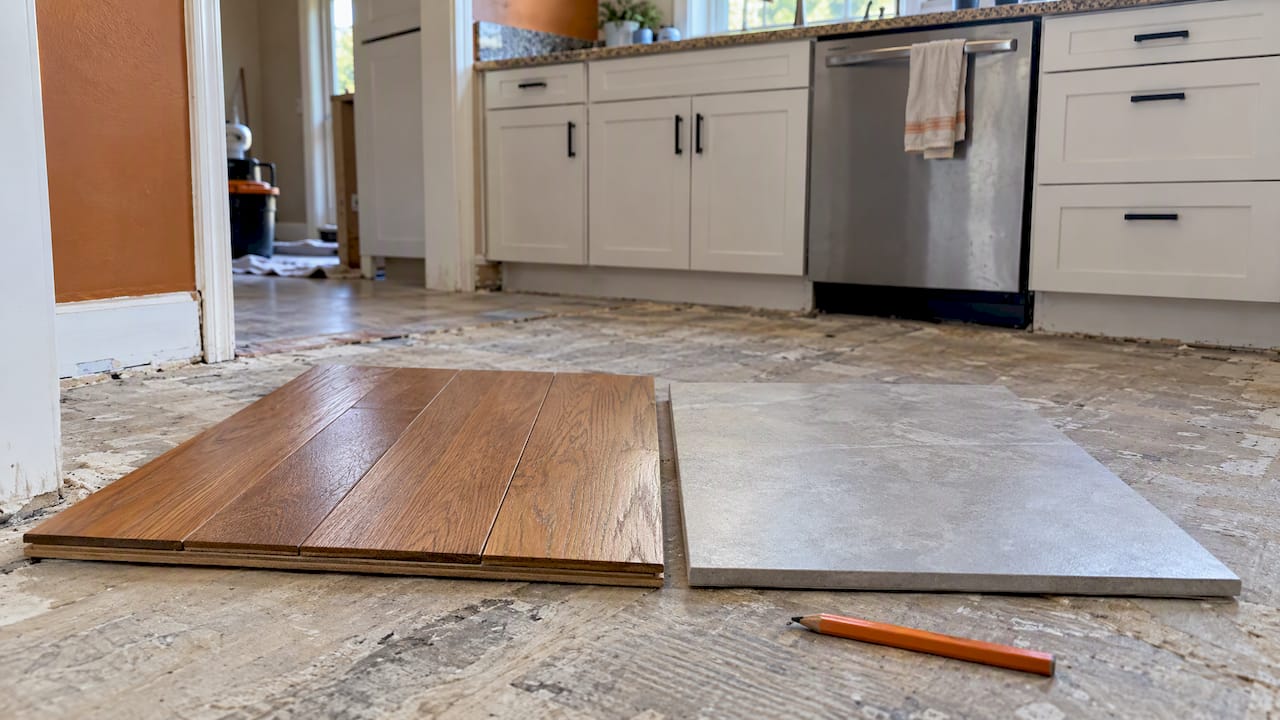
Tile wins on toughness and water. Hardwood wins on warmth, comfort and a seamless look with the rest of the house. If your kitchen sees heavy spills, pets, kids and humidity, porcelain tile is the safer floor. If you stand and cook a lot, the kitchen opens onto wood floors, and you will wipe up spills promptly, hardwood is a good fit. The rest of this guide shows how each floor behaves in a working kitchen so you can decide before you sign anything.
TL;DR
- Choose porcelain tile for the most scratch, stain and moisture resistance. Choose hardwood for a warmer, more forgiving surface underfoot.
- Wood is far from waterproof, so it asks for quick spill cleanup. Tile is not bothered by water, but you should check its slip rating.
- Tile is the easier floor to keep clean. Wood can be sanded and refinished, which tile cannot match.
- Installed cost depends on subfloor condition, layout and labor, not just the price per square foot. Get the full scope priced before you choose.
- Open-plan homes with wood next door usually look best with wood. Closed, hard-working kitchens usually look best with tile.
Table of Contents
- The quick way to decide
- Comfort underfoot
- Water, spills and moisture
- Scratches, dents and everyday wear
- Cleaning, upkeep and repair
- What each floor costs
- Looks and flow with the rest of the house
- Resale and long-term value
- Side by side
- Our perspective on kitchen floors
- Planning flooring as part of a kitchen remodel
- Get a kitchen floor priced as part of the whole plan
- A checklist before you choose
- FAQ
- Sources
The quick way to decide
Before comparing details, answer four questions about your own house.
- Does the kitchen open onto wood floors? If so, continuing the wood keeps the sightlines clean. Tile creates a visible break where the materials meet.
- How wet does this kitchen get? Dishwasher leaks, a dog’s water bowl, toddlers with sippy cups and a humid climate all favor tile.
- How long are you on your feet? Serious cooks who stand at the counter for an hour or more tend to prefer wood.
- How long will you stay? Both floors can last decades, but they age differently, as the sections below show.
If you answered “yes” to the first and fourth and “no” to the second, lean toward wood. If the reverse, lean toward tile.
Comfort underfoot
This is where hardwood earns its reputation. Fine Homebuilding describes wood as a warmer, more forgiving surface for people standing at the counter, and gentler on dropped dishes than tile. A glass that would shatter on porcelain has a better chance of surviving a landing on wood.
Tile is the same hard surface whether you are in July or January. Rugs, anti-fatigue mats and a good pair of shoes take the edge off, and many households live happily with tile for exactly that reason. If you have knee or back trouble and cook daily, though, give comfort real weight in the decision.
Water, spills and moisture
A kitchen floor lives next to a sink, a dishwasher and often a refrigerator with an ice maker. Here the two materials differ most.
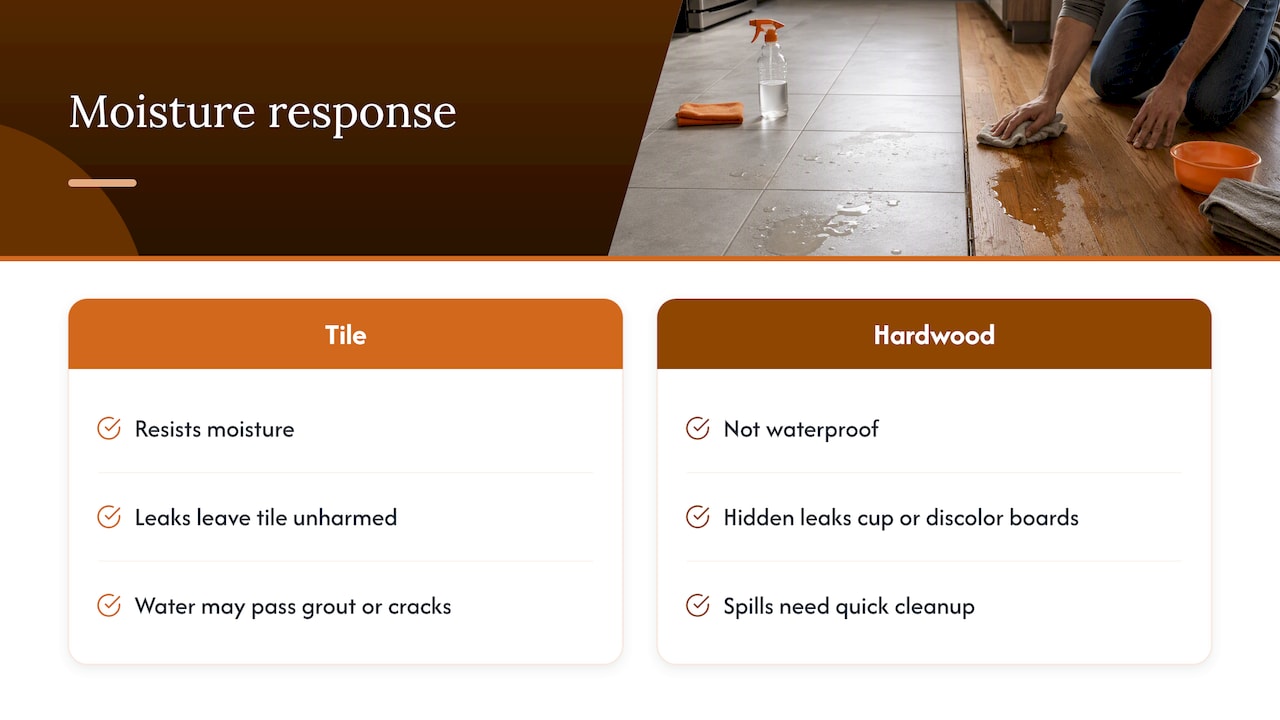
Tile. Ceramic and porcelain resist moisture, stains, scratches and dents, according to Consumer Reports. Porcelain is fired hotter than ceramic, which makes it the more durable and weather-resistant of the two. A leak that would ruin a wood floor leaves tile unharmed, though water can still reach the subfloor through grout lines or beneath cracked tiles.
Hardwood. Wood can work in a kitchen, but Fine Homebuilding is clear that it is far from waterproof. Spills need to come up quickly, and the finish needs to stay in good condition. A slow, hidden leak under the dishwasher is the real danger, since you may not notice it until boards cup or discolor.
If you like the look of wood but worry about moisture, ask your contractor about engineered wood, which is built in layers and is generally more dimensionally stable than solid planks. Ask about the specific product’s moisture guidance rather than assuming any engineered floor is water-safe.
Check the slip rating on tile
Not every tile is equally suited to a wet room. HGTV advises checking a tile’s water absorption and its wet-slip performance rather than assuming it will do. A glossy, polished tile can be slick when wet. A textured or matte finish gives more grip, which matters with kids, older relatives or a wet dog.
Scratches, dents and everyday wear
In Consumer Reports’ flooring tests, porcelain tile was the top kitchen choice for scratch resistance, while wood floors were generally much more prone to denting. In practice that means:
- Dropped pots, chair legs and pet nails leave marks on wood far sooner than on porcelain.
- Harder species hold up better. Designer Becky Shea, quoted by Homes & Gardens, recommends harder woods such as white oak or walnut for kitchens.
- Tile’s weak spot is impact. A heavy cast-iron pan dropped on one tile can chip or crack it, and a replacement may be hard to match years later. Keep a few spare tiles from your original order.
Wood’s wear is not always a flaw. Many homeowners like the patina that a lived-in wood floor develops. If you want a floor that looks new for as long as possible, tile is the better bet. If you want a floor that ages with character, wood delivers.
Cleaning, upkeep and repair
Tile
Tile is low-maintenance. Consumer Reports notes that vacuuming and mopping are enough to keep it clean. The one chore people forget is grout. Cement-based grout is porous and can stain around the stove and sink, so ask about sealing it or choosing a stain-resistant grout.
Hardwood
Wood asks for a little more care. The Spruce describes the routine as sweeping and periodic wiping with a barely damp mop or a hardwood cleaner, and it warns that harsh cleaners can damage the finish. Steam mops and soaking-wet mops are out.
The payoff is repairability. Fine Homebuilding points out that hardwood can be sanded and refinished to restore its beauty. A cracked tile has to be chiseled out and replaced, while a tired wood floor can be renewed in place, and that is a real advantage over a 20- or 30-year span.
What each floor costs
Tile is not automatically the cheaper choice, and the material price alone is misleading. Consumer Reports’ 2025 flooring buying guide lists tested-product costs of $6 to $15 per square foot for ceramic and porcelain tile and $5 to $11 per square foot for solid wood. Those are product figures, not installed prices, and the ranges overlap heavily.
The same guide notes that tile can cost more to install because it takes more time and expertise. Several things move your total:
- Subfloor condition. Tile needs a smooth, flat, rigid and clean base, and depending on what you have, HGTV notes that cement tile backer board may be required. That is added labor and material before the first tile goes down.
- Tile size and pattern. Large-format tile demands a flatter subfloor. Patterns and mosaics take longer to set.
- Layout. Cuts around an island, cabinets and appliances add labor on either floor.
- Demolition. Removing old flooring, especially glued or thinset-bonded material, adds cost.
- Wood species and finish. Site-finished solid planks, prefinished planks and engineered boards sit at very different price points.
The practical takeaway: get a written quote for the whole floor, including prep and removal, rather than comparing two price-per-foot figures.
Looks and flow with the rest of the house
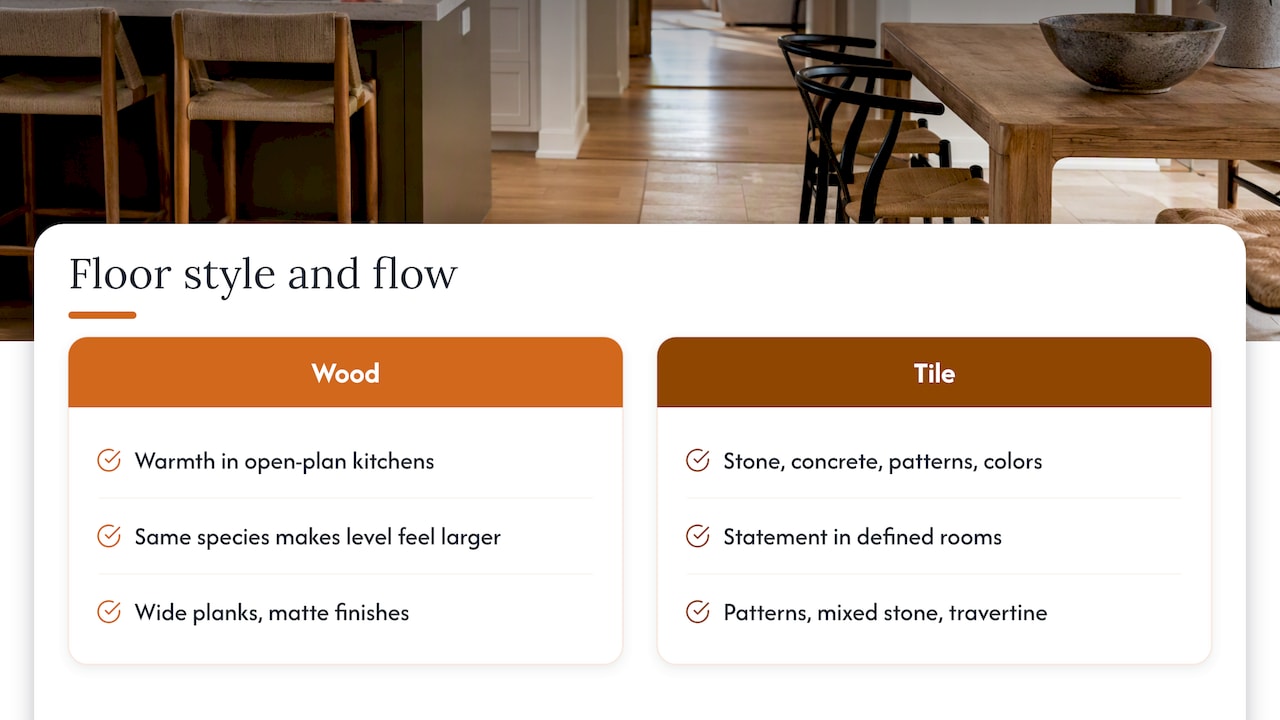
A floor is the largest surface in the room, so it sets the tone. Fine Homebuilding notes that wood brings warmth and continuity to open-plan kitchens. If your living and dining areas already have wood, running the same species through the kitchen makes the whole level feel larger.
Tile gives you more design range: stone looks, concrete looks, patterns, colors, and large-format porcelain with very few grout lines. Shea told Homes & Gardens that large-format porcelain is durable and low-maintenance for busy kitchens. If the kitchen is a defined room with its own character, tile lets you make a statement without worrying about matching anything.
If you are planning around trends, House Beautiful’s 2026 kitchen trend roundup points to wide-plank wood with softer matte finishes, patterned and mixed-stone floors, and travertine. Trends fade, so treat them as a tiebreaker and not a reason to pick a material that does not suit your household.
Resale and long-term value
Fine Homebuilding notes that kitchen and bath floors have a major impact on resale, so a floor that looks tired or failed (cupped boards, cracked tile, stained grout) costs you at showing time. The right answer for resale is usually the one that suits the house: wood in a kitchen that flows into wood rooms, durable tile in a kitchen that works hard. A floor that fits the home and is in good condition beats a more expensive floor that clashes. For more on what moves value in a kitchen project, see our guide to home remodeling values for kitchen upgrades.
Side by side
| Factor | Hardwood | Porcelain or ceramic tile |
|---|---|---|
| Comfort when standing | Warmer and more forgiving | Hard and cool |
| Dropped dishes | More forgiving | Less forgiving |
| Water resistance | Far from waterproof, spills need fast cleanup | Resists moisture, check slip rating |
| Scratches and dents | Dents more easily | Top scratch resistance in Consumer Reports tests |
| Routine cleaning | Sweep, barely damp mop | Vacuum and mop, keep grout clean |
| Repair | Can be sanded and refinished | Damaged tiles are replaced |
| Installation | Depends on product and subfloor | Needs flat, rigid subfloor, may need backer board |
| Best for | Open plans, cooks who stand long | Busy, wet, high-traffic kitchens |
Our perspective on kitchen floors
We design and build kitchens in-house, so we see how floors perform after the dust settles, not just how they look on a sample board. Our view is simple: the floor should be chosen last-minute never. It affects the cabinet layout, the island, the transitions to the next room and the subfloor work, so it belongs in the plan from the first design conversation.
When homeowners ask us to settle wood versus tile, we ask about daily life before style. Who cooks? Are there pets? Does the dishwasher sit on an older subfloor? Will the floor continue into another room? In a humid climate like Tampa’s, we usually steer busy families toward porcelain with a textured finish, and we are glad to talk about wood where the layout and the household suit it. The mistake we see most is a choice made from a showroom sample without thinking about the subfloor, because the prep work is where a floor’s cost and lifespan are decided.
That is also why our Lead Carpenter stays with a project from start to finish, and why our Work Clean System keeps dust contained during demolition and installation. Flooring is one of the dustiest, most disruptive stages of a remodel, and a clean process is part of the result.
— MediaBeast
Planning flooring as part of a kitchen remodel
If you are replacing the floor alone, the choice is mostly about the factors above. If you are remodeling the whole kitchen, flooring interacts with cabinets, countertops and appliances, and the sequence matters. We walk through the options in our pages on the most durable flooring for kitchens, natural flooring choices and creative kitchen flooring. Your countertop choice should be made alongside the floor too, so the two work together: our guide to choosing a kitchen countertop is a good next read.
Get a kitchen floor priced as part of the whole plan
Bath & Kitchen Gallery handles design and construction together, with up-front pricing and an itemized list, so the floor, the prep and the rest of the room are priced in one place. You can see our published kitchen project ranges on our kitchen remodel costs page: for example, a small U-shaped kitchen with an island is listed at $41,200 to $52,050, and a large kitchen with an island at $74,100 to $93,600. A local showroom lets you handle the materials in person before you commit.
If you are comparing floors for a Tampa-area kitchen, start with our kitchen remodeling page and tell us how your household uses the room. We will help you weigh wood against tile for your layout.
A checklist before you choose
- Sketch where the new floor meets the next room and decide whether you want a transition or a continuous run.
- Ask for the subfloor to be inspected before demolition ends, not after.
- If choosing tile, confirm the absorption and wet-slip specifications, and choose a grout you are willing to maintain.
- If choosing wood, pick a hard species and ask the installer how the finish handles water at the sink and dishwasher.
- Order extra material (wood or tile) for future repairs.
- Get one written quote that includes removal, prep, materials, installation and cleanup.
FAQ
Is tile flooring cheaper than hardwood?
Not necessarily. Consumer Reports lists tested product costs of $6 to $15 per square foot for ceramic and porcelain tile and $5 to $11 for solid wood, so the ranges overlap. Tile can cost more to install because it takes more time and expertise, and it may need subfloor prep. Compare full installed quotes rather than material prices.
Are hardwood floors good for kitchens?
They can be, with care. Wood is warm and comfortable and forgiving to dropped dishes, but it is not waterproof, so spills need to be wiped up quickly. Harder species such as white oak or walnut are the usual recommendation, and a worn floor can be sanded and refinished.
Which is better for a busy family kitchen?
Porcelain tile is usually the stronger choice. It resists moisture, stains and scratches, and it needs only vacuuming and mopping. Pick a textured finish for better wet grip, and add a mat where you stand most.
What are the trendy kitchen flooring options for 2026?
House Beautiful’s roundup points to wide-plank wood with softer matte finishes, patterned and mixed-stone floors, and travertine. Choose a trend only if it also suits how you cook, clean and live.
Sources
- Durable Flooring for Kitchens (and Baths), Fine Homebuilding
- How to Select the Best Flooring for Every Room in Your Home, Consumer Reports
- Flooring Buying Guide, Consumer Reports
- Hardwood Flooring in Kitchens Review: Pros & Cons, The Spruce
- Kitchen Tile Flooring Options, HGTV
- Should you choose wooden or tile kitchen flooring? Homes & Gardens
- 12 Top Kitchen Trends Designers Anticipate for 2026, House Beautiful