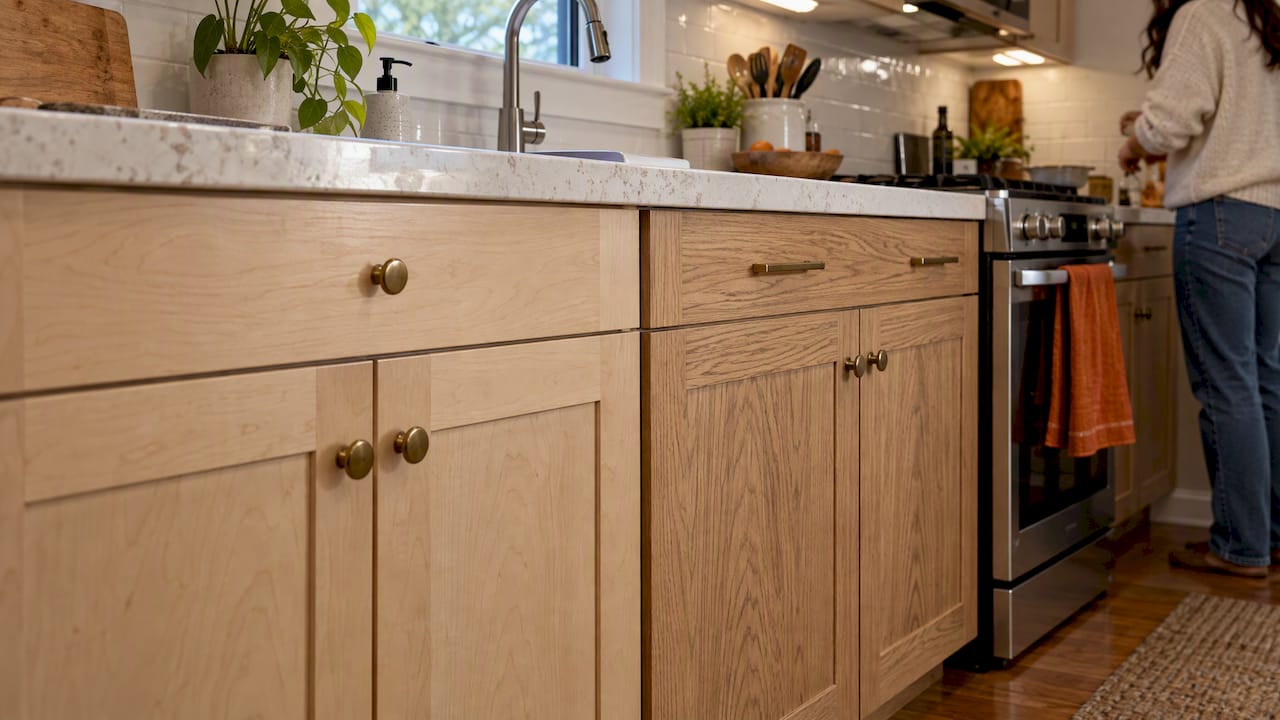

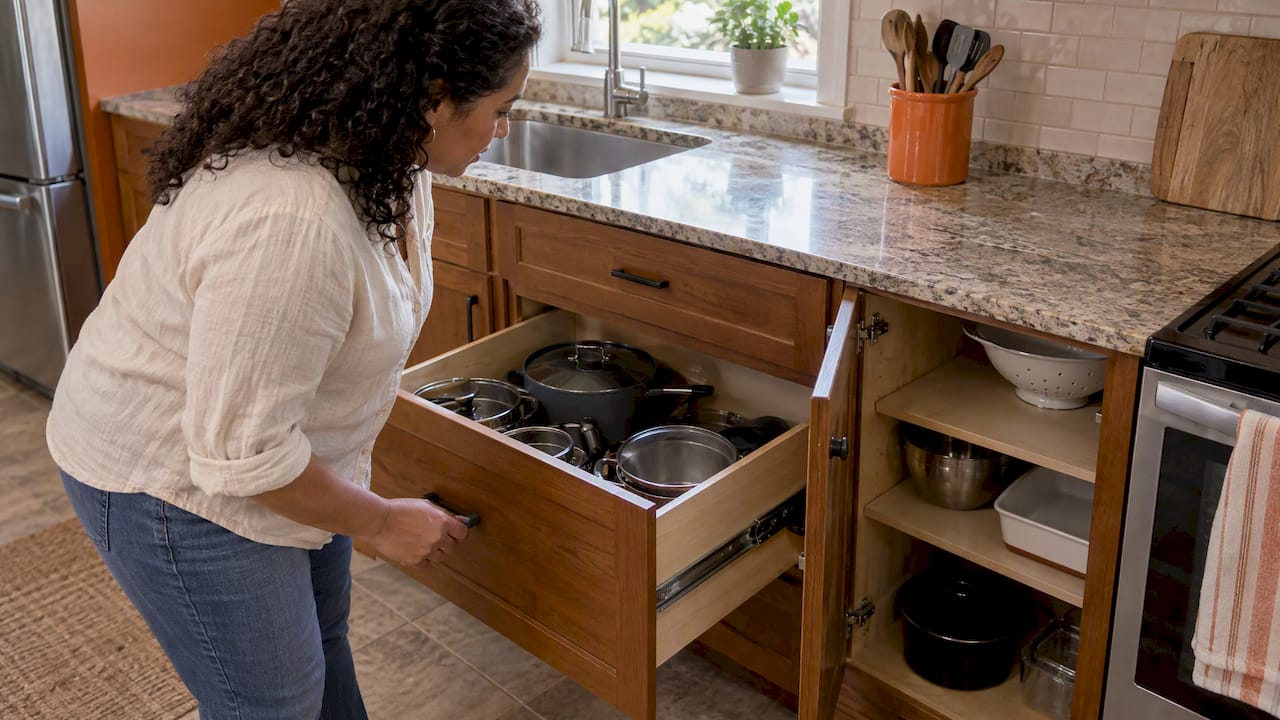
For base (lower) storage, drawers usually win. They pull the whole contents toward you, so you don’t kneel and dig. Door cabinets still earn their place for tall, bulky or oddly shaped items, and for budgets that can’t stretch to a bank of drawers. Most well-planned kitchens use both, placed by what you store and where you use it.
This guide shows where each option works best, what the trade-offs are in cost, weight and retrofitting, and how to decide zone by zone before you sign a remodeling contract.
TL;DR
- Drawers beat door cabinets for base storage you use daily: pots, pans, utensils, dishes and lids.
- Door cabinets (with adjustable shelves or pull-outs) suit tall, bulky or irregular items, and they usually cost less.
- Drawers generally cost more than basic cabinets, may carry less weight, and swapping existing base cabinets for drawers can require structural changes.
- Plan by zone: drawers near prep and cooking, pull-outs or shelves in the pantry area, cleaning supplies near the sink.
- Decide this at design stage. It is far cheaper than fixing a layout after the cabinets are installed.
Table of Contents
- What you are actually comparing
- Where drawers win
- Where door cabinets still win
- Pull-out shelves: the middle path
- Drawers vs. shelves, item by item
- Plan by zone, not by cabinet
- Accessibility and aging in place
- Retrofitting: what changes when you swap
- The downsides of drawers
- Small kitchens
- Our perspective
- Planning your kitchen with drawers in mind
- A simple checklist before you decide
- FAQ
- Sources
What you are actually comparing
The phrase “drawers vs. cabinets” blurs three different things:
- Drawers: a box on slides that opens fully, with a drawer front you see from outside.
- Door-front cabinets with fixed or adjustable shelves: you open a door, then look and reach into a deep space.
- Door-front cabinets with pull-out shelves: a hybrid. The door opens, and the shelf slides out on runners so you reach items from the front.
The real question is rarely “which is better overall?” It is “what goes where?” A pot drawer and a tray cabinet are both right, in different spots.
Where drawers win
Access. A drawer pulls out completely, so what’s inside comes into view and you don’t have to reach into a deep cabinet, according to Martha Stewart’s comparison. That alone changes daily cooking: no crouching, no moving the front row to find the back one.
Usable space. The same source notes that drawers can offer more usable storage than a cabinet because there is no vertical divider breaking up the space. Removable or repositionable organizers then let you arrange the contents the way you cook.
Heavy, frequently used items. Deep drawers are convenient for dishes, pots, pans, lids and skillets, and the National Kitchen & Bath Association (NKBA) describes them that way in its accessible-design guidance. Designers quoted by Bob Vila make a similar point: deep drawers are efficient for bulky and frequently used items because you can see and reach everything without digging.
Reach range. The NKBA says pull-out drawers and shelves bring stored items into more accessible reach, and recommends placing roughly half of storage between 18 and 48 inches from the floor for people who reach from a seated position. That range is also comfortable for anyone with a bad back or knees, or anyone who simply doesn’t want to bend to the floor ten times a day.
Where door cabinets still win
Tall and irregular items. Stand mixers, tall pitchers, stockpots with tall handles, and cookie sheets stored on edge don’t always fit into drawer tiers. A door cabinet with an adjustable shelf or a vertical divider handles them without wasted space. The FIRA Kitchen Layout Design Guide, a UK industry publication, suggests reserving door-front cabinets or adjustable shelves for tall, irregular or bulky items that do not fit well into fixed drawer tiers.
Cost. Drawers generally cost more than basic cabinets, a point both the Martha Stewart and Bob Vila pieces make. A drawer needs a box, slides and a front. A shelf behind a door needs far less hardware. An older Oregon State University cabinet bulletin makes the same point about construction: shelves are more economical to build, and a drawer should be planned for a specific purpose where it has clear advantages.
Weight. Drawers may not support as much weight as a cabinet shelf. A drawer loaded with cast iron and stoneware is a lot to ask of slides, so check the load rating of the hardware before you commit your heaviest cookware to it.
Contents that shift. The same Oregon State bulletin says drawers suit materials that do not shift when the drawer moves. Tall bottles and loose containers slide around every time you open and close a drawer. Behind a door, they stay put.
Pull-out shelves: the middle path
If you like the look or price of door cabinets but hate reaching into the back, pull-out shelves solve most of the problem. FIRA’s guide says cupboards work better with pull-outs than with fixed shelves because items are easier to reach. Using design information it cites, it reports that wider pull-outs can create about 15% more storage, deeper ones up to 30% more, and higher-sided drawers up to 55% more.
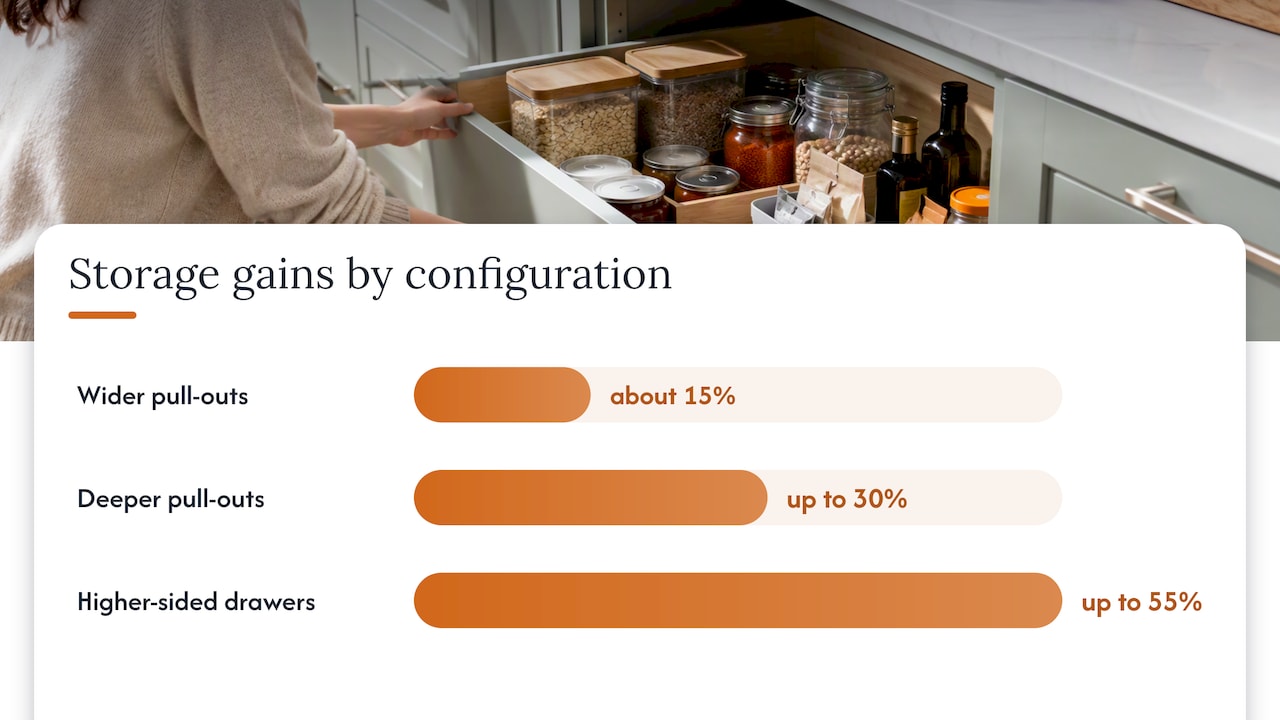
Treat those as the guide’s cited figures, not a promise for your kitchen. Your actual gain depends on the cabinet width, the slide hardware and what you store. But the direction is clear: sliding storage uses the cabinet’s depth better than a fixed shelf.
NKBA’s guidance also describes pull-out units for spices and adjustable shelves inside a pull-out cabinet, which suits a narrow cabinet beside the range or a pantry unit.
Drawers vs. shelves, item by item
This table pulls together the guidance above into a quick decision aid.
| What you store | Best fit | Why |
|---|---|---|
| Pots, pans, lids, skillets | Deep base drawer | Everything visible from above, no digging |
| Plates and bowls | Deep drawer or cabinet with shelf | Drawer is easier to reach; shelf is cheaper |
| Utensils, cutlery, small tools | Shallow drawer with organizer | Frequently used, small, needs sorting |
| Spices | Pull-out unit or shallow drawer | Everything in view, close to cooking |
| Cans and packaged food | Pull-out shelves or pantry shelves | Adjustable heights, nothing lost at the back |
| Tall bottles, big appliances | Door cabinet, adjustable shelf | Height flexibility; contents don’t shift |
| Cleaning supplies | Door cabinet near sink | Tall bottles, kept near where they are used |
| Baking sheets, trays | Vertical-divider cabinet | Stored on edge, doesn’t need a drawer tier |
Plan by zone, not by cabinet
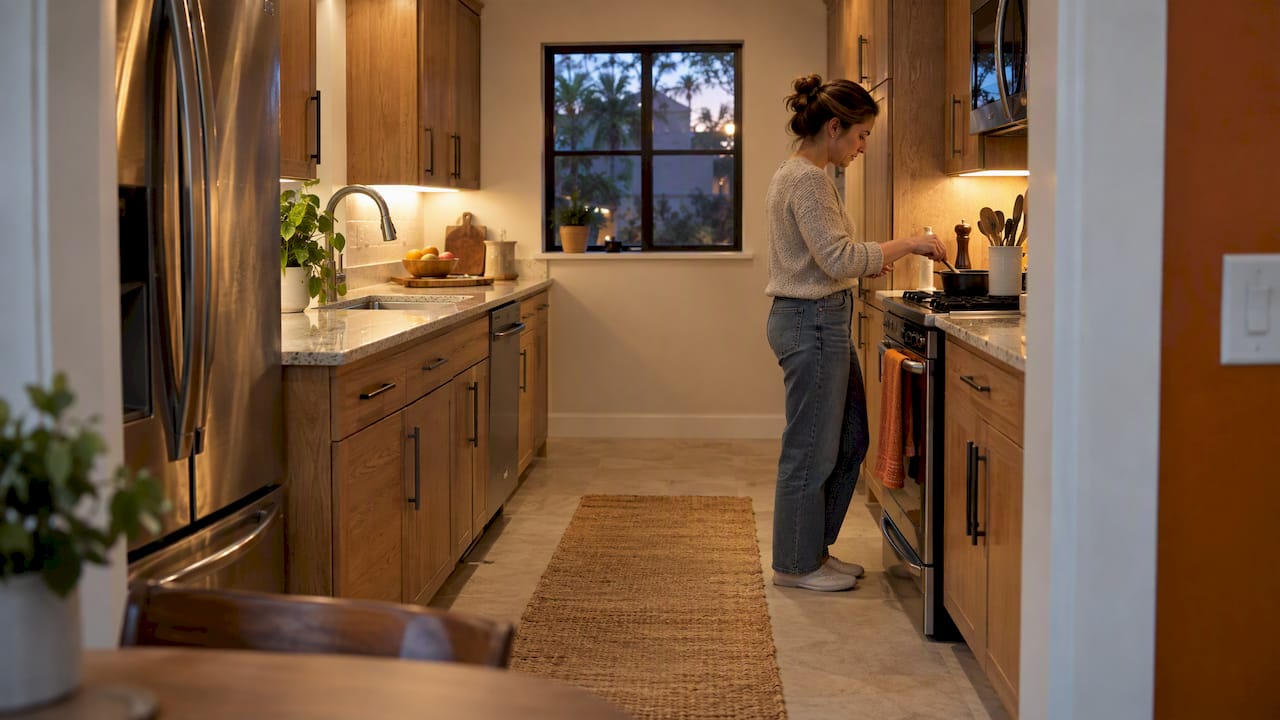
The most useful idea from the professional guidance is to organize storage by activity. FIRA’s guide breaks storage into consumables, non-consumables, cleaning, preparation and cooking zones. Food sits near the refrigerator, tableware near the sink or dishwasher, preparation tools near the worktop, and pots and pans near the hob and oven.
Turn that into a drawer-or-door decision:
- Cooking zone (beside the range or cooktop): drawers for pots, pans, lids and cooking utensils. This is where the extra cost per drawer pays off most, because you open them several times every meal.
- Prep zone (between sink and range): shallow drawers for knives, peelers and measuring tools, and a deep drawer for mixing bowls.
- Food storage zone (near the fridge): pull-out shelves or a pantry cabinet for cans, boxes and tall containers.
- Cleaning zone (sink and dishwasher): door cabinets for tall bottles and sponges, plus a drawer for dish towels if you like them close.
- Dishware zone (near the dishwasher): a deep drawer or a cabinet with shelves. A drawer makes unloading easier on the back; a cabinet saves money.
The same logic applies to the layout itself. Where appliances and work surfaces sit determines which storage you use most, which is why kitchen layout and workflow planning should come before you pick cabinet types.
If the sequence in your kitchen keeps breaking down even with plenty of cabinets, our own guide on why full cabinets still fail walks through the most common causes.
Accessibility and aging in place
If anyone in your home uses a wheelchair, has limited mobility or wants to stay in the house for decades, drawers become more than a convenience. NKBA advises planning storage between 18 and 48 inches from the floor and notes that large, deep base-cabinet drawers make dishes, pots and pans convenient for a wheelchair user to reach. Upper cabinets above that range, and the dark back corners of deep base cabinets, are the first things to rethink.
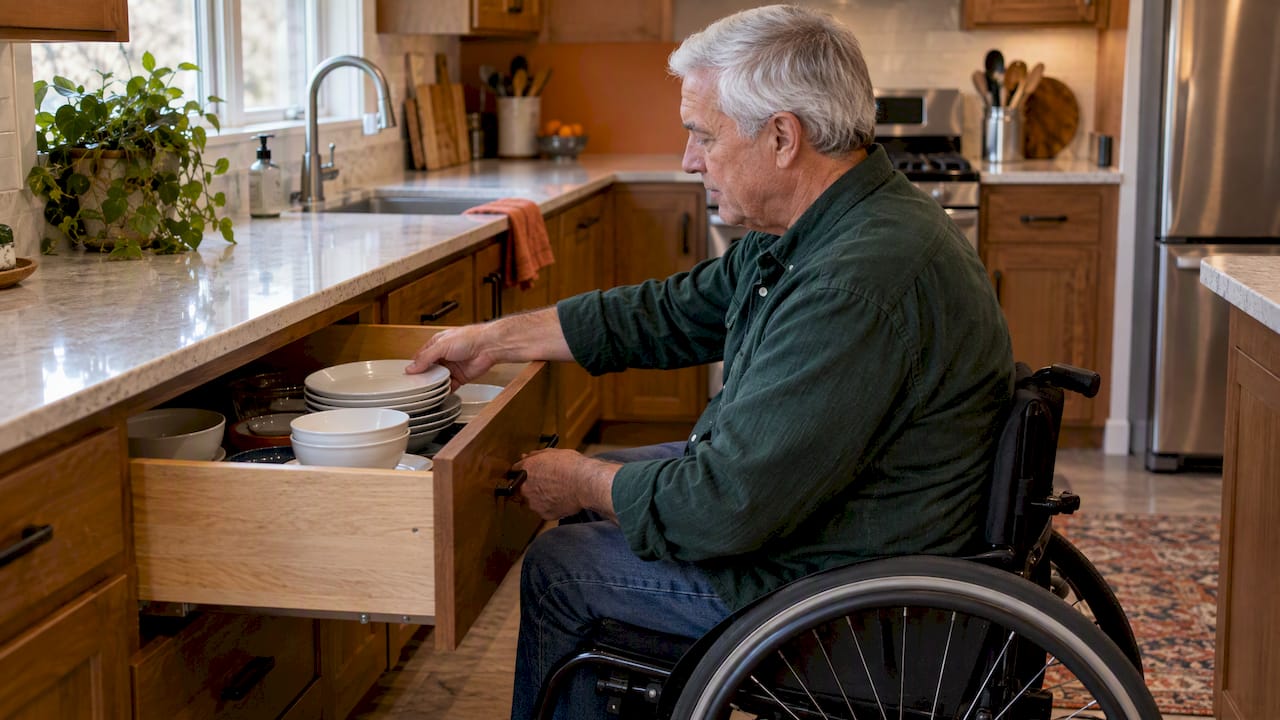
Seated reach affects more than cabinets: counter heights, knee clearance and appliance placement all matter. Planning a kitchen remodel around accessible storage from the start is easier than adapting it later.
Retrofitting: what changes when you swap
This is where many homeowners are surprised. Replacing lower door cabinets with drawers may require structural changes, according to Martha Stewart’s comparison. A drawer base cabinet is built differently from a door base: it has no center stile or shelf, and it needs a frame designed to carry the slides.
That is why the cheapest path to better access is often one of these:
- Add pull-out shelves inside an existing door cabinet, if the box and opening are sound.
- Replace only the cabinets that matter most, typically the ones beside the range and the main prep area.
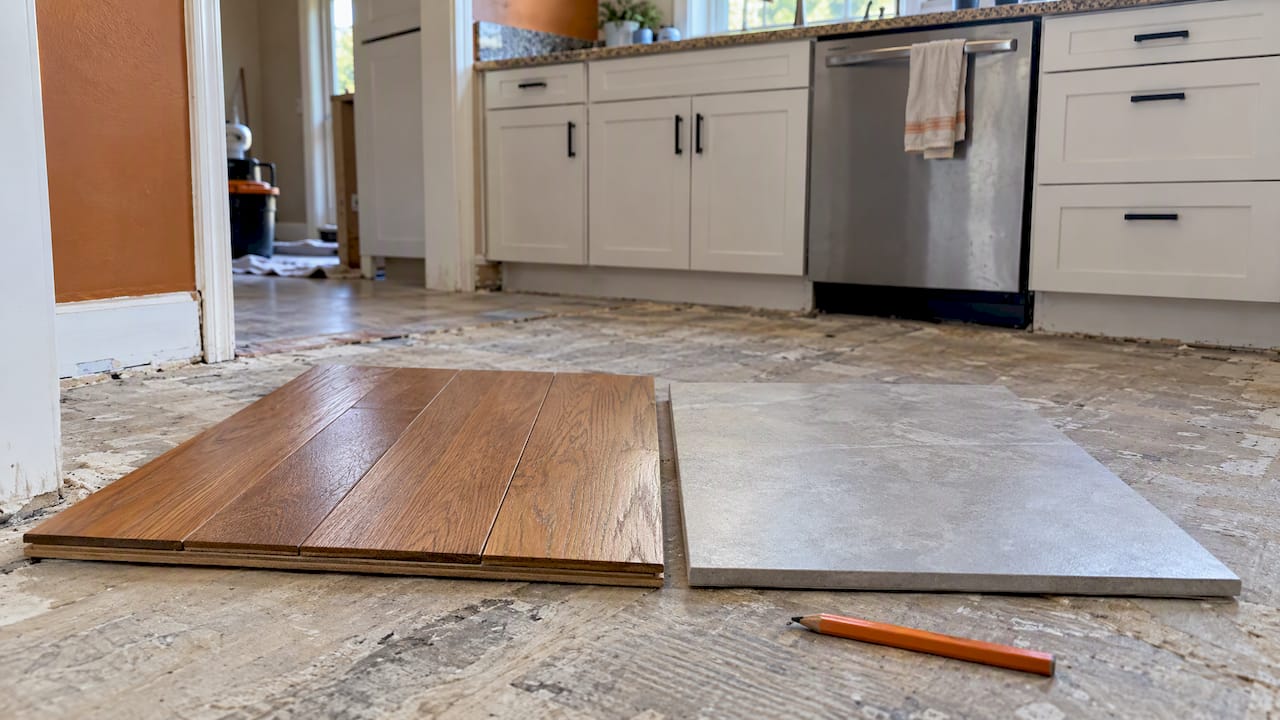
- Reface or replace in one project, so the layout, plumbing, electrical and countertop work happen once. Our page on the alternative to replacing old kitchen cabinets explains options between full replacement and keeping what you have.
If you are already opening up the kitchen, switching to drawers costs far less than doing it as a standalone job later, because the cabinet boxes are being built or ordered anyway.
The downsides of drawers
Honest planning means knowing what can go wrong:
- Overfilled drawers get messy. Bob Vila’s designers warn that drawers can become cluttered if you stuff them. Organizers fix this, but they add cost.
- Cost adds up. A bank of three or four drawer bases costs more than the same width of door cabinets. You can control this by using drawers where you use them most and doors elsewhere.
- Weight limits. Heavy items need heavy-duty slides. Ask what the rated load is, and don’t guess.
- Corners. Drawers don’t solve the blind corner. That is still a job for a corner cabinet with a pull-out system or a lazy-Susan style unit.
- Narrow cabinets. A drawer in a 12-inch base is usually too small to be useful. A pull-out or a door with a rack often works better.
Small kitchens
Space is tight, so every inch matters. In a small kitchen, drawers are usually the better choice for the base run, because depth you can’t see into is wasted. Keep door cabinets for tall items, and consider whether upper cabinets or open shelves serve you better. We compare the options in open shelving vs. cabinets and smart storage solutions for small bathrooms and kitchens.
The same applies to bathrooms. A vanity with a top drawer for small items and a door cabinet below for tall bottles often beats an all-door vanity.
Our perspective
We design and build kitchens and bathrooms under one roof, so we see what happens when storage is chosen late. The usual story: a family picks cabinet finishes first, then discovers during installation that the pots live in a cabinet they must kneel to reach.
Our view is simple. Decide storage before style. Walk through how you cook, list what you reach for most, and put drawers there. Then use door cabinets and pull-outs for the rest, where they cost less and fit odd shapes better. Because design and construction are handled together, with one dedicated Lead Carpenter on the project and up-front pricing with detailed item lists, those choices show up as line items you can see before work starts, not surprises afterward.
If you’re weighing a drawer-heavy layout against a traditional one, ask your contractor to price both. The difference is often smaller than people fear, and it is easier to cut a drawer or two on paper than to wish you had added them after the countertop is set. Our overview of custom kitchen cabinets explains how custom sizing can fit drawers to the things you own.
— MediaBeast
Planning your kitchen with drawers in mind
If you’re in the Tampa area and ready to plan, we handle both design and construction for kitchen remodels, from layout and cabinetry through countertops and installation, with a Work Clean System that keeps dust and disruption down while you live in the house. Our published ranges for kitchen projects include a Small U-Shaped Kitchen at $48,500-$60,200 and a Large L-Shaped Kitchen with Island at $62,600-$79,100, with the full list on our kitchen remodel cost page.
When you are ready to talk through drawers, pull-outs and layout, start with our kitchen remodeling service. Final cost depends on scope and materials, and we give you an itemized price before work begins. For a broader budget, see how much kitchen remodeling costs.
A simple checklist before you decide
- List what you reach for at least once a day. Those items go in drawers or pull-outs, between 18 and 48 inches from the floor.
- List what is tall, bulky or rarely used. Those go behind doors on adjustable shelves.
- Mark where you cook, prep and clean on the floor plan, and match storage to each zone.
- Ask for the load rating of the slides on any drawer that will hold heavy cookware.
- Price a drawer-heavy version and a door-heavy version side by side.
- If you are keeping existing cabinets, ask whether pull-out shelves can be added instead of a full swap.
- Check cabinet material and construction. Our guide to popular wood types for cabinets can help.
FAQ
Are drawers better than cabinets in a kitchen?
For lower storage you use daily, usually yes. Drawers bring the contents out so you can see everything without bending or digging. Door cabinets are still better for tall or bulky items and for tighter budgets.
Do kitchen drawers cost more than cabinets?
Generally, yes. Both Martha Stewart’s and Bob Vila’s comparisons say drawers cost more than basic cabinets, because each one needs a box, slides and a front. You can control the cost by using drawers only in the zones where you open them most.
Can I convert base cabinets to drawers?
Sometimes, but it may require structural changes, since a drawer base is built differently from a door base. If your cabinet boxes are sound, pull-out shelves inside the existing cabinet are often a simpler upgrade. A contractor can check this on site.
Are pull-out shelves better than drawers?
They are a good middle option. Pull-outs make items easier to reach than fixed shelves and suit narrow cabinets, pantry units and spice storage. Deep drawers remain better for pots, pans and dishes.
What should go in a drawer rather than a shelf?
Pots, pans, lids, dishes, utensils and small tools work well in drawers. Tall bottles and loose containers that tip when the drawer moves are better behind a door, on a shelf.
Sources
- Kitchen Drawers vs. Cabinets: Which Is Best? (Martha Stewart)
- Pull Out, Pull Down, Go Deep (NKBA)
- Kitchen Layout Design Guide (FIRA)
- Kitchen Designers Weigh In on Deep Drawers vs. Cabinets (Bob Vila)
- CABINETS (Oregon State College bulletin)