
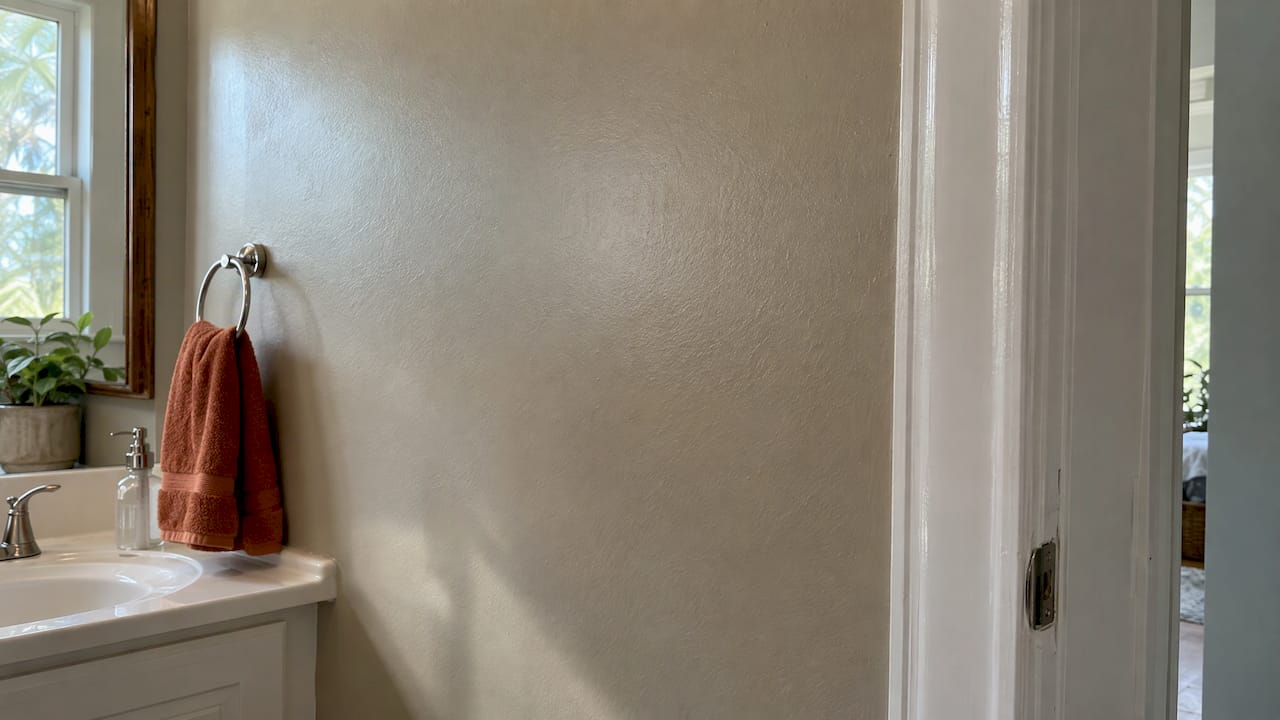
For most bathrooms, the right paint finish is satin or semi-gloss. Satin suits walls and ceilings, and semi-gloss suits trim, doors, vanities and the walls closest to the shower. Both repel moisture and stand up to cleaning, which flat and matte paints do not. The finish is only half of the result, though. Prep, ventilation and the paint formula decide whether it still looks good in five years. In a humid climate like Tampa’s that matters even more, and it is a good reason to decide on paint while you plan the whole room, not after the tile is set.
TL;DR
- Use satin on bathroom walls and ceilings, and semi-gloss on trim, doors, vanities and walls beside the shower.
- Skip flat and matte paint in a bathroom: it absorbs moisture and is harder to clean.
- Higher sheen is easier to wipe down but shows every wall flaw, so smooth the surface before you paint.
- No paint finish replaces ventilation or a proper shower surround. Clean, dry, mildew-free surfaces are what make paint last.
- Expect to repaint every five to seven years, sooner if the room is poorly ventilated or heavily used.
Table of Contents
- What paint finish actually means
- Satin vs. semi-gloss on bathroom walls
- A zone-by-zone guide
- Finishes to avoid
- The paint formula matters as much as the sheen
- How to get a finish that lasts
- How often to repaint
- When the paint question is really a remodel question
- What a bathroom remodel costs in Tampa
- Let us handle the whole bathroom
- FAQ
- Sources
What paint finish actually means
Finish and sheen are two words for the same thing: how shiny the paint is once it dries. Benjamin Moore’s paint guide describes sheen as how reflective the surface is, and notes that the sheen you pick can hide minor flaws, call out architectural details or make cleanup easier.
The scale runs from flat or matte, through eggshell, satin and semi-gloss, up to high-gloss. Each step up gets shinier, tougher and more washable. Each step up also shows more of what is underneath.
There is a simple reason for that trade-off. Sherwin-Williams explains that high-sheen paint has more resin, or binder, which creates a smooth, durable film that is easier to keep clean. Low-sheen paint has more pigment, which makes a duller, rougher, less resilient surface. The same article notes that high-sheen paint draws attention to even small flaws. A bathroom needs a film that sheds steam and splashes, so it leans toward the shinier end. Your wall condition pulls you back toward the duller end. Most of the decision is balancing those two.
Satin vs. semi-gloss on bathroom walls
This is the question behind most searches, and the sources largely agree. This Old House says satin or semi-gloss work best in most bathrooms because they repel water and hold up to frequent cleaning. Consumer Reports reports that the person who leads its paint testing recommends the same two finishes because they resist stains and clean easily.
The differences come down to three things.
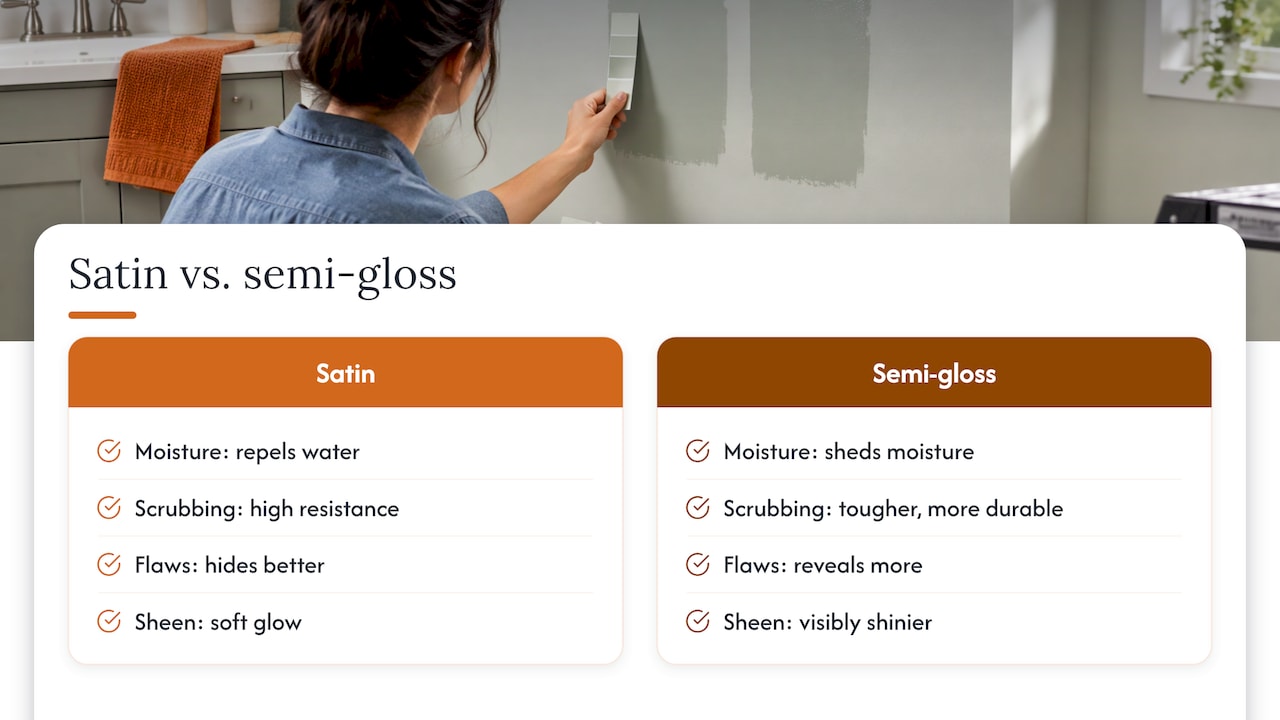
Moisture and scrubbing. Semi-gloss is the tougher of the two. The Spruce points out that semi-gloss contains more resins and binders than flat paint, sheds moisture and is less prone to peeling. Glidden names semi-gloss as its recommendation for bathrooms because it is the most durable and scrubbable option.
Hiding flaws. Satin is more forgiving. Valspar’s sheen guide says semi-gloss offers excellent stain and scrub resistance but reveals more surface imperfections, while satin has good hide along with high stain and scrub resistance. If your walls have old patches, texture or slightly wavy drywall, satin will look better.
Look. Satin has a soft glow. Semi-gloss is visibly shinier and reads as more utilitarian on a large wall. Homes and Gardens notes that both finishes work on walls, with satin the better fit there, and that both suit woodwork and trim even more.
The usage question helps break ties. Glidden suggests that eggshell and satin are fine for bathrooms that do not get heavy use, such as a powder room or guest bath. A family bathroom with daily showers and kids points to semi-gloss near the water and satin elsewhere.
A zone-by-zone guide
There is no need to treat the bathroom as one surface. Moisture exposure and flaw visibility change from the shower wall to the ceiling to the vanity door. The table below combines the guidance from the sources above.
| Surface | Best finish | Why |
|---|---|---|
| Walls away from the shower | Satin | Soft look, good scrub resistance, hides imperfections better |
| Walls next to the shower or tub | Satin or semi-gloss | More steam and splashing, so the tougher film is worth it if the wall is smooth |
| Ceiling | Satin or semi-gloss in a bathroom-rated formula | Steam rises and condenses overhead, so it needs a moisture-resistant film |
| Trim, baseboards, door and window casings | Semi-gloss | Wiped often, bumped often, and flaws are rare on smooth wood |
| Vanity and cabinets | Semi-gloss | Consumer Reports says semi-gloss can go on a vanity if you accept the shinier look |
High-gloss has a place too, but a small one. The Spruce says gloss has the toughest sheen for washing and scrubbing, yet its mirror-like look makes it best reserved for door jambs or cabinets. Homes and Gardens advises keeping gloss to woodwork and trim rather than walls.
Finishes to avoid
Flat and matte. They look beautiful in a bedroom and fail in a bath. This Old House reports that flat and matte finishes absorb moisture rather than repel it, which makes them more prone to mold and mildew and harder to clean. Finishes not designed for moisture may stain, peel or develop mold patches, according to Homes and Gardens.
Eggshell on high-use walls. Eggshell is a gentle, low-sheen finish that some designers choose for walls. Satin is the more durable step up. Consumer Reports describes satin as more durable and shinier than eggshell, and usable on walls, ceiling and trim. In a powder room, eggshell in a bathroom-rated paint can work. In a shower bath, go up a step.
Gloss on large walls. It magnifies every roller mark and wall dent. Save it for small, smooth pieces.
The paint formula matters as much as the sheen
A bathroom finish is only as good as the paint under it. This Old House reports that paints designed for humid rooms often include antimicrobial additives that help prevent mildew growth. Look for a can labeled for bathrooms, or kitchens and baths, rather than a standard wall paint in the same sheen.
Some premium lines are built to hold up at every sheen. Sherwin-Williams’ sheen guide says lower-gloss paints hide imperfections better while higher-gloss ones are generally easier to clean, with exceptions such as Emerald and Duration Home, which it describes as washable and stain-resistant at all sheen levels. It also states that Duration Home with Moisture Resistant Technology is aimed at moist spaces like bathrooms. Such lines cost more per gallon, but a bathroom uses so little paint that the price difference is small next to the labor of repainting early.
The label on the can also gives the real-world instructions. For example, Benjamin Moore’s Aura Bath & Spa data sheet calls for surfaces that are clean, dry and free of dirt, grease, soap, scaling paint and mildew. It recommends waiting at least 24 hours before putting the room back to full use, and says painted surfaces can be washed after two weeks. High humidity and cool temperatures lengthen dry and recoat times.
How to get a finish that lasts
Sheen is the visible choice. Preparation is what you do not see, and it is where bathroom paint jobs usually go wrong.
- Clean off mildew and soap film. Consumer Reports advises removing existing mildew with one part bleach to three parts water, ventilating the room while you work and letting the walls dry fully before painting. Wear gloves and eye protection, keep the window open or the fan running, and never mix bleach with other cleaners.
- Fix and smooth the surface. Satin, and especially semi-gloss, draw attention to imperfections, so Consumer Reports recommends smoothing walls first. Fill holes and cracks, sand patches flush and wipe off dust.
- Prime where needed. Consumer Reports says one coat of self-priming paint is enough on walls in good condition. Stained, patched or bare areas need a primer that suits the problem.
- Apply thin, even coats. Keep a wet edge and follow the recoat time on the can. Cool, humid rooms take longer to dry.
- Ventilate and wait. Keep the fan running or a window open as the paint cures, and hold off on long hot showers until the can’s instructions say the film is ready.
Ventilation deserves its own mention. Paint cannot make up for a fan that does not move air. If your mirror stays fogged long after a shower or you see mildew returning along the ceiling line, the fan is the first thing to fix. Sheen is not a waterproofing layer either. The paint sheds condensation and splashes, but the wet zone inside a shower enclosure needs tile or a solid surround, not paint.
How often to repaint
Consumer Reports quotes an interior designer who recommends refreshing bathroom paint every five to seven years, depending on location and use. That timing makes sense for a well-ventilated bathroom with a quality paint. A busy family bath with daily showers sits at the short end, and a rarely used guest bath at the long end.
Signs that the finish is ready to be redone:
- Mildew that comes back soon after cleaning
- Peeling at ceiling corners or around the shower
- A chalky texture that rubs off on a cloth
- Stains that no longer wipe away
- A sheen that has dulled in the spots you scrub most
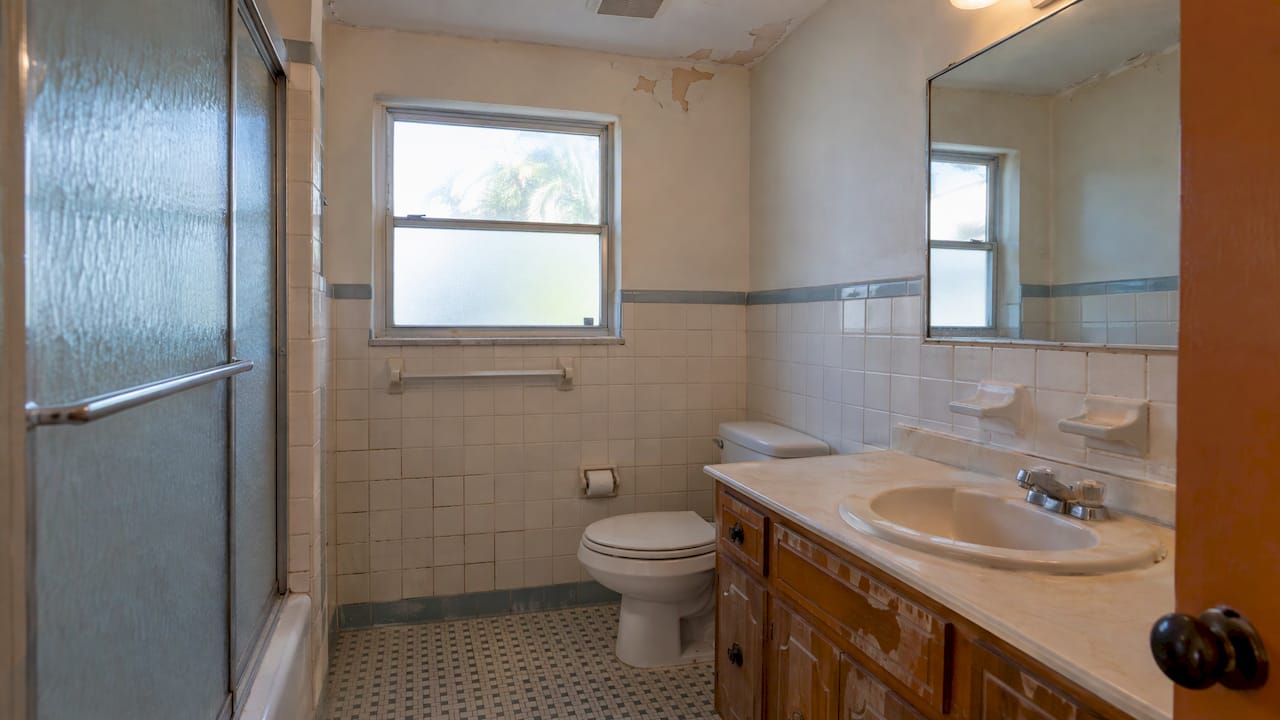
If you see peeling or repeated mildew, ask why before you repaint. The cause is often moisture getting into the wall from a worn caulk line, a failing grout joint or a fan that is too weak. Painting over a moisture source gives you a fresh finish that fails on schedule.
When the paint question is really a remodel question
A new finish can refresh a bathroom that is structurally sound. It cannot fix an outdated layout, worn tile, a tired vanity or a shower that leaks. When your paint is failing in several spots, the better question is whether the room has reached the point where a remodel would serve you better than a repaint.
If you do remodel, choose the paint at the design stage. Tile, vanity, countertop and fixture colors all change how a finish looks under your actual lighting, and a glossy trim next to a matte-looking tile can feel off. Our pages on choosing paint for a remodel and on a bathroom color scheme walk through how colors work with the materials. For selecting the surfaces that sit beside the paint, see material selection for a bathroom remodel.
Painting also belongs in the bigger schedule of any renovation. Painting before the vanity, tile and trim are in invites scuffs, and painting after the plumber leaves invites touch-ups. Homeowners who plan the sequence of a larger project from the start, as in whole-home renovation planning, tend to avoid the repeat work that comes from painting at the wrong moment.
What a bathroom remodel costs in Tampa
If you are weighing a repaint against a full remodel, it helps to see real figures. Our bathroom remodel cost page lists project ranges, with paint and finishing as part of the scope. A Small 3-Fixture Bath with Shower runs $22,100 to $30,000. A Large 3-Fixture Bath with Shower runs $26,700 to $34,000. A 4-Fixture Bath with Shower runs $35,000 to $46,000, and a 5-Fixture Bath with Freestanding Tub runs $52,400 to $65,700. The final number depends on the scope and the materials you choose.
Our view: pick the finish with the room, not after it
We design and build bathrooms in-house, so paint is never an afterthought on our projects. A finish only performs when the wall under it is sound, the surfaces around it are chosen to go with it and the room’s moisture is under control. That is why we like to settle sheen, tile, vanity and trim together during design.
What we have found is that homeowners get the best results when one team handles design and construction. A Lead Carpenter is assigned to each project, so there is one person who knows where every surface and finish is going. Our up-front pricing comes with detailed item lists, so you see what is included before work starts.
Our Work Clean System is built to limit dust and disruption during a remodel, which matters when fresh paint is curing nearby. For a family living in the home, a smooth sequence of work and clear communication are what make a renovation feel manageable.
MediaBeast
Let us handle the whole bathroom
If your bathroom needs more than a coat of paint, our bathroom remodeling service covers design and construction in one team, with up-front pricing, a dedicated Lead Carpenter and a Work Clean System to limit dust. You can also choose materials at our local showroom.
If you want to see how others have approached their rooms, browse our remodeling bathrooms page for ideas, or look at bathroom remodeling tips for homeowners as you plan.
FAQ
Should bathroom paint be satin or eggshell?
Satin is the better choice for most bathrooms. It is more durable and more washable than eggshell, and it still has a soft look that hides flaws reasonably well. Eggshell can work in a powder room that sees little steam, as long as the paint is a bathroom-rated formula.
What paint finish is most durable in a bathroom?
Semi-gloss is the toughest finish you would normally put on walls, and gloss is tougher still but best kept for small woodwork pieces. Semi-gloss sheds moisture and scrubs well, which is why it is often used for trim, doors, vanities and walls beside the shower. Its drawback is that it highlights surface flaws, so smooth the wall first.
Can I use the same finish on the walls and the ceiling?
Yes. Satin works well on both in most bathrooms, provided you use a paint labeled for bathrooms or moisture. Because steam collects overhead, a bathroom formula on the ceiling is worth it. Many homeowners use a flatter ceiling paint in bedrooms, but flat finishes absorb moisture and are not recommended in a bathroom.
How often should I repaint a bathroom?
Plan on every five to seven years, depending on use and ventilation. A busy family bath may need it sooner, and a guest bath may last longer. Repaint earlier if mildew keeps returning, paint peels near the shower or the surface stays stained after cleaning.
Does a moisture-resistant finish stop mold on its own?
No. Bathroom paint with antimicrobial additives helps resist mildew, but it works alongside a good exhaust fan, clean and dry surfaces before painting, and sound caulk and grout. Fix the moisture source first, then paint.
Sources
- A simple guide to the right paint, Benjamin Moore
- Sheen and gloss guide, Sherwin-Williams
- Choosing Paint Sheen, Sherwin-Williams
- Choose the Right Type of Paint for Your Bathroom, This Old House
- How to Paint a Bathroom for Lasting Appeal, Consumer Reports
- The Best Type of Paint for Bathrooms, The Spruce
- Paint finishes for bathrooms explained, Homes and Gardens
- What Type Of Paint For Bathroom, Glidden
- How to Choose a Paint Sheen or Finish, Valspar
- Aura Bath & Spa data sheet, Benjamin Moore