


A punch list is the documented tally of everything left to fix, finish, or correct before your remodel counts as done. It exists to protect you: it turns “the shower door still doesn’t close right” into a written record tied to your final payment. Show up to the walkthrough with a phone, good lighting, and a plan to write down every flaw before signing off or releasing the balance owed.
TL;DR:
- Most homeowners should focus on a rolling punch list process, which reduces the number of unresolved issues at project completion and minimizes costly rework.
- Common punch list items include misaligned doors and drawers, grout and caulk gaps, loose fixtures, and paint or electrical flaws, often repeating across projects.
- A thorough walkthrough with a detailed, photo-attached list and clear responsible trades helps ensure quick fixes and prevents overlooked issues.
- Retainage, typically 5% to 10%, acts as leverage to ensure all punch list items are addressed before final payment releases; never release this until all issues are resolved.
- Using a shared digital tool with structured fields speeds up tracking, accountability, and communication between homeowners, contractors, and trades.
Table of Contents
- What Is a Punch List in Remodeling, and Who Creates It?
- Common Punch List Items by Room and Trade
- How to Run an Effective Punch List Walkthrough
- Who Pays for Punch List Items and How Retainage Works
- Best Practices That Shrink Your Final Punch List
- Templates and Digital Tools for Tracking Punch List Items
- How a Managed Remodel Cuts Down Punch List Headaches
- Ready for a Remodel Closeout Without the Chaos?
- Sources
- FAQ
What Is a Punch List in Remodeling, and Who Creates It?
A punch list is a document built during the final walkthrough that catalogs incomplete, incorrect, or damaged work that has to be corrected before the project reaches substantial completion. Some contractors call it a snag list or closeout checklist. Same idea, different name.
On a remodel, the list usually comes together with input from you, your designer if you used one, and your general contractor or Lead Carpenter. Commercial construction contracts often reference the AIA A201 general conditions, which formally tie the punch list to substantial completion and the release of final payment. Residential remodeling contracts borrow the same logic informally: the work isn’t “done” for payment purposes until the list is cleared.
There are two ways to run this process:
- One-time punch list: everything gets caught in a single walkthrough at the very end, which works fine on small jobs but risks a long, contentious list on bigger ones.
- Rolling punch list: items get logged and closed continuously at milestones throughout the project, which reduces what’s left at the finish line and cuts the odds of expensive rework.
Most experienced remodelers push clients toward the rolling model. It spreads the friction out instead of dumping it all at once.
Common Punch List Items by Room and Trade
Punch lists tend to cluster around the same trouble spots project after project. Knowing what to look for before you walk through saves you from missing something obvious in a rushed final inspection.
- Cabinet hardware and alignment. Doors that don’t sit flush, drawers that stick, pulls installed off center.
- Backsplash and countertop seams. Grout lines that don’t match, visible seams where slabs meet, chips at the edges.
- Appliance fit and function. A dishwasher panel that doesn’t sit level, a range hood that vents weakly, gaps around built-in appliances.
- Bathroom grout and caulk. Gaps around tubs, showers, and sinks where caulk pulled away or was never smoothed properly.
- Fixture stability. Loose towel bars, wobbly faucets, a toilet that rocks slightly when you sit on it.
- Drain and supply leaks. Slow drips under sinks or behind access panels that only show up after a day of use.
- Tile chips and cracks. Especially at corners, thresholds, and around shower niches.
- Door and window function. Hinges that squeak, doors that don’t latch cleanly, weatherstripping that’s missing or misaligned.
- Paint and finish flaws. Scuffs from installation, missed touch-ups, or a color that doesn’t match the sample you approved.
- Electrical and lighting. Switches wired backward, dimmers that flicker, outlets installed at the wrong height.
- HVAC and plumbing systems. Vents blocked by new cabinetry, water pressure that dropped after fixture swaps.
Walk each room with this list in hand, not from memory. Small stuff hides in plain sight when you’re excited about a finished kitchen.
How to Run an Effective Punch List Walkthrough
A good walkthrough is methodical, not a quick lap around the house. Set aside real time, ideally 45 minutes to an hour depending on project size, and go room by room instead of jumping around.
Before you start:
- Bring a fully charged phone or camera, a flashlight, and a printed or digital checklist template.
- Open every cabinet, closet, and access panel. Problems hide in the spaces nobody looks at twice.
- Run every faucet, flush every toilet, and cycle every switch and dimmer.
While you document, be specific. Vague entries create arguments; precise ones get fixed fast. Instead of “bathroom tile issue,” write “master bath, shower niche, right wall, cracked tile 4 inches from top, photo attached, timestamp 2:14 PM.” Attach a photo or short video to every item. That evidence matters more than your memory will six weeks from now.
Assign each item to a specific trade or person, not just “the contractor.” Set a realistic target date for each fix rather than a vague “soon.” Track status in one shared document so nobody’s guessing whether something got done.
If you spot something you want changed rather than fixed, that’s not a punch list item. That’s new scope, and it needs a signed change order describing the work, the cost, and any schedule impact before anyone touches it.
Pro Tip: Take a “before” photo of every punch list item the moment you spot it, and an “after” photo the moment it’s fixed. That pair is your proof if anyone ever disputes whether the work happened.
Once a fix is done, verify it in person or by photo, and get a brief written sign-off before releasing any held-back payment tied to that item.
Who Pays for Punch List Items and How Retainage Works
Here’s the financial mechanic behind punch lists that a lot of homeowners miss until it matters: many contracts let owners hold back 5% to 10% of the total contract amount as retainage until every item on the list gets resolved. That holdback is your leverage. Release it too early and you lose your best tool for getting fixes finished.
- Contractor responsibility: work that doesn’t meet the agreed contract specifications gets corrected at the contractor’s cost, no additional charge to you.
- Owner-requested additions: if you decide mid-punch-list that you want something different, not just fixed, that requires a documented change order with price and schedule impact spelled out.
- Disputed items: keep dated photos and written notes for anything contested. A timestamped photo showing a crack existed before handover carries far more weight than a verbal disagreement weeks later.
Never accept a verbal promise to fix something “later.” Get it in writing, tied to a date, before you release final payment.
Best Practices That Shrink Your Final Punch List
The homeowners who end their remodel with a short, painless punch list almost always did the same thing: they never let one big list accumulate in the first place.
- Start a rolling punch list the moment framing or rough-in work wraps, not after the final coat of paint.
- Schedule short mini-walkthroughs with your Lead Carpenter or general contractor at each milestone, not just at the end.
- Keep a living log with timestamps and photos so nothing gets forgotten between visits. Memory fades fast on a multi-week project.
- Agree on a closeout schedule up front so every subcontractor knows exactly when their piece needs to be punch-list clean.
Rework can account for up to 20% of total construction cost on projects where issues pile up unaddressed. Catching problems early, one at a time, is cheaper than fixing a dozen of them in the same frantic week.
Templates and Digital Tools for Tracking Punch List Items
A usable punch list template doesn’t need to be complicated. It needs these fields, consistently filled in for every entry:
| Field | Why it matters |
|---|---|
| Item ID | Lets you reference the item quickly in conversation or email |
| Room/location | Specific enough to find without asking |
| Description | Exact and detailed, not general |
| Photo link | Visual proof, attached at the time it’s spotted |
| Responsible trade | Who fixes it, not just “the contractor” |
| Priority | Urgent, standard, or cosmetic |
| Target date | A real date, not “soon” |
| Status | Open, in progress, fixed, verified |
| Approver | Who signs off once it’s confirmed fixed |
Digital punch-list apps let you and your contractor see the same list in real time, attach photos directly to each entry, and timestamp every update automatically. That shared visibility cuts down on the “I never heard about that” conversations that drag out closeouts. If you’re managing a project with a lot of moving pieces, tools built around construction task tracking can keep rolling punch lists organized without a spreadsheet falling out of date.
How a Managed Remodel Cuts Down Punch List Headaches
Most punch list frustration traces back to one root cause: too many hands, not enough accountability. When design and construction sit with separate companies, punch items get argued over instead of fixed, because nobody wants to own a problem that might be “the other guy’s fault.”
Having design and construction under one roof can shrink that finger-pointing considerably. Assigning a dedicated Lead Carpenter who’s accountable for the work from the first day to the final sign-off, and using a Work Clean System specifically designed to reduce dust and disruption, can help cut down on some of the cosmetic punch items that come from a messy job site. Providing up-front pricing with itemized lists also may reduce arguments about whether a fix is included or a billable change order.
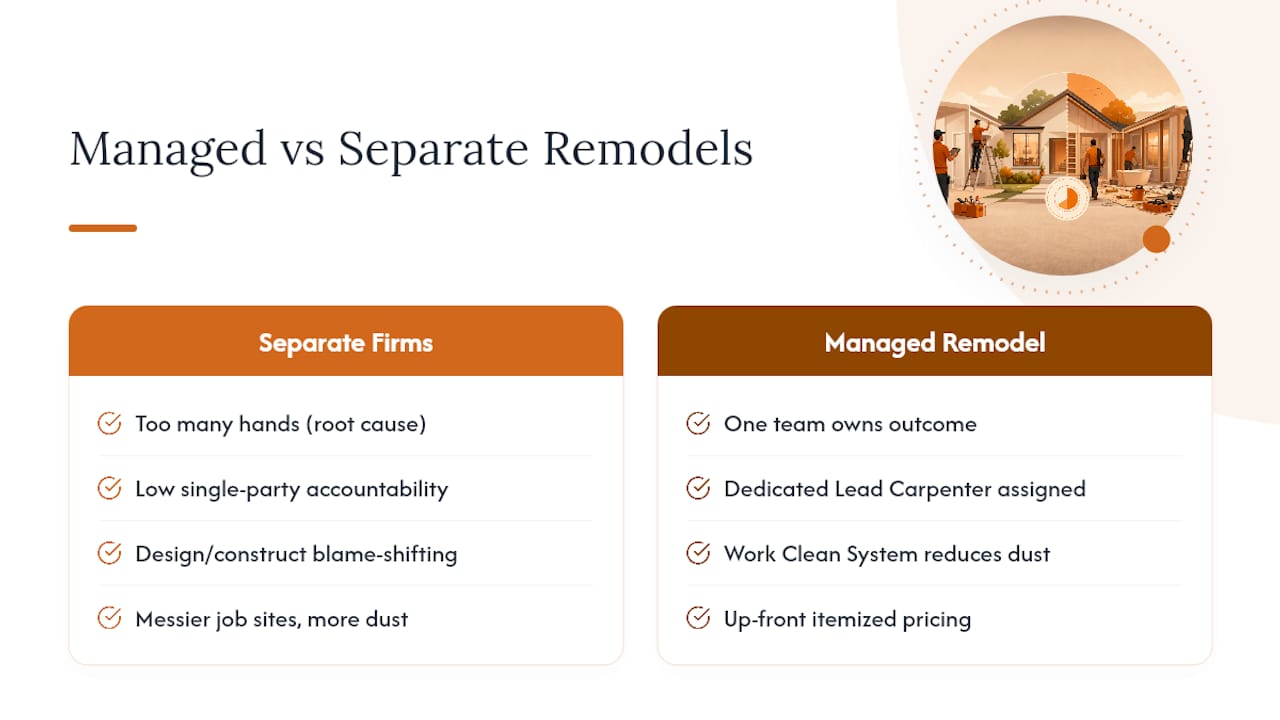
None of that eliminates punch lists entirely. It just means the list you end up with is shorter and gets resolved faster, because one team, not three, is on the hook for the outcome.
Read more homeowner experiences on the remodel testimonials page.
— MediaBeast
Ready for a Remodel Closeout Without the Chaos?
If you’ve made it this far, you’ve probably realized the real punch list problem isn’t the list itself. It’s coordinating fixes across a fragmented team where nobody quite owns the outcome. Structuring projects to have one company handle both design and construction, assigning a Lead Carpenter to each job, and offering up-front pricing that spells out what’s included before work begins can help avoid coordination issues.
That structure matters most at closeout, when a shorter, cleaner punch list means you get your finished kitchen or bathroom sooner and with less back-and-forth over who’s responsible for what. If you’re planning a bathroom project, check current bathroom remodel costs to see what a contractor-managed closeout looks like for your scope, or explore kitchen remodel costs if that’s the room on your mind. Either page is a solid starting point for scheduling a consultation before you’re deep into a project without a clear plan for handling the final details.
Sources
- Punch list – Wikipedia
- Your guide to construction punch lists – PlanRadar
- Construction punch list explained – Procore
- Punch list | Cambridge Dictionary
- What is a construction change order? – ProjectManager
FAQ
What Are Typical Punch List Items?
Typical items include misaligned cabinet doors, grout and caulk gaps, loose fixtures, paint touch-ups, and switches or outlets that were wired incorrectly. Most fall into cosmetic fixes or minor function issues rather than major structural problems, since serious defects usually get caught before the final walkthrough.
What Is a Punch List in Construction?
A punch list is a document created at the final walkthrough that lists incomplete, incorrect, or damaged work needing correction before final payment or substantial completion. It applies the same way in remodeling, just at a smaller project scale than new commercial construction.
Who Pays for Punch List Items?
The contractor generally pays to fix items that don’t meet contract specifications, while owner-requested additions require a signed change order with its own cost. Many owners also hold 5% to 10% of the contract amount as retainage until the list is fully resolved.
Can You Provide an Example of a Punch List?
A single entry might read: “Kitchen, island cabinet, left door, hinge misaligned causing gap, photo attached, assigned to cabinet installer, target date March 20, status: open.” A full list is just dozens of entries like that, organized by room and tracked to completion.
What’s the Difference Between a Punch List and a Change Order?
A punch list catches work that was already agreed on but done wrong or left unfinished. A change order documents new or different work you’re requesting, along with its added cost and schedule impact, and needs a signature to be enforceable.