
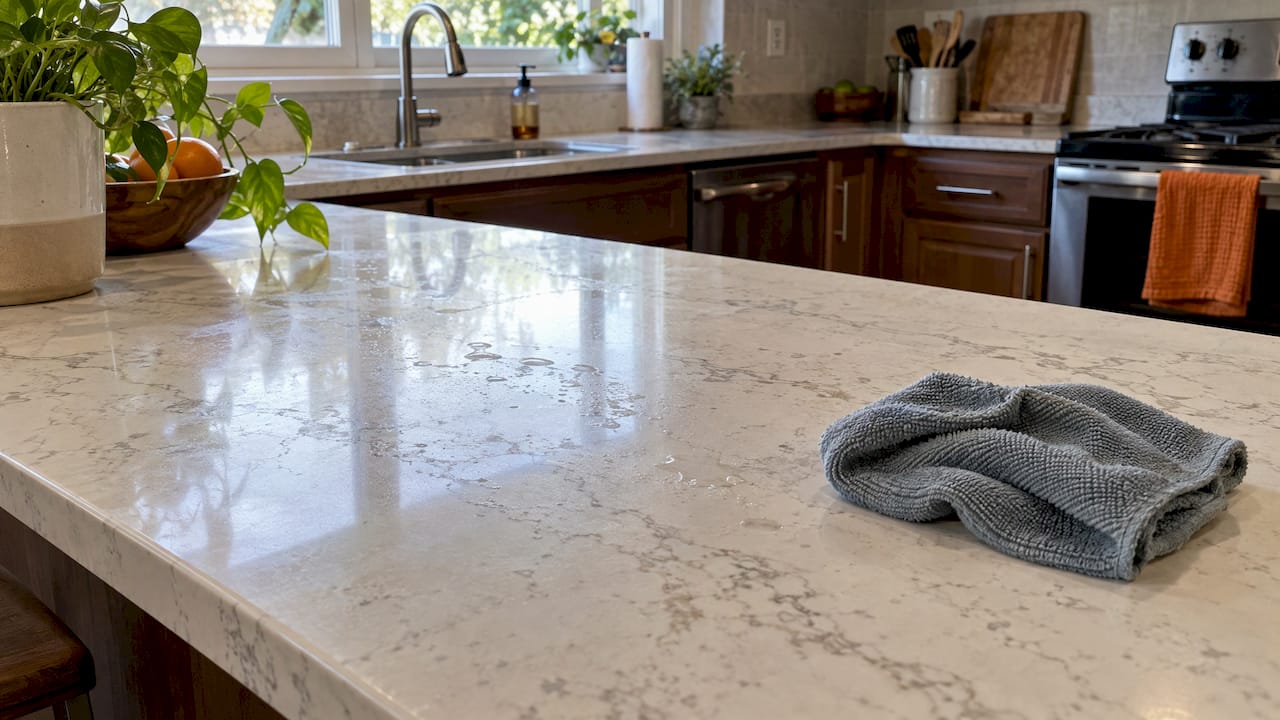
Quartz needs very little: wipe it with mild soap and water, dry it, use a trivet under hot cookware, and keep harsh chemicals away. It never needs sealing or polishing. If you are planning a kitchen or bath and want counters that fit a busy household, our design-and-build team at Bath & Kitchen Gallery helps you choose a surface and a layout you will actually enjoy living with. The rest of this guide covers the details: what to use daily, how to handle stains and disinfecting, what to avoid, and how to prevent heat damage.
TL;DR
- Daily care is a soft cloth, warm water and a few drops of mild dish soap, then rinse and dry.
- Do not seal or polish quartz. Manufacturers say the surface is non-porous and sealer only leaves residue and uneven gloss.
- Skip bleach, ammonia, oven cleaners, drain cleaners, acetone and abrasive pads. Use 70% isopropyl alcohol when you want to disinfect.
- Always put a trivet or hot pad under pots, pans and small appliances. Quartz is heat resistant, not heat proof.
- Wipe up spills quickly. Wine, turmeric and markers are the usual culprits for marks.
Table of Contents
- Why quartz is easy to care for
- Daily cleaning: what to use and how
- Can you use Windex, Clorox wipes or vinegar on quartz?
- How to remove stains and stuck-on messes
- What to keep away from your quartz
- Do not seal or polish quartz
- Protecting quartz from heat, scratches and sun
- A simple weekly routine
- Our view: the best counter care plan starts before install
- Planning new counters? Start with the whole room
- FAQ
- Sources
Why quartz is easy to care for
Quartz countertops are engineered stone: ground quartz held together with a polymer resin. One countertop supplier’s care guide describes the mix as roughly 90% quartz and 6 to 10% resin. That resin fills the tiny gaps that make natural stone absorb liquids, which is why one manufacturer states its quartz is non-porous and requires no sealing.
The same resin explains the rules. It resists absorbing spills, but it reacts to harsh chemicals and to concentrated heat. A major manufacturer’s guide puts it plainly: because of the resin binder, the harshest cleaner is counterproductive and mild soap and water does the job. Almost everything below follows from that one idea.
If you are still choosing a surface, our page on why non-porous kitchen countertops matter explains what that property means for a family kitchen.
Daily cleaning: what to use and how
For everyday crumbs, drips and fingerprints, the routine is the same across manufacturers’ care sheets.
- Wipe once a day or as needed. Use a damp soft cloth or paper towel. One manufacturer says this removes ordinary food residue and household soils.
- Add mild soap when the surface feels tacky. A few drops of dish soap in warm water works. One care sheet suggests a mix of 1 part mild detergent to 5 parts warm tap water, at 122°F to 140°F. Ordinary warm tap water is fine.
- Rinse. Soap left behind attracts dirt and can leave a film. Use cool or warm clean water.
- Dry. Wiping the surface completely dry with a soft cloth prevents water spots and streaks, and one care sheet specifically says to wipe it completely dry.
Use a soft cloth, microfiber or a non-abrasive sponge. Keep the green scrubby side of the sponge in the drawer.
A note on finish
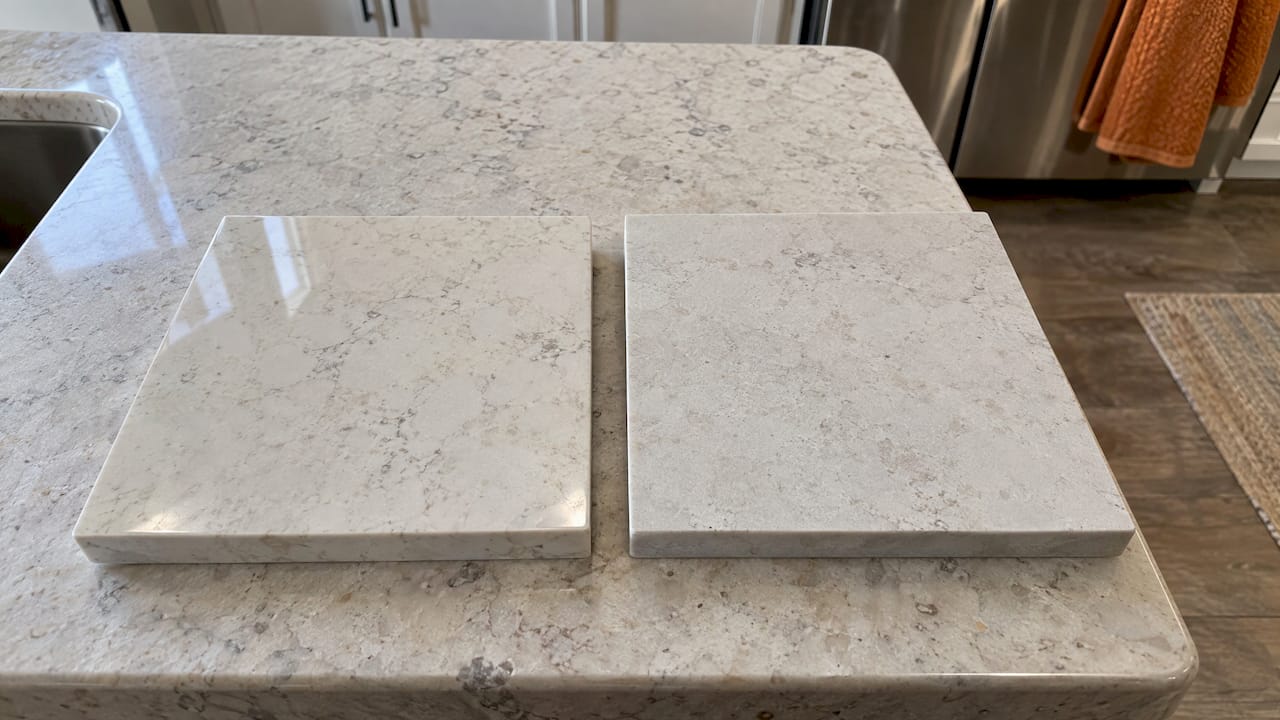
Polished quartz is the easiest to maintain. A leading manufacturer notes that natural, honed, concrete and rough finishes need more frequent cleaning than polished ones, and that wet spills should always be wiped up to prevent a patina. If you love a matte look, plan on wiping a little more often.
Can you use Windex, Clorox wipes or vinegar on quartz?
This is what most people search for, and the honest answer is that manufacturers differ, so the safest path is the plainest one.
| Product | What manufacturers’ care sheets say |
|---|---|
| Dish soap and water | Recommended everywhere for daily care |
| Windex and similar glass or all-purpose sprays | Listed as acceptable mild household cleaners by two manufacturers, then rinse and dry |
| 50/50 water and vinegar | One manufacturer lists it for daily care, though soap and water is the simpler default |
| 70% isopropyl alcohol | Approved for cleaning and disinfecting |
| Disinfecting wipes | Some sheets list specific bleach-free wipes, others say to avoid bleach and quaternary ammonium |
| Bleach, ammonia | Avoid |
Because sheets disagree on disinfecting wipes, the choice that works with every brand is 70% isopropyl alcohol. One manufacturer recommends an alcohol-based cleaner or isopropyl alcohol at at least 70%, keeping the surface wet for 5 minutes, and says to avoid products containing bleach, ammonia or quaternary ammonium, which can degrade the surface over time. Wipe with water afterward and dry.
If your countertop came with a care sheet, keep it. Your slab’s own instructions are the final word on your warranty.
How to remove stains and stuck-on messes
Quartz is stain-resistant, not stain-proof. A manufacturer’s stain guide says coffee, tea and most cooking spills wipe away when handled within a few hours, while prolonged contact with red wine, turmeric, beetroot juice, strong acids or permanent markers can leave marks that soap and water will not lift. Work up from the gentlest step and stop when the mark is gone.
- Soften dried spills first. Lay a damp cloth over the spot for several minutes so the residue loosens. Manufacturers advise reactivating dried spills with water before cleaning.
- Wash with soap and water. Rub in a circular motion over a slightly larger area than the stain.
- Try a non-abrasive pad. For dried spills, one tile and stone maker suggests a white non-abrasive scrub pad with mild soap.
- Use a non-abrasive cleaner for stubborn soil. A liquid gel cleaner such as Soft Scrub on a damp cloth is approved by some manufacturers. Use a flat hand, not fingertips, since scrubbing hard with fingertips can mark the finish.
- Grease spots: isopropyl alcohol on a cloth.
- Glue, tape, stickers, gum: a citrus-based adhesive remover and a plastic putty knife. Never use a metal blade.
- Finish every time with soap and water, a cool-water rinse and a dry cloth.
For permanent marker or dye, rinse with water immediately. If a mark is still visible, a stone-care cleanser followed by a water rinse is the next step.
Always test a new cleaner on a small hidden spot first, such as the area behind the faucet or the back edge.
What to keep away from your quartz
Harsh chemicals are the most common way people damage quartz without realizing it. Manufacturer care sheets point to the same list:
- Strong cleaners: oven and grill cleaners, drain cleaners, toilet bowl cleaners, floor strippers, paint removers and tarnish removers. One manufacturer warns that damage from these is likely not covered by warranty.
- Bleach, ammonia and quaternary ammonium products. Some are fine in a quick, diluted, rinsed use according to one sheet or another, but the product-wide safe choice is to leave them out.
- Acetone (nail polish remover). One manufacturer states it should never be used on quartz for any reason.
- Abrasives: steel wool, scouring powders and abrasive pads. One care sheet advises avoiding Scotch-Brite pads of any color, while another approves the white non-abrasive pad for stubborn spots. When in doubt, use a soft cloth.
- Oil soaps and furniture polish. These can leave a film that dulls the gloss.
- Natural-stone products. Cleaners made for granite or marble are not meant for quartz.
What about brand differences? One manufacturer’s UK guidelines prohibit Comet, Soft Scrub and S.O.S. pads, while the sheets above approve Soft Scrub gel. The care sheet that came with your slab decides which applies to you. If you do not have one, soap and water plus 70% isopropyl alcohol will cover almost everything.
Do not seal or polish quartz
Many homeowners moving from granite assume sealing is part of the routine. For quartz it is not, and doing it can hurt. A manufacturer states that quartz is non-porous and does not need sealing, and another tells owners never to apply sealers, penetrants or topical treatments because they wear off and leave the gloss looking dull or inconsistent. Polishing is also unnecessary: one tile and stone maker says engineered stone does not require polishing to stay smooth and shiny.
That is the real maintenance advantage: no annual sealing day, no reconditioning. For a busy family, that is time back.
Protecting quartz from heat, scratches and sun
Heat
Quartz handles normal kitchen use, but the resin is the weak point. One manufacturer describes quartz as heat resistant, not heat proof: generally safe up to 250°F, while intense localized heat can cause thermal shock and cracking. Another notes the risk comes from sudden, extreme temperature changes, and advises hot pads or trivets under crockpots, electric skillets and griddles too.
Practical habits:
- Keep two or three trivets within arm’s reach of the stove.
- Put slow cookers, air fryers, electric griddles and roaster ovens on a closed-weave pad or solid trivet.
- Never take a pan from the burner or a dish from the oven and set it straight on the counter.
- Take extra care around cutouts and edges. A product manual explains that high heat damage concentrates at edges and cutouts.
Heat damage shows up as a white or cloudy ring or a scorched patch where the resin has burned, and it cannot be buffed out. Prevention is the whole strategy.
Thickness matters too. The same manual says 3 cm slabs are more resistant to thermal shock than 2 cm slabs. If you are comparing quotes, our guide to 2 cm versus 3 cm countertop thickness explains why slab prices alone can mislead.
Scratches and chips
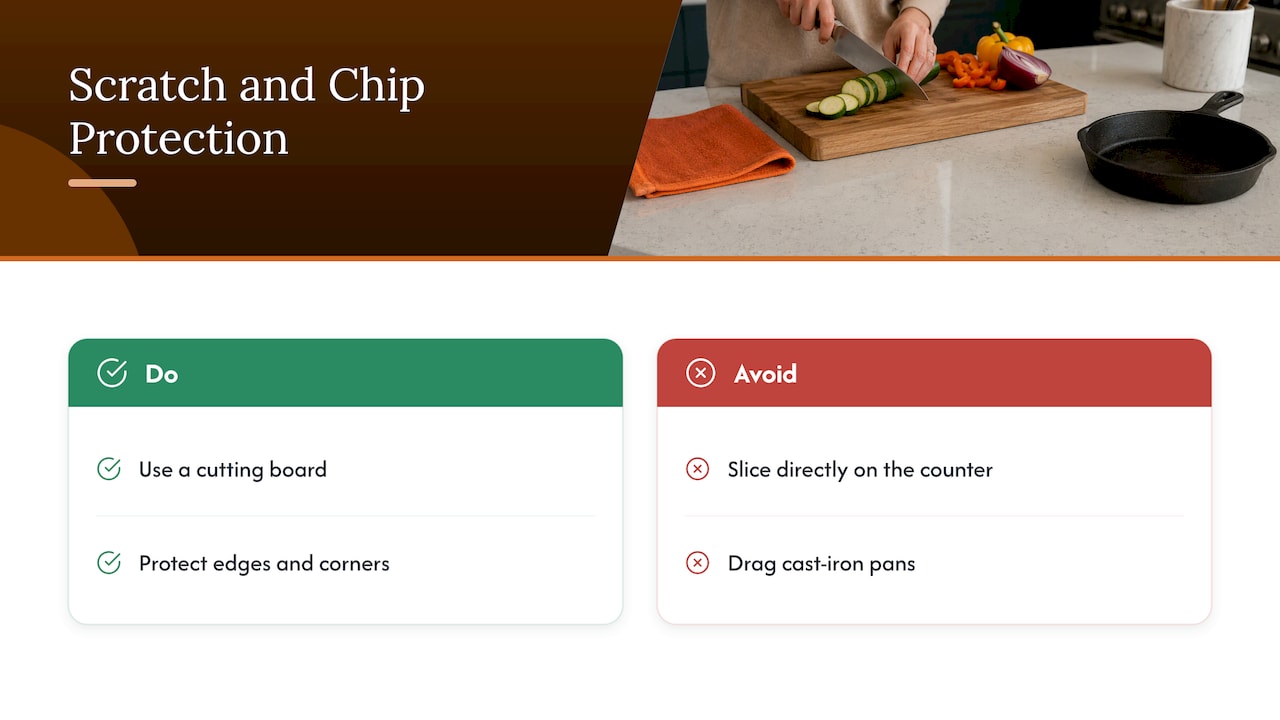
Quartz is tough, but no stone is scratch-proof or chip-proof. One manufacturer’s guidelines state that no surface is chip-proof or scratch-proof. Use a cutting board, do not slice directly on the counter, and avoid dragging heavy cast-iron pans across it. Edges and corners are the most vulnerable to a hard knock.
Sunlight
Keep in mind where the counter sits. A sunny window or a lanai-facing kitchen in Florida brings strong light. Fabricator guidance warns that long UV exposure can yellow lighter quartz colors and fade darker ones over months to years, so for outdoor kitchens check that the product is rated for outdoor use before you buy.
A simple weekly routine
If you want it on one card for the fridge:
| When | What to do |
|---|---|
| After cooking | Wipe with a damp cloth, dry |
| Daily | Soap, warm water, rinse, dry |
| Weekly | Disinfect with 70% isopropyl alcohol, 5 minutes wet, wipe with water and dry |
| As spills happen | Wipe quickly. Soften dried spills with a damp cloth first |
| Always | Trivets under hot items, cutting board for chopping |
| Never | Sealer, bleach, ammonia, acetone, oven cleaner, steel wool |
Our view: the best counter care plan starts before install
We hear the same question from homeowners who are tired of renovation stress: how much work will this surface be once the project is done? Our answer is that care starts with choices made during design. Where the cooktop sits, whether there is a trivet landing spot, whether the sink area has a drying zone and how thick the slab is all affect how easy a counter is to live with.
That is why we handle design and construction together. When one team plans the layout and builds it, those daily-use details are decided at the same table, and a dedicated Lead Carpenter keeps the project on track from start to finish. Our up-front pricing comes with detailed item lists, so you can see what goes into the counters, cabinetry and tile before you sign.
Our local showroom lets you compare materials in person, and we encourage families to ask for the manufacturer’s care sheet for whatever surface they choose. Non-porous counters that never need sealing are a good fit for busy households, and the habits in this guide are all you need to keep them looking new.
MediaBeast
Planning new counters? Start with the whole room
If you are reading this because your counters are due for a change, the surface is only one decision in a kitchen. Bath & Kitchen Gallery designs and builds kitchens and bathrooms in the Tampa area, with custom cabinetry, countertops, tile installation and fixture upgrades handled under one project. Our Work Clean System is designed to minimize dust and disruption while crews are in your home.

You can see how we price projects on our kitchen remodel costs page, compare surfaces in our guide on how to choose the right kitchen countertops, or go straight to our Tampa kitchen remodeling page to start a conversation. If a bathroom vanity top is next, see our vanity countertop ideas.
FAQ
What is the best thing to clean quartz countertops with?
Mild dish soap and warm water on a soft cloth, followed by a rinse and a dry wipe. It is the method every manufacturer’s care sheet lists first. For disinfecting, 70% isopropyl alcohol is the option approved most widely.
Can I use Clorox wipes on a quartz countertop?
Some manufacturers list specific bleach-free wipes as acceptable, with a water rinse afterward. Others advise avoiding bleach and quaternary ammonium products altogether. Check your slab’s care sheet, or use 70% isopropyl alcohol, which is accepted across the board.
Do quartz countertops need to be sealed?
No. Quartz is non-porous, and manufacturers say sealers sit on top, wear unevenly and leave the gloss looking dull or patchy. Daily wiping is all the upkeep needed.
Can I put a hot pan on quartz?
No. Quartz is heat resistant, not heat proof. One manufacturer says it is generally safe up to 250°F, and sudden or concentrated heat can cause cracking or permanent white marks. Use a trivet or hot pad every time.
How do I get a stubborn stain out of quartz?
Soften it with a damp cloth, wash with soap and water, then step up to a non-abrasive cleaner on a damp cloth, using a flat hand and a circular motion. Rinse and dry afterward. Marks from red wine, turmeric or permanent marker are easiest to remove when you act quickly.
Sources
- Wilsonart quartz care and maintenance sheet
- ENVI Surfaces quartz care and maintenance
- Crescent Quartz care and maintenance sheet
- Caesarstone care and maintenance for quartz surfaces
- Caesarstone: Does quartz stain?
- Caesarstone: best quartz countertop cleaner
- Bria Quartz care and maintenance insert
- Daltile quartz care step-by-step guide
- Quartz USA care and maintenance
- Pompeii Quartz product manual
- Cambria quartz worktops use and care guidelines, UK