
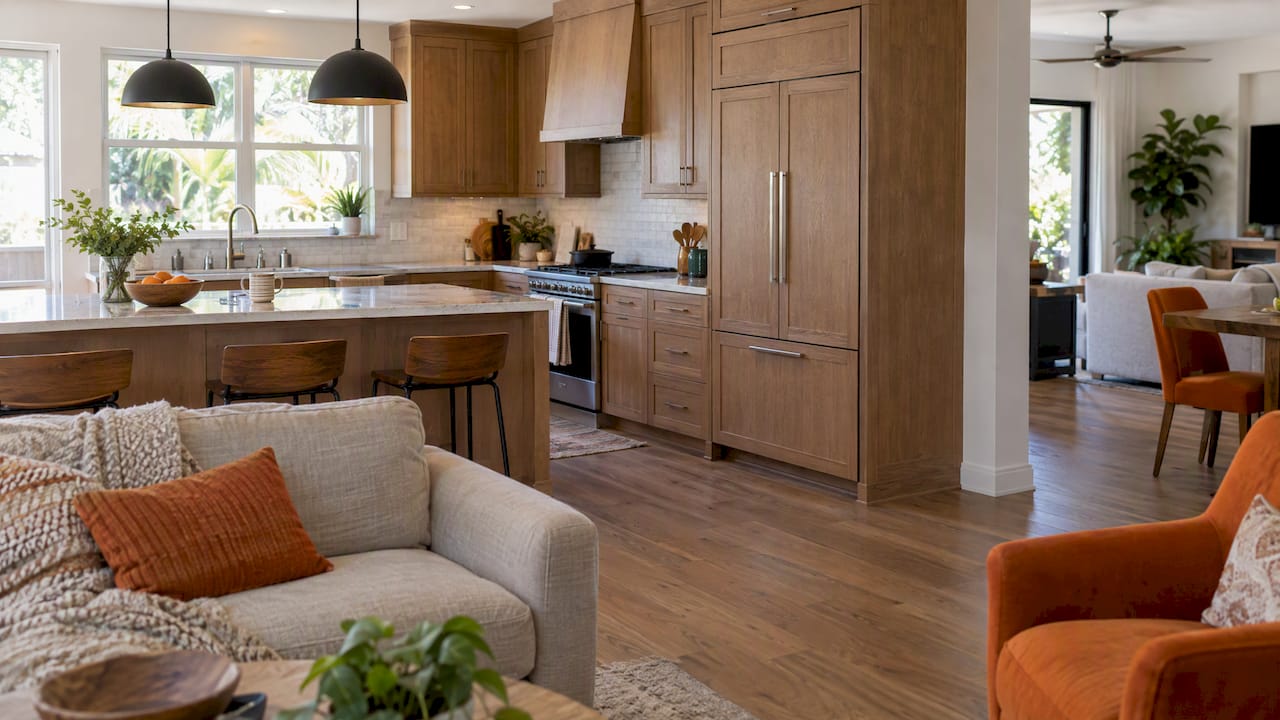
Panel ready appliances are built to accept a custom front panel, usually made to match your cabinets, so the fridge, dishwasher or other unit blends into the kitchen instead of standing out. The look is seamless, but the details decide whether it works: the panel is usually bought separately, it has to fit the manufacturer’s weight and thickness limits, and the cabinetry around it has to be planned for the exact model. This guide covers what qualifies, what it costs, and how to plan one in a remodel.
TL;DR
- Panel ready means the appliance is designed to take a custom cabinet panel over its front. Refrigerators and dishwashers are the most common, but wine storage, freezers and warming drawers also come panel ready.
- Panels and handles are usually purchased separately, and each model lists its own panel size, thickness and weight range.
- Expect a higher price than for a stainless version, plus more labor to install and service.
- Choose the appliances first. Cabinet openings, clearances and panels all depend on the exact model.
Table of Contents
- What panel ready actually means
- Which appliances can be panel ready
- Panel ready fridges: what to know
- Panel ready dishwashers: panel weight and cutout
- Panels and handles: who supplies what
- What panel ready appliances cost
- The trade-offs, and how to choose well
- When panel ready is the right call
- Planning order for a remodel
- Our perspective
- Planning a kitchen with panel ready appliances in Tampa
- FAQ
- Sources
What panel ready actually means
A panel ready appliance has a plain front, or a front frame, built to hold a panel you supply. Per AJ Madison’s buying guide, the panel typically matches the surrounding cabinetry, so the appliance and its controls are hidden from sight.
The vocabulary around it is loose, so it helps to separate three terms:
| Term | What it means in practice |
|---|---|
| Panel ready | The appliance is made to accept a custom panel on its front |
| Integrated | A matching panel is installed flush so the appliance is hidden entirely |
| Built-in | Any appliance set within cabinetry, panel or not |
These definitions follow a cabinetry maker’s explanation of overlay and integrated appliances. Manufacturers do not use the words consistently, so a spec sheet matters more than a product title. If a listing says “integrated” or “built-in,” confirm whether it actually takes a custom panel and whether the panel is included.
Which appliances can be panel ready
The two big categories are refrigerators and dishwashers. Lowe’s buying guide names these as the main panel ready categories. The range is wider at the premium end. Thermador’s panel ready lineup includes:
- Bottom-freezer refrigerators
- Refrigerator and freezer columns
- Wine refrigeration
- Under-counter refrigeration
- Dishwashers
- Warming drawers
Sizes vary as well. One manufacturer’s 24-inch undercounter beverage center is described as panel ready, accepting custom cabinet panels or a separately sold stainless panel. The same brand’s 30-inch integrated refrigerator has a panel ready exterior. Ranges, wall ovens and microwaves are generally finished in metal and left visible, so a panel ready kitchen usually pairs a few hidden units with one or two showpieces.
Panel ready fridges: what to know
A panel ready refrigerator is the appliance people picture first, and it is the largest surface in the kitchen. Covering it with cabinet-matched panels makes the biggest visual change. Built-in models are typically shallower so the front sits flush with the cabinet line, and the compressor placement differs too. According to AJ Madison, built-in fridges typically have compressors on top, while freestanding units have them on the back.
Clearance deserves attention before you fall in love with a model. A large integrated refrigerator needs room for doors and drawers to open. For one 36-inch designer-series model, the manufacturer’s quick reference guide lists 34 1/2 inches for doors and 18 3/8 inches for drawers that must be accounted for in the plan. If a wall, an island or a neighboring pantry door sits too close, the door will not swing the way you expect. We check this on paper before cabinets are ordered, not after.
Panel ready dishwashers: panel weight and cutout
A panel ready dishwasher is the easiest way to get the look on a budget, because it is a single door and a modest panel. The catch is that the panel has to suit the machine. One major manufacturer’s installation guide says the custom panel must be at least 3/4 inch thick and weigh 7 to 24 lb, with the dishwasher shipping factory-ready for 11 to 18 lb. A heavier or thinner panel needs different springs or adjustments, and a panel outside the range can make the door drop open or slam shut.
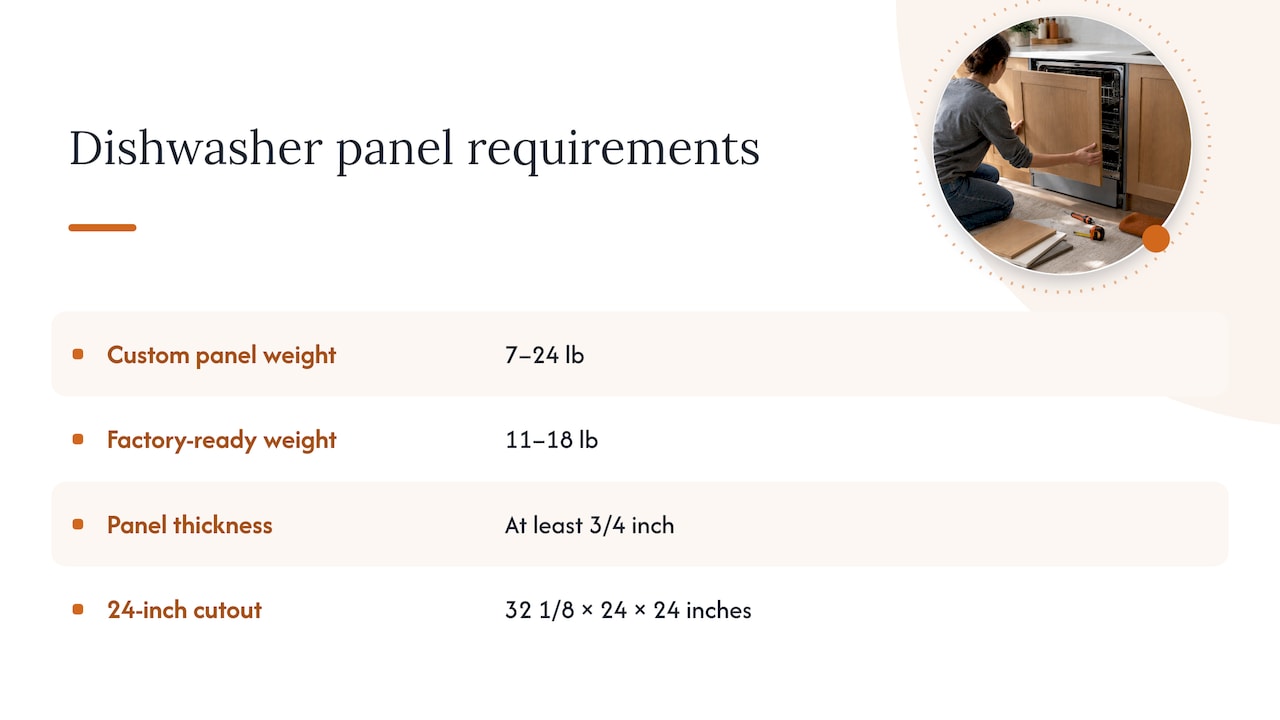
Cutout dimensions are specific to the model. For one 24-inch panel ready dishwasher, the required cutout is 32 1/8 by 24 by 24 inches. The electrical location depends on how it is connected, and plumbing varies by local code. Your installer should work from the installation sheet for the exact model, not from a generic dishwasher opening.
Panels and handles: who supplies what
Most panel ready appliances arrive without a panel. Lowe’s notes that custom panels and appliance handles are usually purchased separately. A few points keep this from becoming a delay:
- Order panels from the cabinet source. Lowe’s advises ordering panels from a cabinet manufacturer, which keeps the finish, grain and color consistent with the doors beside them.
- Read the spec sheet for panel data. It should list panel width, height, thickness and weight range, plus any hardware required.
- Decide on handles early. Depending on the model, handles may be absent, recessed or matched to your cabinet hardware, as one design center explains.
- Never panel a standard appliance. Lowe’s warns against fitting a cabinet panel to an appliance the manufacturer did not design for one. Extra weight can cause door, tipping, overheating and efficiency problems.
That fourth point is the one we see homeowners tempted by when a stainless model is on sale. If the manufacturer does not sell it as panel ready, do not make it one.
What panel ready appliances cost
Panel ready costs more, and it is better to plan for that than to be surprised. Built-in, panel ready appliances tend to cost more than their freestanding counterparts, and a cabinetmaker’s guide points to higher appliance and hardware costs along with more involved installation.
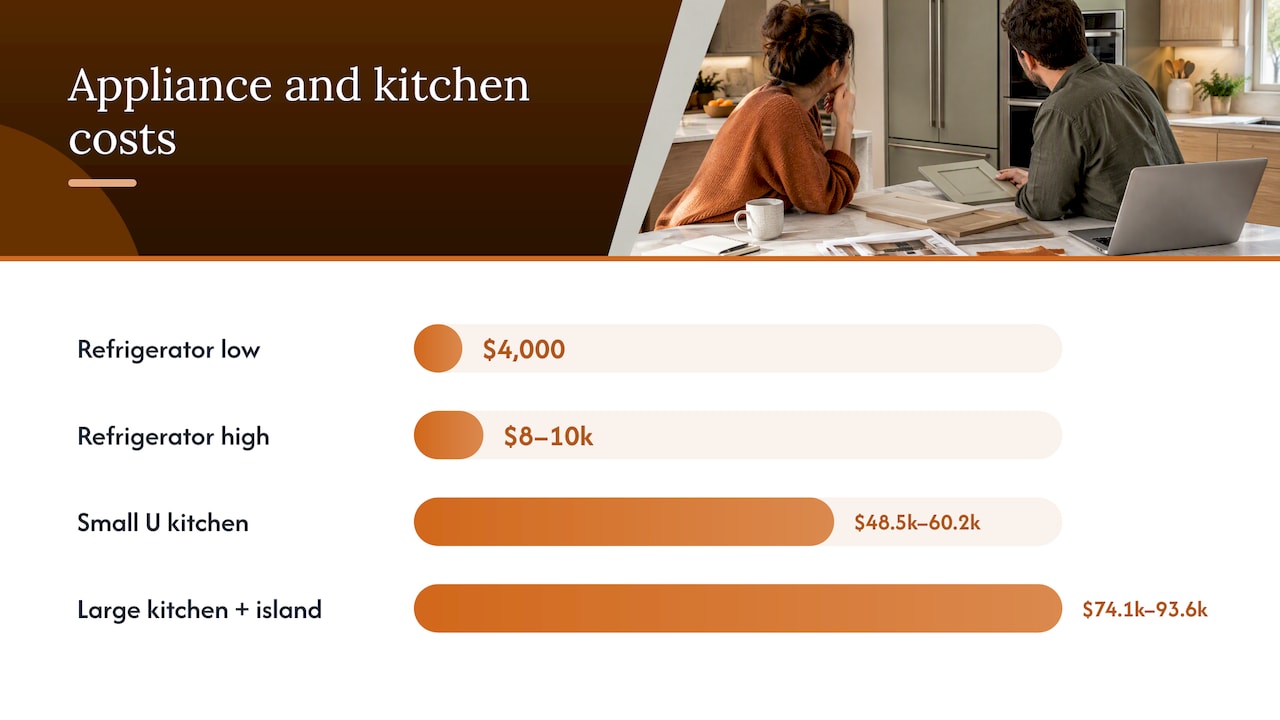
For a sense of scale, a homeowner-focused guide puts a built-in panel ready refrigerator at around $4,000 at the low end, climbing to $8,000 to $10,000, before installation. Prices shift by brand and year, so treat those figures as a starting range and confirm current numbers with your dealer.
Budget these lines together, not one at a time:
- The appliance itself
- Panels and any hardware kit
- Cabinet work around the opening, such as a surround or filler
- Installation labor, which grows because the panel must be fitted and aligned
- Electrical and plumbing adjustments at the opening
A kitchen remodel timeline guide is a helpful reference when you are lining up the order of appliance delivery, cabinet lead times and installation, since custom panels are one of the items that can hold up the final week.
When you set the overall number, our published ranges give context. Our kitchen remodel cost page lists a Small U-Shaped Kitchen at $48,500-$60,200 and a Large Kitchen with Island at $74,100-$93,600. Those are complete project ranges, so check what each includes when you add premium appliances to the plan.
The trade-offs, and how to choose well
The common question is about the disadvantages of a panel ready fridge. The honest answer is that they are about planning, not quality. Paneling adds significant labor to installation and potentially to future repairs, because technicians must remove the custom panel to reach the unit. Knowing that, you can make the choice work:
- Choose a model with a service record you trust. Ask your dealer about local service coverage before you buy.
- Keep a spare set of panel hardware and the install sheet in a folder with your warranty.
- Plan access. Built-in units can be easier to clean around, since some components are more reachable than on freestanding units.
- Think about resale. The same guide says panel ready units can significantly increase a home’s value. Our page on home remodeling values for kitchen upgrades covers what tends to matter to buyers.
Smart features are a bonus. Many panel ready appliances have Wi-Fi that can alert you to a finished dishwasher cycle or a fridge door left open, which is handy when the front looks like a cabinet and gives no visual cue.
When panel ready is the right call
It suits kitchens where the layout is open to the living area, where the fridge sits at the end of a run of cabinets, or where you want a calm, furniture-like look. It suits couples updating a kitchen for style and owners who plan to stay long enough to enjoy the finish. It is less compelling if you plan to swap appliances every few years, because the panels are cut for one model.
If you are comparing, the simplest approach is this: pick the one or two appliances where the visual payoff is largest, usually the refrigerator and dishwasher, and make those panel ready. Leave the range and any hood as design features.
Planning order for a remodel
Appliance choice comes before cabinet drawings. We explain the reasoning in our piece on choosing appliances before cabinets. A workable sequence:
- Pick the exact models and download their installation sheets.
- Confirm cutouts, clearances, panel thickness and weight limits.
- Design the cabinet run, including the panel details and handles.
- Order panels with the cabinets so finishes match.
- Schedule delivery so appliances arrive before final trim and panel fitting.
- Test door swing and dishwasher door action with panels fitted before the job is closed.
If you are earlier in the process, what to know when starting a kitchen remodel walks through the first decisions, and our cabinets and countertops page shows the materials available to match your panels.
Our perspective
Panel ready appliances are where design and construction either work together or fall apart. The panel is a cabinet part, the opening is a carpentry detail, and the appliance sets the rules for both. When those three are handled by different people on different timelines, homeowners end up with gaps, doors that rub and panels that arrive the wrong size.
That is why we handle design and construction under one roof. We settle the appliance models first, put the dimensions into the drawings, and give you up-front pricing with a detailed item list, so the appliance, the panel and the labor to fit them are all visible before you sign.
Each project also has a dedicated Lead Carpenter who owns the details at the opening, and our Work Clean System keeps dust and disruption down while the cabinetry and appliances go in. For a busy family or a first-time remodeler, that means fewer surprises and clearer communication.
MediaBeast
Planning a kitchen with panel ready appliances in Tampa
If you want panel ready appliances in a new kitchen, we can plan the appliance selection, cabinetry, panels and installation as one project. Our local showroom helps you choose materials in person, and our kitchen remodeling service covers design through construction with a dedicated Lead Carpenter.
To see where your project might land, start with our published kitchen remodel cost ranges, or contact us through our site to talk through your layout.
FAQ
What appliances can be panel ready?
Refrigerators and dishwashers are the most common. Some manufacturers also offer panel ready freezer columns, wine refrigeration, under-counter refrigeration and warming drawers. Ranges and ovens are typically left visible.
What are the disadvantages of a panel ready refrigerator?
They usually cost more than freestanding models, and installation takes more labor. Service can also take longer because the custom panel has to come off to reach the unit. Planning panels, clearances and service access ahead of time handles most of this.
What is the difference between panel ready and integrated?
Panel ready describes an appliance made to accept a custom panel. Integrated describes the finished result, where a matching panel sits flush and the appliance is hidden. Because brands use the terms differently, check the spec sheet for panel dimensions and weight.
Can I put a cabinet panel on a regular dishwasher or fridge?
Only if the manufacturer designed it for a panel. Extra weight on a standard door can cause tipping, door and overheating problems, so choose a model sold as panel ready.
Who supplies the panels and handles?
Usually you do, through your cabinet maker. Panels and handles are generally sold separately from the appliance, so list them in your budget and order them with the cabinets.
Sources
- What Are Panel-Ready Appliances? | AJ Madison
- Overlay vs. Integrated: Choosing Built-In Kitchen Appliances
- Custom Panel Ready Appliances | Thermador
- Create a Seamless Look With Panel-Ready Appliances | Lowe’s
- 24-inch undercounter beverage center specifications
- 30-inch integrated refrigerator quick specs
- Integrated refrigerator quick reference guide
- Custom panel dishwasher installation guide
- 24-inch custom panel dishwasher specifications
- Panel-Ready Appliances Explained | Charleston Design Center
- Panel-ready appliances cost guide | HomeLight
- Kitchen remodel timeline guide